Archive
Programming language choice is becoming a build option
What significant problems do high-level programming languages solve in a world of coding agents?
The original rationale for using high-level languages was to reduce the cost of porting existing software to different platforms. In a coding agent world, this is a benefit for those interested in having their software run on more than one platform. Is it a worthwhile benefit for those running on just iOS and Android (Shopify recently switched to a common codebase in React Native)? A general answer to this question will have to wait until things have settled down, some years from now.
Some software systems have configuration options that are selected at compile time. Having coding agents generate all possible option configurations is only practical when there are only a few possible combinations. The Linux kernel contains around 15,000 options, and while many of the  possible option combinations are unrealistic, just 243,323 combinations produces a huge variety of executable programs. The source code approach is the only workable approach when many compiler time options need to be supported.
Existing practice is that program source code is written in a high level language, which is then translated to an executable form. Generating source in the programming language(s) being actively used enables coding agents to be seamlessly integrated into existing practices.
In specification based programming, English (or another human language) is the language used to create software. The actual programming language used when generating source code is not yet irrelevant.
Various kinds of activities are reviewed during the development of a software system. These include: requirements review, design review, code review, test review, and acceptance review.
Source code is needed for code review, which is frequently talked about but infrequently performed (an analysis of evidence; see section 6.6.1 for a summary of practices). Code review is a great mechanism for synchronizing practices within a team, training new developers and generally keeping team members up to date with what others are doing. These are benefits that apply when software is written by people. When source is generated by a coding agent, why do people need to review it? The reasons I have heard involve issues covered during requirements and design reviews. Another coding agent might check the code looking for mistakes, and this could be labelled as a (non-human) code review.
If the generated source is not going to be read by people, does it matter which programming language is used to generated it?
Coding agents require source code for training, and this is available in a variety of programming languages. Quantity of source code training data has a significant impact on LLM performance. Generating source in the language most likely to elicit the best coding agent performance is the obvious answer.
Choice of programming language is sometimes driven by current fashions, happenstance or a particular belief system. For instance, the conversion of existing non-Rust source to Rust is driven by the current fashionably status of that language, along with the effectiveness and low cost of coding agents.
Programming languages choice is evolving in to being a configuration option.
I’m sure that eventually somebody will convert the Linux kernel to Cobol and build a running system. As a start, I used the Devin coding agent to convert the contents of the kernel init directory to Cobol source and Fortran source. Both sets of source compile, but don’t link against any other kernel object files.
Before coding agents hackers were content to create their own new Linux distribution. To be leading edge in the future, a hacker will need to translate the Linux kernel and/or distribution to a language of their own creation (LLMs are now building compilers).
Single-handedly creating/implementing a language and using it to implement an operating system used to be a niche activity. First released in 2005, Terry A. Davis single-handedly wrote TempleOS in a language he created and implemented called HolyC, driven by a revelation from God. In the coming years, I expect to see many of these belief driven projects.
Source line length before coding agents
Will coding agent generated source code contain the same consistent patterns of behaviors that appear in human written source?
A brief analysis would suggest that the answer is: Yes. LLM training data is human written code, and coding agents are generating code to implement the functionality that developers would have otherwise implemented themselves.
Some coding patterns are driven by historical accidents, or at least appear to be. A line of code has to be visible on the display seen by the person writing it. Consequently, a line of source containing more characters that can be displayed on a line are likely to be rare. The plot below shows the number of C/C++ source lines containing a given number of characters in early 2000 (red) and 2026 (green), and the number of lines containing a given number of tokens in 2000 (blue), lines are fitted exponentials, and vertical grey lines at 80 and 120 characters (common default value used for tab characters; code+data):
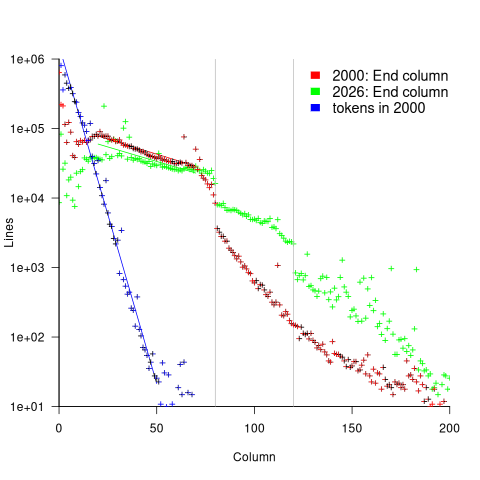
The dramatic drop in the number of lines of a given length, just below 80 characters, is consistent with the majority of character-based displays having lines containing 80 characters (the same as punched cards). A revolution in display technology happened between 2000 and 2026, namely CRTs were replaced by LCDs, significantly increasing possible display width. The decline in number of lines containing a given number of characters has decreased since 2000. In 2026, the 80 character line length break-point is less dramatic than in 2000, and the decline a lot less steep. Also, there appears to be a new break-point emerging at 120 characters; perhaps without LLMs the 80 character break-point would have gradually disappeared. While bit-mapped displays don’t have lines, existing practices live on and evolve.
The number of lines containing a given number of tokens, for the early 2000 measurements, decreases exponentially, with  . Whitespace indentation adds characters, not tokens.
Most long lines are caused by indentation of the source code, e.g., indenting the body of an if-statement. Indentation is used to reduce the developer effort needed to understand statement clustering and sequencing.
The plot below shows the number of if-statements occurring at a given nesting level, along with regression fits, of the form  , to the 2026 Vim and SQLite data; the Linux data was better fitted by a power law (code+data):

Some of the reasons developers write deeply nested code include: the nested code accesses local variables that would be a hassle to pass as function arguments, creating a function would interrupt their train of thought.
Deep nesting is often cited as bad practice, along with the usual unsubstantiated claims about it being error-prone, or hard to understand, or whatever.
Coding agents indent code because the training data contains indented code, and because the generated source is likely to be looked at and modified by developers. Attention based LLMs include information on the position of the token on a line, so given the contents of the training data, coding agents are unlikely to generate lines containing more than 80 characters.
If a time is reached when most developers don’t look at agent created code (few look at the assembly code generated by compilers), its visual layout becomes irrelevant. There are cost savings to be made by not indenting or limiting nesting depth. Indentation increases coding agent costs by consuming more tokens. Creating a new function consumes more tokens that simply generating a deeper nesting level.
If a developer wants to see indented source, they can always use a pretty printer.
A coding agent can be told not to indent, but given their training data do they indent internally and then remove it, i.e., an increase in token usage? This is another question to the growing list of Mechanistic interpretability problems.
Software effort estimation in 2026
It’s 2.5 years since my 2024 post summarizing what I knew about software effort estimation. For ongoing projects the role of estimation is as a planning tool, breaking down a large chunk of work into what are estimated to be small, well-defined, chunks. With two-thirds of estimates being within a factor of four (over or under) of the actuals, accuracy was not a primary goal.
The impact of coding agents capable of implementing these small tasks for peanuts is on developer staffing, not on the need for planning and breaking down work into connected small chunks.
Coding agents follow the specification they are given. Large, complicated programs will have large complicated specifications, which are likely to require a lot of human effort to create. For instance, the specification for the recent LLM generated C compiler
How long will it take to create a specification and how many iterations will be needed to create a good enough program? Estimation has not gone away, it has just moved upstream of the implementation. While specifications have existed millennia longer than software development, we are at the start of learning to use them to direct coding agents (the term vibe coding was created in February 2025). While logs of developer coding agent sessions are starting to be collected, it will take some years for patterns of practice to stabilize.
The process followed to estimate Function Points appears to be ideally placed to be extended to cover specification creation for coding agents.
Peanuts in bulk can be expensive. The novelty of much lower costs, when using coding agents, will soon wear off. Agent costs will become the new normal, which means there will be pressure to reduce them, and management will want estimates because the requirement to fill in boxes has not gone away.
Is agent token consumption purely a driven by the LLM(s) used and the selected configuration values? A recent study investigated the impact of the wording of the specification on the tokens spent by a selection of agents. The results showed that a specification containing bare user stories increased token spending by 30%. We will have to wait to find out whether the implications of this result (i.e., investing in more detailed user stories reduces token spending) replicates.
It would be very useful to have an estimate of likely token usage for a given specification, before any code is generated, or perhaps a real-time cost estimate during generation. One study found that current frontier models failed to accurately predict their own token usage (correlation of 0.39), humans predictions were equally poor.
Many projects don’t have a separate line item for testing costs, which often get bundled with implementation costs (the SEA Data Warehouse dataset separates out design/implementation/testing effort). Large projects may have people who work on integration and/or release testing.
When coding agents are used, testing is clearly a distinct piece of work separate from implementation. How effective is the specification used to generate the code at generating good enough tests? Current research is an extension of existing testing practices, rather than anything coding agent specific. A lot of existing research has focused on unit testing, and of course models have been fine-tuned for unit testing.
Implementation cost reductions have brought N-version programming into the realm of consideration for some projects.
Will the way developers work change to be like tradesmen who are hired to install a new fitted kitchen or bathroom? With developers installing new application functionality specified by the client. Perhaps some will be more like builders hired to make structural changes to a house, while others will do small jobs, like plumbers, electricians and carpet fitters.
As always, some researchers fail to move on when the world changes and continue to publish papers that use LLMs to estimate human task implementation time.
Recent Comments