Archive
Number of projects worked on concurrently
Developers working for companies whose business is project based are often involved with multiple projects at the same time. If one project is held up, they have other projects to work on (reducing days when there is no project for them to book their time to).
How many software projects might a developer be working on at any time, and how is their time distributed across projects?
I was hoping that the SEA Data Warehouse dataset would provide some answers. However, while it contains detailed task data on 1,211 software projects, many of the people involved on these projects also worked on projects that are not included in the dataset (or they only worked a few hours a day, or the data is not as complete as claimed).
The 2,271 distinct people in the dataset worked on a total of 210,088 person days, working an average of 190 minutes (3.2 hours) per day. The plot below shows the number of minutes worked on each of the 210,088 person days, in sorted order (code+data):

A 7.5-hour work day contains 450 minutes; what were they doing during the other 260 minutes each day? If people were not working on one of the projects in the dataset, they were presumably working on project(s) that are not in the dataset.
Within the available data, how many projects were individuals working on during various time intervals? The plot below shows the percentage of time intervals (there are more days in the year than weeks, and more weeks than months, and to make the plot easier to interpret the counts for each time interval has been normalised) where a given number of projects were worked on by an individual during a particular time interval, for day/week/month intervals, with fitted exponential models (exponents are: -2.8, -2.2, and -1.6, respectively; code+data):
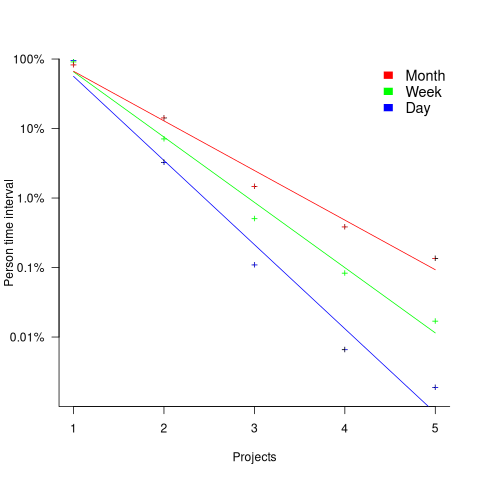
For the 1-project case, the percentage values are higher for days than weeks, and higher for weeks than months. However, the approximate nature of the fitted regression lines happens to have this the order reversed.
The plotted values are a lower bound for the number of projects an individual worked on within any of the time intervals. The average number of minutes worked per day implies that most people are working on at least two projects every day.
End-user Pentium and SIMM prices in the 1990s
People buy a computer today because they have a problem that needs to be solved today, or in the near future. If today’s computer is good enough to solve today’s problem, then any expectation of the next generation being substantially faster is irrelevant.
If a cpu manufacturer (e.g., Intel) knows that the next generation, available in less than 18 months, is going to be substantially faster, how do they price the existing products over the months before and after the next generation is launched? Similarly, for memory chip manufacturing businesses (there used to be many) knowing that the next generation, in less than 18 months, is going to have twice the storage capacity, how the existing products be priced over the months before and after the next generation is launched?
During the 1990s desktop computers regularly became noticeably faster. Computers also regularly became faster in earlier decades, but early manufacturers built their own cpus, rather than selling them to others to integrate into a finished product. Yes, there were manufacturers selling cpus in the 1980s, but the market was fragmented, and any trends that might be present are obscured by market turbulence.
At the start of the 1990s, compiler messages appeared slowly enough that they could be read as they scrolled up the screen, but within a few years it was hard work spotting just a few words before the lines disappeared at the top of the screen. When working on a new machine for the first time, developers would be amazed at the rate compiler messages scrolled up the screen, but this rate quickly became the new normal.
During the 1990s, the performance of Intel’s x86 cpu family increased exponentially, and memory device capacity grew exponentially.
Manufacturer pricing data for cpu/memory chips in the 1990s is somewhat sporadic. However, end-user prices are listed in computer magazine adverts. The paper The economics of PC remanufacturing by G. Ferrer lists monthly end-user prices between August 1995 and January 1997, extracted from adverts in the British magazine Personal Computer World. I extracted prices for the same cpus/memories from the earlier/later editions available online. All monthly prices are averaged over all advertised prices found in each month’s edition.
The plot below shows monthly prices for Intel’s 80486DX2 and Pentium processors running at various clock rates; the extended straight lines are fitted exponential models (code+data):

When first released, higher performing cpus were sold at a premium price, which decreased (exponentially) at around 30% per year. Staying on the leading edge of computer performance required regularly paying premium prices to buy a new computer containing the latest cpu.
In the 1990s memory chips were packaged in SIMMs, of various form factors, which were superseded in the late 1990s by DIMMs, and then the DDR SDRAM we use today. The plot below shows the price of non-parity 72-pin SIMMs chips having a given capacity (code+data):
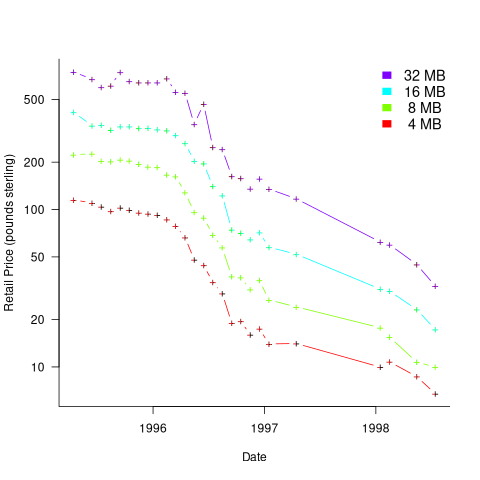
The decreases extend over a longer period than the cpu prices (presumably because people are adding more memory to older computers that are not being replaced).
The price changes could just as well have been plotted using a linear scale, as the exponential one used. In both cases there are distinct periods where the prices form a roughly decreasing line.
Why are manufacturers able to make such large reductions in the prices of the devices they sell?
Many semiconductor devices are fabricated on a large wafer. When the fabrication process for a particular device is new the yield may low, i.e., only a small percentage (perhaps 10%) of devices are functional. As production experience is gained the device yield increases and the production process is speeded up, i.e., more functional devices are produced for not much more cost.
There are two supplies for Pentiums, Intel and AMD, with Intel dominating, and having a large profit margin. There are many manufacturers of memory devices, it is a commodity market with slim profit margins.
An analysis of the extent to which profit margins and market structure influence pricing is outside my domain expertise.
Computers installed in the UK during the 1960s
The first commercially produced digital computer, the UNIVAC I, became available in 1951, and by 1961 the exponential annual growth in the number of computers installed was well underway (it may have been earlier, but earlier data is sparse).
For the UK, detailed annual installation data is listed in the paper: The Spread of Computer Usage in the UK, 1954-1970 by P. Stoneman (his PhD thesis: “Technological Diffusion and the Computer Revolution: The UK experience” is not available online {I have the book of the thesis}; perhaps someone from Cambridge could scan a copy of the thesis). The data comes from the trade periodical “Computer Survey”, and Stoneman extrapolated back from when it started in 1961. The plot below shows the number of computers installed in the UK in a given year, and the number still installed in subsequent years (colored line for each year), along with two fitted regression lines (both exponential; code+data):

Between 1958 and 1970 (end of the data) the annual growth rate of new computers was 34%. After the first year, installations decline at a rate of around 16% per year (presumably replaced by a more powerful system).
Which industries installed these computers? The plot below shows the annual spend (adjusted for inflation til 2026) on new computer systems by 26 UK industry classifications, the grey line is an exponential fit to the total, showing a 53% annual growth rate (code+data):
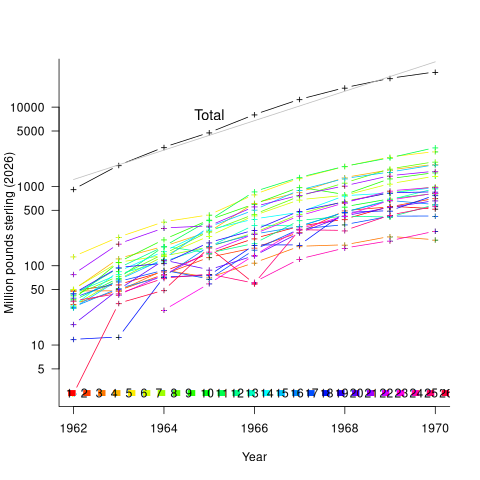
The mapping from colored line to industry is via the numbers/colors in the legend at the bottom of the plot, and the table below:
 Number           Industry description
    1      Aircraft Manufacturers and Guided Weapons
    2      Armed Services
    3      Atomic Energy
    4      Chemicals, Rubber, Glass, Plastics, Paints, Cosmetics
    5      Computer Manufacturers and Service Bureaux
    6      Electrical Engineering
    7      Ferrous and Non-Ferrous Metals, Mining and Quarrying
    8      Financial: Banks, Building Societies etc.
    9      Food, Drink and Tobacco Manufacturers
   10      Retail, Wholesale, Mail Order, Merchants
   11      General and Constructional Engineering
   12      Government Departments
   13      Government and Other Research Establishments
   14      Insurance and Assurance
   15      Local Government
   16      Motor
   17      Oil
   18      Public Bodies (mainly Post Office)
   19      Public Utilities (Coal, Electricity, Gas, Water)
   20      Transport
   21      Universities and Other Educational Establishments
   22      Textiles, Clothing, Furniture and Toys
   23      Publishing, Printing, Paper, Book clubs
   24      Sports, Leisure, TV, Films, Hotels
   25      Miscellaneous
26 Unknown |
The higher spending industries tended to be those with lower Numbers, while the lower spending industries are at the higher Numbers. The total spend on new computers grew at 53% per year.
How much computer power did the £27.8 billion (in 2026 money) spent in 1970 buy?
In the 1960s most computers were used by businesses for regularly (i.e., weekly, monthly, quarterly) performing simple calculations on large quantities of information, and then printing the results. The printed outputs were items such as employee payslips, gas/electric/water bills, and invoices between companies.
The scientific/engineering uses of computers attracted most of the coverage in the popular press (after a few iterations, weekly/monthly payroll becomes deadly dull), and bought the larger machines, but businesses had a lot more money and an immediate need.
The British Commercial Computer Digest (published annually between 1959 and 1970, and also based on “Computer Survey” magazine data) lists computer installations by purchaser and computer installed, along with tables of computer performance, monthly lease prices and selling prices. The following data was obtained from the 10th edition, published in 1969.
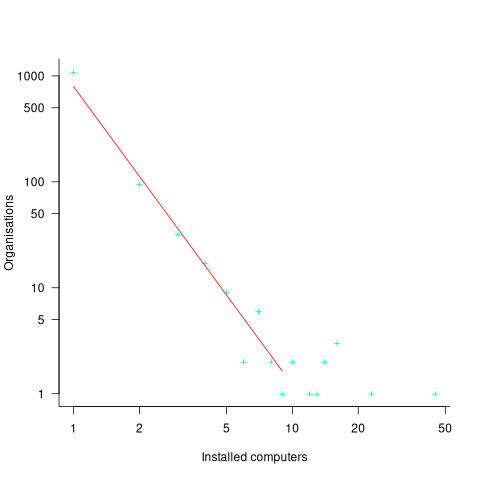
The plot below shows the number of organizations having a given number of computers installed, along with a fitted power law whose exponent is -2.8 (code+data):
The table below shows the six computer models, out of 48, that represented 60% of all computers installed. The monthly rentals are an estimated average, and inflation adjusted 2026 pounds sterling. Possible memory capacities varied between 4k to 64k (yes, thousands of bytes). Readers will be familiar with the IBM 360, the ICL 1900 series was the UK’s home-grown response (via Canada):
        Computer    Installed    Percent   Monthly rental
       IBM 360/30     305          17          £42k
       ICL 1901       253          14          £21k
       IBM 360/20     147           8          £17k
       ICL 1902       138           8          £37k
       IBM 360/40     127           7          £84k
ICL 1903 101 6 £45k |
The compute capacity of UK computers installed in 1969 might be less than one 2026 smartphone. However, the computer printer capacity (in bills/payroll slips/invoices/etc) might be about the same as it is today, down from a peak in the late 1990s, when the major push to electronic billing started.
2026 in the programming language standards’ world
This week I was on a virtual meeting of IST/5, the BSI committee responsible for programming language standards in the UK. It’s been three years since I last reported on the programming language standards’ world, what has been going on?
tl;dr: Business as usual, with a handful of active committees.
I have been meeting secretary for the last few years, and sometimes struggle to write something in the minutes, other than: “The document was noted”, or “No action”. IST/5 is a management committee whose job is to check that the various programming language panels/committees (who do the technical work) follow the procedures. When experienced people are chairing the technical work, procedures are followed, and IST/5 get to tick a box.
The latest revision of C was intended to be published in 2023, hence the commonly used name C23, but slipped to 2024, and there are people who refer to it as C24. The plan is for the next revision to be published in 2028. Over the last few years there has been a significant increase in proposals for new languages features. C has started to follow in the footsteps of C++ (the committee is currently an order of magnitude smaller), attracting bored consultants looking for a creative outlet.
The ISO C++ committee acquired a new chief sheep herder, who has been restructuring the organization of the committee, which had outgrown its previous way of working.
The C++26 document is out for balloting by SC22‘s 28 P-member countries. It’s possible that this vote will fail (people in various National bodies are canvassing for No votes). The sticking point is contracts, which was removed from the C++20 draft to enable it to progress, and did not make it into C++23. Stroustrup, voted against the proposal, and has said (53 minute mark) “…it’s claimed to be a minimal viable product. It’s not minimal, it’s not viable.” The ballot closes on 27 September.
BSI is active on the climate bandwagon, and is constantly reminding its committees about the London Declaration (net-zero, etc). What can a programming language standards’ committee do to reduce emissions and cut electricity use? There have been various studies comparing the electricity consumed by different language constructs. I have not written about them on this blog because they were either poorly run, or the results were essentially noise. Interpreted languages obviously consume more electricity than compiled languages. However, none of the three languages within SC22 that are commonly interpreted (WG8 BASIC, WG16 ISLISP, and WG17 Prolog) are actively being worked on.
Programming language standards were among the first to support the non-8-bit character sets (SC2 Coded Character Sets). Andrew West was an active member of SC2 and attended IST/5 meetings to report what was going on. Andrew died towards the end of last year, and has an obituary in The Guardian.
At the start of the year BSI moved to new headquarters in Covent Garden, about 100 yards up the road from the Royal Opera House/Royal Ballet. A rather different ambience than an office block above Gunnersbury underground station (which is being converted to flats). This week’s IST/5 meeting was intended to be hybrid, to have a chance to meet new faces (and check out the plush new offices). However, BSI’s net-zero rules restrict us to online only; no BSI tea and biscuits for us 🙁 I walked past the building one evening a few weeks ago, and pressed by nose against the door, but could not see any BSI signage through the tinted glass.
UK based readers can apply to join a panel. Existing panel members are emailed the CV of applicants, and asked if “… applicant’s knowledge would be beneficial to the work programme and panel…”. Anybody can join the US Standards body, INCITS, by paying an annual fee for membership of a language committee ($1,530/$2,703).
INCITS recently introduced a new rule which prevents its members being a member of any corresponding National committee: “However, Individuals who are participating as members of other National Bodies (NBs) for an International Technical Committee (TC) or Subcommittee (SC) are not permitted to participate in INCITS IOEs responsible for the same international standards activities. This is to ensure the confidentiality of the USNB discussions and positions and to avoid conflict of interests.”
Flagging poor algorithm choice: LLMs next role
Current use of LLMs in software engineering has focused on using them as proficient coding assistants or having them write programs from specifications.
Algorithm selection is an important issue that has yet to attract much attention within the software engineering LLM ecosystem. While much of a program’s functionality is mundane, and the accuracy/performance of the algorithm chosen is not critical, there is always some functionality where algorithm choice can have a big impact on accuracy/performance.
Existing code repositories provide the training data for both the mundane and the critical functionality.
In the same way that LLMs generate code that contains mistakes, LLMs can use an inappropriate/suboptimal algorithm, i.e., the algorithm does not do what is required, or does it inaccurately/slowly.
The flip side of generating code containing mistakes, is that LLMs can flag mistakes in existing code. A large number of serious coding issues are now being found by LLMs. I suspect that some of these were being flagged by traditional static analysis tools, along with a huge number of non-serious issues. However, LLMs appear to do a better job of separating out the really important issues from the run-of-the-mill.
The ability to find coding mistakes is not surprising. LLMs are creatures of their training data, and there are lots of examples of coding mistakes, along with discussions in fault reports, online posts, and the large number of developer interactions that the major vendors now have.
Fixing coding mistakes in existing code will soon be an infrequent activity. Fixing poor choice of algorithms is the next step up the value chain.
Despite its importance, algorithm selection is something of a niche topic (yes, there are lots of books discussing the mathematics behind algorithms and their implementation), with the common default of using what everybody else uses (which is often a good strategy). There is also the issue that choice of algorithm can be context dependent. For instance, a simple algorithm with quadratic runtime performance may be selected because the number of items processed is expected to be low. As program usage grows this initial assumption may evolve to a high number of items being processed, with quadratic performance becoming a bottleneck. I am not aware of a large source of examples of poor/good algorithm selection.
One domain where algorithm choice can have a huge impact is the numerical solution of the equations used in scientific and engineering applications. How good are LLMs at flagging the use of suboptimal/inappropriate algorithms in this domain?
Pre-LLM, figuring out which algorithm a function implemented, if any, was a very hard problem. The numbers tool was written to pattern match any real literals appearing in the source against a database of known formula and associated constants. The assumption being that any matching formula was the one implemented by the function containing the literals. Maintaining the numbers/formula database was a huge task, and the project died, apart from as a tool to flag possibly inaccurate literal use.
Based on a small sample (some ChatGPT responses), LLMs appear to do a good job of matching a cluster of floating literals to the corresponding formula (in all the cases I tried, they searched the web). All the scientific source I have is readily available on the web, apart from the Climategate code, which only contains simple data analysis and plotting code.
Recent papers appear to still be using the solution via a prompt approach (e.g., The orbit has an eccentricity of 0.6, and at a specific moment, the mean anomaly is 0.6 radians… find the eccentric anomaly in radians), code generation via a specification, or investigating low level improvements to existing code (e.g., detecting instabilities and stabilizing numerical expressions).
Recent Comments