Archive
End-user Pentium and SIMM prices in the 1990s
People buy a computer today because they have a problem that needs to be solved today, or in the near future. If today’s computer is good enough to solve today’s problem, then any expectation of the next generation being substantially faster is irrelevant.
If a cpu manufacturer (e.g., Intel) knows that the next generation, available in less than 18 months, is going to be substantially faster, how do they price the existing products over the months before and after the next generation is launched? Similarly, for memory chip manufacturing businesses (there used to be many) knowing that the next generation, in less than 18 months, is going to have twice the storage capacity, how the existing products be priced over the months before and after the next generation is launched?
During the 1990s desktop computers regularly became noticeably faster. Computers also regularly became faster in earlier decades, but early manufacturers built their own cpus, rather than selling them to others to integrate into a finished product. Yes, there were manufacturers selling cpus in the 1980s, but the market was fragmented, and any trends that might be present are obscured by market turbulence.
At the start of the 1990s, compiler messages appeared slowly enough that they could be read as they scrolled up the screen, but within a few years it was hard work spotting just a few words before the lines disappeared at the top of the screen. When working on a new machine for the first time, developers would be amazed at the rate compiler messages scrolled up the screen, but this rate quickly became the new normal.
During the 1990s, the performance of Intel’s x86 cpu family increased exponentially, and memory device capacity grew exponentially.
Manufacturer pricing data for cpu/memory chips in the 1990s is somewhat sporadic. However, end-user prices are listed in computer magazine adverts. The paper The economics of PC remanufacturing by G. Ferrer lists monthly end-user prices between August 1995 and January 1997, extracted from adverts in the British magazine Personal Computer World. I extracted prices for the same cpus/memories from the earlier/later editions available online. All monthly prices are averaged over all advertised prices found in each month’s edition.
The plot below shows monthly prices for Intel’s 80486DX2 and Pentium processors running at various clock rates; the extended straight lines are fitted exponential models (code+data):
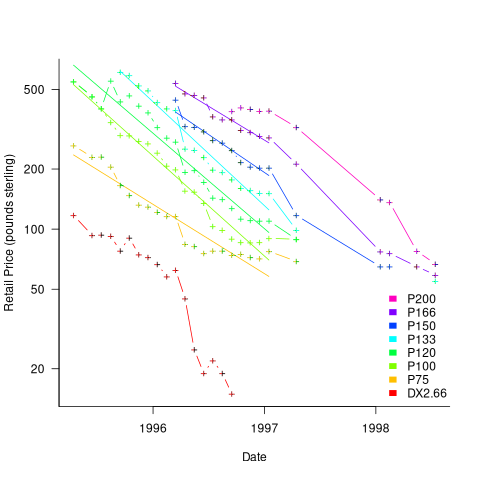
When first released, higher performing cpus were sold at a premium price, which decreased (exponentially) at around 30% per year. Staying on the leading edge of computer performance required regularly paying premium prices to buy a new computer containing the latest cpu.
In the 1990s memory chips were packaged in SIMMs, of various form factors, which were superseded in the late 1990s by DIMMs, and then the DDR SDRAM we use today. The plot below shows the price of non-parity 72-pin SIMMs chips having a given capacity (code+data):
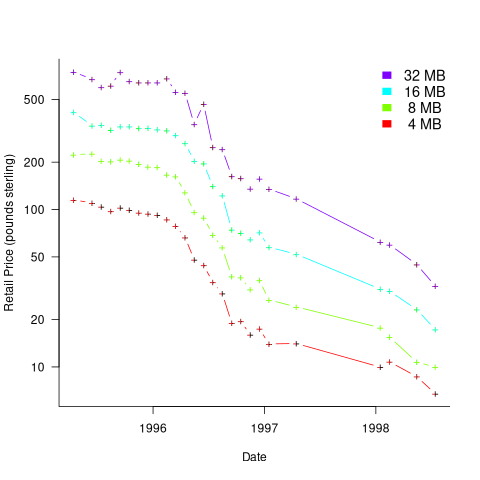
The decreases extend over a longer period than the cpu prices (presumably because people are adding more memory to older computers that are not being replaced).
The price changes could just as well have been plotted using a linear scale, as the exponential one used. In both cases there are distinct periods where the prices form a roughly decreasing line.
Why are manufacturers able to make such large reductions in the prices of the devices they sell?
Many semiconductor devices are fabricated on a large wafer. When the fabrication process for a particular device is new the yield may low, i.e., only a small percentage (perhaps 10%) of devices are functional. As production experience is gained the device yield increases and the production process is speeded up, i.e., more functional devices are produced for not much more cost.
There are two supplies for Pentiums, Intel and AMD, with Intel dominating, and having a large profit margin. There are many manufacturers of memory devices, it is a commodity market with slim profit margins.
An analysis of the extent to which profit margins and market structure influence pricing is outside my domain expertise.
How has the price of a computer changed over time?
We are told that computers are now orders of magnitude cheaper than they once were. Computers have changed an awful lot over the last 70 years; how is the functionality supported by different computers normalised such that the price of computers from long ago can be compared with today’s computers?
One approach is to narrow the question down to calculating the cost of performing some basic operation, e.g., numerical calculation or sorting a list of values. Nordhaus’s famous paper: Two Centuries of Productivity Growth in Computing uses this approach.
The primary advantage of the cost-of-operation approach is that it can be made to work across the complete range of computing platforms. The major disadvantage of this approach is that it focuses on the performance of the cpu/memory, ignoring the ability to store large amounts of data and perform I/O (which is most of the cost of some computer systems).
The US consumer price index (CPI) uses Hedonic regression to adjust the average price of a product family whose quality changes over time (the CPI is used to track inflation, and so every price needs to be for a product identical to the exemplar chosen at some start date). Hedonic pricing models are also used to understand how specific features within a product category (e.g., housing, automobiles, or electronics) contribute to the price. The term hedonic is derived from hedonism, and was first used in a 1939 paper analysing the price/quality of automobiles.
The 1979 paper “Hedonic Prices and the Structure of the Digital Computer Industry” by R. Michaels (cannot find a downloadable copy) appears to have kick-started the computer/hedonic research rabbit hole (the 1969 book “The Economics of Computers” by W. F. Sharpe covers computer costings in detail). Hedonic regression estimates the value of a product by braking it down into its major components which are used as the explanatory variables in a regression model that predicts the product price on given dates, e.g., for mainframe computers: price, cpu speed, amount of memory, number/size of hard disks, number of tape drives and card readers.
While mainframes and microcomputers share some characteristics (e.g., cpu, memory, and discs), they address different markets with very different requirements (e.g., mission-critical requires high reliability and tape backups). Different Hedonic regression models need to be fitted for each.
Gathering a representative sample of information on all the major components of a product, preferably for each year, is a lot of work. Many papers make use of information from proprietary databases. A lot of historical information is now available in scanned trade publications, but LLMs are not yet good enough to reliably extract detailed information from scanned documents (e.g., they sometimes ignore information, rather than hallucinating). I am waiting for the error rate to decrease.
The analysis in the book chapter Computer Processors and Peripherals by R. J. Gordon spends a lot of time dealing with the issues around potentially inconsistent data sources. The final price index (table 6.7) shows that the normalised price of mainframes decreased by a factor of 922 between 1951 and 1983 (23% per year, for 33 years). That is, the equivalent 1951 mainframe purchased in 1983 would have been cheaper by a factor of 922. In practice, prices did not decrease by a factor of 922, rather some combination of price/quality of the average mainframe changed by this factor (where quality is some combination of faster cpus, more memory and other factors). For an analysis of computer related products see the book “Price Measurements and Their Uses” by Foss, Manser, and Young.
The price of microcomputers (or computers as we call them today, as there is little public perception of any other type of computer) has decreased, but by how much (in the Hedonic sense)?
The first Hedonic analysis of microcomputers was Cohen’s 1988 Master’s thesis, for personal computers between 1976 and 1987. I think Cohen is pushing product family boundaries to treat the 8-bit computers introduced before the IBM PC in August 1981 (which did not include a hard disk until 1983, and did not really become a 16-bit computer until the IBM AT in 1987) as being comparable with later microcomputers. Cohen’s analysis found positive/negative swings in the adjusted prices of the microcomputers.
The paper Price and quality of desktop and mobile personal computers: A quarter-century historical overview by Berndt, Dulberger and Rappaport claim that there was an average annual 27% decline in microcomputer prices between 1976 and 1999. Again, my comments on pre-1987 microcomputers applies. A later paper (appendix table 1) shows average actual prices increasing until 1991 and decreasing thereafter, with the averages of cpu frequency, memory capacity and hard disk size continually increasing. There was little difference in the prices at the start(1976)/end(2002) of the period analysed, but a huge difference in the quality characteristics. While writing my Evidence-based software engineering book, I emailed Berndt for the data, which a co-author kindly made available. Unfortunately, I found that much of the data was confidential (the name of a company that sold computer sales data appeared in the files), and could not be publicly shared 🙁
Hedonic analysis of computers appears to have become unfashionable around the start of 2000. More recent papers analyse products such as mobile phones and cloud services. Please leave a comment if you know of any recent hedonic analysis of computer prices.
The only detailed microcomputer price data I know of consists of 6,259 detailed prices collected by Stengos, and Zacharias over 35 months, starting in January 1993, from the adverts in PC Magazine.
Recent Comments