Archive
Source line length before coding agents
Will coding agent generated source code contain the same consistent patterns of behaviors that appear in human written source?
A brief analysis would suggest that the answer is: Yes. LLM training data is human written code, and coding agents are generating code to implement the functionality that developers would have otherwise implemented themselves.
Some coding patterns are driven by historical accidents, or at least appear to be. A line of code has to be visible on the display seen by the person writing it. Consequently, a line of source containing more characters that can be displayed on a line are likely to be rare. The plot below shows the number of C/C++ source lines containing a given number of characters in early 2000 (red) and 2026 (green), and the number of lines containing a given number of tokens in 2000 (blue), lines are fitted exponentials, and vertical grey lines at 80 and 120 characters (common default value used for tab characters; code+data):
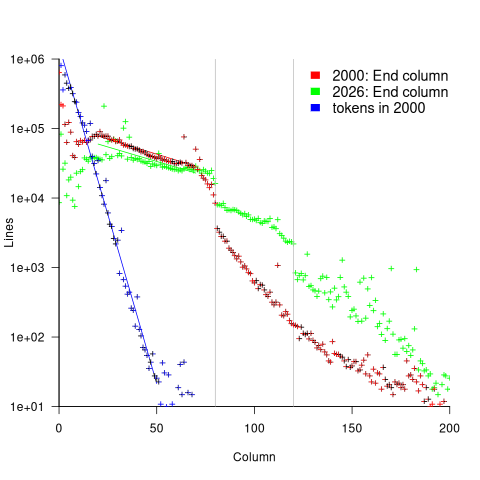
The dramatic drop in the number of lines of a given length, just below 80 characters, is consistent with the majority of character-based displays having lines containing 80 characters (the same as punched cards). A revolution in display technology happened between 2000 and 2026, namely CRTs were replaced by LCDs, significantly increasing possible display width. The decline in number of lines containing a given number of characters has decreased since 2000. In 2026, the 80 character line length break-point is less dramatic than in 2000, and the decline a lot less steep. Also, there appears to be a new break-point emerging at 120 characters; perhaps without LLMs the 80 character break-point would have gradually disappeared. While bit-mapped displays don’t have lines, existing practices live on and evolve.
The number of lines containing a given number of tokens, for the early 2000 measurements, decreases exponentially, with  . Whitespace indentation adds characters, not tokens.
Most long lines are caused by indentation of the source code, e.g., indenting the body of an if-statement. Indentation is used to reduce the developer effort needed to understand statement clustering and sequencing.
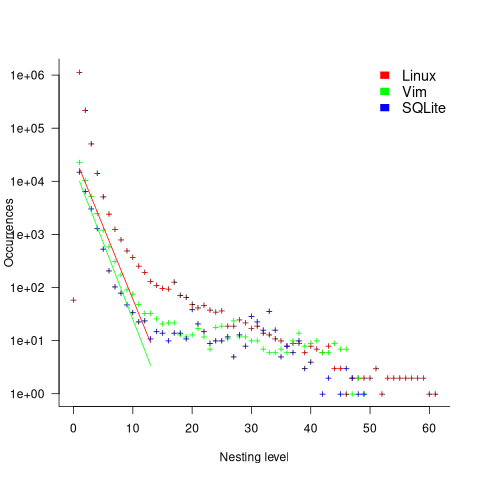
The plot below shows the number of if-statements occurring at a given nesting level, along with regression fits, of the form  , to the 2026 Vim and SQLite data; the Linux data was better fitted by a power law (code+data):
Some of the reasons developers write deeply nested code include: the nested code accesses local variables that would be a hassle to pass as function arguments, creating a function would interrupt their train of thought.
Deep nesting is often cited as bad practice, along with the usual unsubstantiated claims about it being error-prone, or hard to understand, or whatever.
Coding agents indent code because the training data contains indented code, and because the generated source is likely to be looked at and modified by developers. Attention based LLMs include information on the position of the token on a line, so given the contents of the training data, coding agents are unlikely to generate lines containing more than 80 characters.
If a time is reached when most developers don’t look at agent created code (few look at the assembly code generated by compilers), its visual layout becomes irrelevant. There are cost savings to be made by not indenting or limiting nesting depth. Indentation increases coding agent costs by consuming more tokens. Creating a new function consumes more tokens that simply generating a deeper nesting level.
If a developer wants to see indented source, they can always use a pretty printer.
A coding agent can be told not to indent, but given their training data do they indent internally and then remove it, i.e., an increase in token usage? This is another question to the growing list of Mechanistic interpretability problems.
Recent Comments