Task implementation time with/without LLM access
When performing a software related task, how much time is saved by using an LLM? The answer to this question has changed over the last 18 months, as LLMs have improved and people have learned about using them. There are plenty of anecdotes and personal experiences, but until a few weeks ago there was no measurement data.
In the middle of October an email arrived from Oleksandr Padura, who runs Kultrix a small product studio in Lviv, Ukraine. He had seen a post discussing task estimation, that asked for data, and sent me a link to his own blog post on the subject. I, of course, requested an anonymous copy of the data, Oleksandr agreed, and off we went.
The project task estimate/actual data runs from March 2025 to October 2026, and the 4,271 records include the flag llm_access. This flag is true if the person implementing the task had access to an LLM (over time: Claude Sonnet 4, Sonnet 4.5, Opus 4.5, Opus 5 and Opus 5.5). It is not known what use they made of this access, or even if they used it at all. The plot below shows the percentage of tasks, per week, where LLM access was available (code+data):
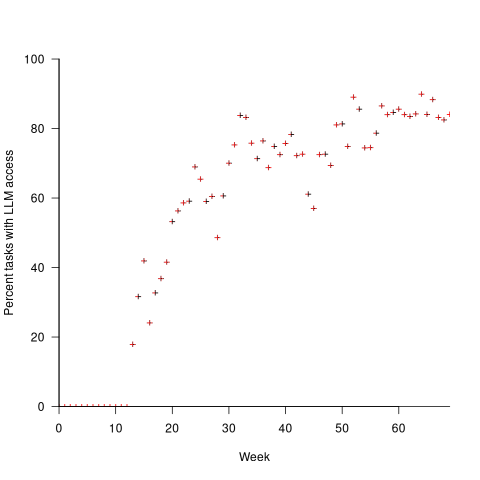
Many developers do not have any experience of maintaining a task level log of time spent, and switching to logging task time requires learning new habits. Prior to 17 June 2025 the time logged to many tasks was greater than 15 hours, i.e., took more than one day. Things settled down after this date, and only tasks after this date are used.
Project implementation involves a range of activities. The table below shows the six recorded activities, and the number of times the person involved had LLM access (yes/no):
bugs design dev meetings other qa no 422 87 682 283 380 188 yes 577 125 1129 199 66 133 |
Assuming that similar tasks were implemented with/without LLM access, on the same projects, by people working in the same environment, then a regression model comparing actual task implementation time with/without LLM access can be fitted. The LLMs used changed over time; Oleksandr tells me that they adopted new versions as they became available. Person identity has been anonymized across projects, i.e., the random number associated with each person is fixed within a project, but different across projects. So it is not possible to include anonymous person IDs in the model.
The variable of interest is the average logged time for tasks. How big an impact do the variables llm_access, activity and project ID have on this time?
The average logged time, over all tasks, is 5.6 hours (standard deviation 2.7 hours). However, this average varies over the periods when different LLM models were available, e.g., since the end of July most logged times were over 7 hours.
The headline number is that logged time for tasks with LLM access was 0.5 hours shorter, in each period than tasks without LLM access (see code+data for details). The reduction varies between projects and activity, and since the fitted models are somewhat involved they are not discussed here.
Not everybody with LLM access took advantage of this access. So the actual saving from LLM usage is greater than 9% (0.5/5.6).
The Kultrix task data shows some of the patterns seen in other such data. For instance, the use of round numbers. The plot below shows the number of tasks logged as a given number of hours (code+data):
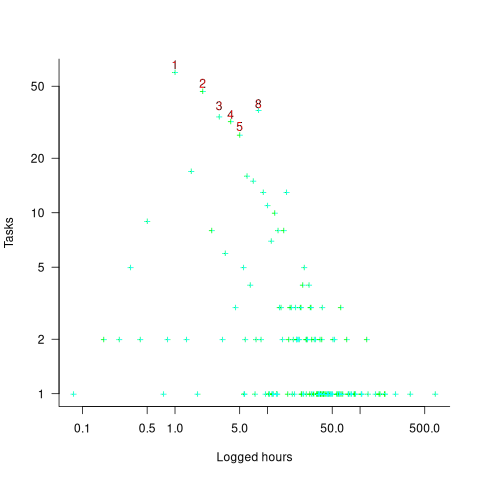
The peak at 8 suggests an eight-hour work day.
The plot below shows the estimated task time against actual logged time (code+data):
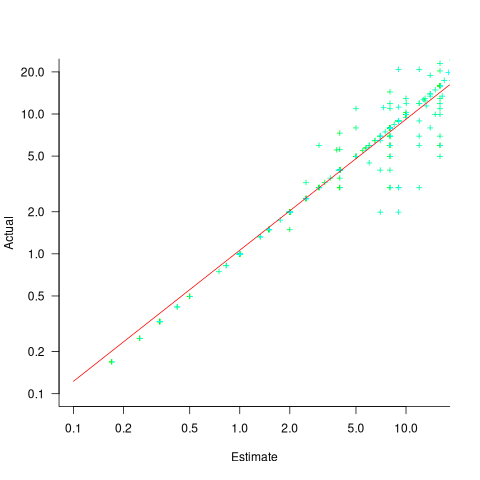
This plot does not look anything like other short task data, example shown below:
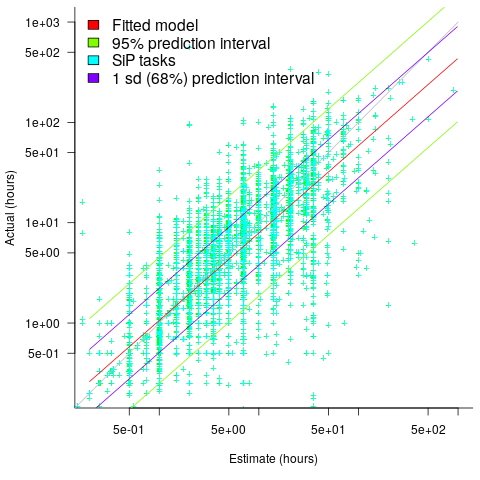
Oleksandr thinks the reason for this higher accuracy is the work they do before estimating. A clickable prototype is built, which is cheap to do with a coding agent. The client checks this prototype before implementation starts, enabling any misunderstandings to be resolved, and giving developers some idea of the work involved.
The task data over this period is unique. LLM access is already over 80% and is only going to grow. Future task data is unlikely to offer a mix of with/without LLM access.
Thanks to Oleksandr Padura for making the data available and answering my questions.
Recent Comments