Coding agents as developer tool or tool front end?
Will the use of coding agents become so pervasive that most existing developer tools fade away?
The Linux kernel has motivated the creation of many developer tools, some of which have been adopted by the kernel developers. One such is Coccinelle, which is used to apply automated patches to many files, e.g., changing the name of a function or adding/removing arguments, when an api is changed.
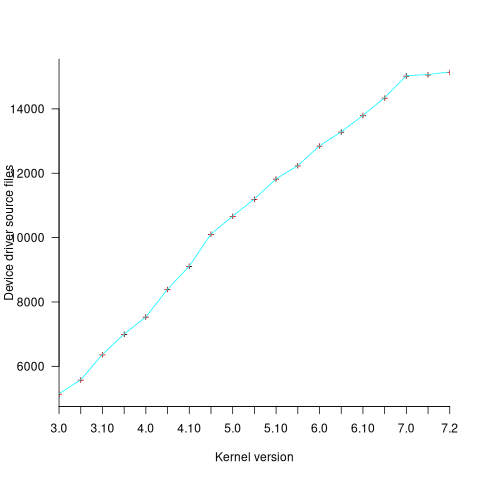
The plot below shows the growth in the number of source files in the device driver directory between 2011 (kernel version 3.0) and 2026 (version 7.0; code+data):
The term collateral evolution originated with the 2006 paper Understanding Collateral Evolution in Linux Device Drivers, which investigated the coordinated update of device drivers when a kernel interface changed. The 2007 paper SmPL: A Domain-Specific Language for Specifying Collateral Evolutions in Linux Device Drivers showed how Coccinelle was an effective tool for mass updating of C source files.
Despite 20 years of active use, if coding agents can do a comparable job to Coccinelle, then future kernel maintainers may switch to applying the tool they use most of the time, i.e., a coding agent. They might instruct a coding agent to drive Coccinelle to make the changes, or instruct the agent to make the changes directly.
The recent paper Keeping Up with the Kernel: Can LLMs Adapt Linux Drivers to Interface Changes?, by Yang, Liu, Kharlamova, Alqasimi, Zhang, Ismail, Sun, and Xue, compared the performance of coding agents against Coccinelle.
The coding agents (DeepSeek Flash, Claude Sonnet 5.5, and GPT-6.1 Sol) did not perform very well. Applying the same patch to many files is probably not a common activity in the training data of coding agent. We will have to wait and how much coding agents improve on this important niche activity.
C is the only language that has a tool as effective as Coccinelle (thanks to the long term work of Julia Lawall; a Java implementation appears abandoned). There has been talk of supporting C++ version, but the size of the language has deterred implementers. Many IDEs support global refactorings, but I don’t know how well they would handle the optional feature support used in the kernel sources.
Using coding agents to patch thousands of files is not an efficient use of resources. Having an agent use Coccinelle to do the work make sense. This is not to say that this is how things will be done. Using coding agents to create a Coccinelle for another language (Python?) is now on my list of things to do (don’t hold your breath).
Writing new code is the high status activity that attracts developers, while maintenance is the lower status activity that occupies most developer time. Will the developer/manager of a coding agent writing new code be considered as higher status than using a coding agent to do maintenance? Management’s strong preference for maintenance is driven by cost and the desire to minimise the likelihood of introducing coding mistakes by minimising the changes made. Now that coding agents have removed the implementation cost hurdle, managers will have to keep close tabs on what developers to ensure they are only doing the high status activity when necessary.
Recent Comments