Archive
A comparison of C++ and Rust compiler performance
Large code bases take a long time to compile and build. How much impact does the choice of programming language have on compiler/build times?
The small number of industrial strength compilers available for the widely used languages makes the discussion as much about distinct implementations as distinct languages. And then there is the issue of different versions of the same compiler having different performance characteristics; for instance, the performance of Microsoft’s C++ Visual Studio compiler depends on the release of the compiler and the version of the standard specified.
Implementation details can have a significant impact on compile time. Compile time may be dominated by lexical analysis, while support for lots of fancy optimization shifts the time costs to code generation, and poorly chosen algorithms can result in symbol table lookup being a time sink (especially for large programs). For short programs, compile time may be dominated by start-up costs. These days, developers rarely have to worry about small memory size causing occurring when compiling a large source file.
A recent blog post compared the compile/build time performance of Rust and C++ on Linux and Apple’s OS X, and strager kindly made the data available.
The most obvious problem with attempting to compare the performance of compilers for different languages is that the amount of code contained in programs implementing the same functionality will differ (this is also true when the programs are written in the same language).
strager’s solution was to take a C++ program containing 9.3k LOC, plus 7.3K LOC of tests, and convert everything to Rust (9.5K LOC, plus 7.6K LOC of tests). In total, the benchmark consisted of compiling/building three C++ source files and three equivalent Rust source files.
The performance impact of number of lines of source code was measured by taking the largest file and copy-pasting it 8, 16, and 32 times, to create three every larger versions.
The OS X benchmarks did not include multiple file sizes, and are not included in the following analysis.
A variety of toolchain options were included in different runs, and for Rust various command line options; most distinct benchmarks were run 10 times each. On Linux, there were a total of 360 C++ runs, and for Rust 1,066 runs (code+data).
The model  , where
  is a fitted regression constant, and
  is the fitted regression coefficient for the
  ‘th benchmark, explains just over 50% of the variance. The language is implicit in the benchmark information.
The model  , where
  is the number of copies,
  is 0 for C++ and 1 for Rust, explains 92% of the variance, i.e., it is a very good fit.
The expression  is a language and source code size multiplication factor. The numeric values are:
1 8 16 32 C++ 1.03 1.25 1.57 2.45 Rust 0.98 1.52 2.52 6.90 |
showing that while Rust compilation is faster than C++, for ‘shorter’ files, it becomes much relatively slower as the quantity of source increases.
The size factor for Rust is growing quadratically, while it is much closer to linear for C++.
What are the threats to the validity of this benchmark comparison?
The most obvious is the small number of files benchmarked. I don’t have any ideas for creating a larger sample.
How representative is the benchmark of typical projects? An explicit goal in benchmark selection was to minimise external dependencies (to reduce the effort likely to be needed to translate to Rust). Typically, projects contain many dependencies, with compilers sometimes spending more time processing dependency information than compiling the actual top-level source, e.g., header files in C++.
A less obvious threat is the fact that the benchmarks for each language were run in contiguous time intervals, i.e., all Rust, then all C++, then all Rust (see plot below; code+data):
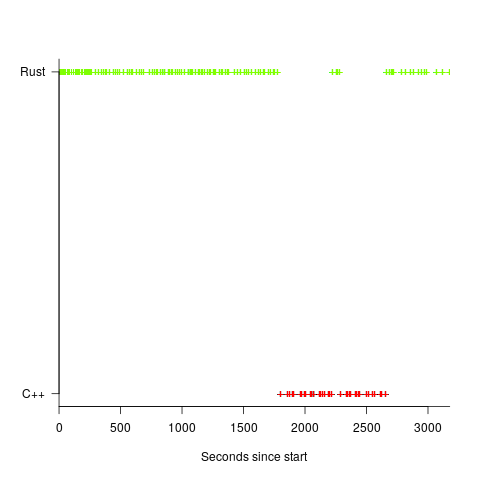
It is possible that one or more background processes were running while one set of language benchmarks was being run, which would skew the results. One solution is to intermix the runs for each language (switching off all background tasks is much harder).
I was surprised by how well the regression model fitted the data; the fit is rarely this good. Perhaps a larger set of benchmarks would increase the variance.
Widely used programming languages: past, present, and future
Programming languages are like pop groups in that they have followers, fans and supporters; new ones are constantly being created and some eventually become widely popular, while those that were once popular slowly fade away or mutate into something else.
Creating a language is a relatively popular activity. Science fiction and fantasy authors have been doing it since before computers existed, e.g., the Elf language Quenya devised by Tolkien, and in the computer age Star Trek’s Klingon. Some very good how-to books have been written on the subject.
As soon as computers became available, people started inventing programming languages.
What have been the major factors influencing the growth to widespread use of a new programming languages (I’m ignoring languages that become widespread within application niches)?
Cobol and Fortran became widely used because there was widespread implementation support for them across computer manufacturers, and they did not have to compete with any existing widely used languages. Various niches had one or more languages that were widely used in that niche, e.g., Algol 60 in academia.
To become widely used during the mainframe/minicomputer age, a new language first had to be ported to the major computers of the day, whose products sometimes supported multiple, incompatible operating systems. No new languages became widely used, in the sense of across computer vendors. Some new languages were widely used by developers, because they were available on IBM computers; for several decades a large percentage of developers used IBM computers. Based on job adverts, RPG was widely used, but PL/1 not so. The use of RPG declined with the decline of IBM.
The introduction of microcomputers (originally 8-bit, then 16, then 32, and finally 64-bit) opened up an opportunity for new languages to become widely used in that niche (which would eventually grow to be the primary computing platform of its day). This opportunity occurred because compiler vendors for the major languages of the day did not want to cannibalize their existing market (i.e., selling compilers for a lot more than the price of a microcomputer) by selling a much lower priced product on microcomputers.
BASIC became available on practically all microcomputers, or rather some dialect of BASIC that was incompatible with all the other dialects. The availability of BASIC on a vendor’s computer promoted sales of the hardware, and it was not worthwhile for the major vendors to create a version of BASIC that reduced portability costs; the profit was in games.
The dominance of the Microsoft/Intel partnership removed the high cost of porting to lots of platforms (by driving them out of business), but created a major new obstacle to the wide adoption of new languages: Developer choice. There had always been lots of new languages floating around, but people only got to see the subset that were available on the particular hardware they targeted. Once the cpu/OS (essentially) became a monoculture most new languages had to compete for developer attention in one ecosystem.
Pascal was in widespread use for a few years on micros (in the form of Turbo Pascal) and university computers (the source of Wirth’s ETH compiler was freely available for porting), but eventually C won developer mindshare and became the most widely used language. In the early 1990s C++ compiler sales took off, but many developers were writing C with a few C++ constructs scattered about the code (e.g., use of new, rather than malloc/free).
Next, the Internet took off, and opened up an opportunity for new languages to become dominant. This opportunity occurred because Internet related software was being made freely available, and established compiler vendors were not interested in making their products freely available.
There were people willing to invest in creating a good-enough implementation of the language they had invented, and giving it away for free. Luck, plus being in the right place at the right time resulted in PHP and Javascript becoming widely used. Network effects prevent any other language becoming widely used. Compatible dialects of PHP and Javascript may migrate widespread usage to quite different languages over time, e.g., Facebook’s Hack.
Java rode to popularity on the coat-tails of the Internet, and when it looked like security issues would reduce it to niche status, it became the vendor supported language for one of the major smart-phone OSs.
Next, smart-phones took off, but the availability of Open Source compilers closed the opportunity window for new languages to become dominant through lack of interest from existing compiler vendors. Smart-phone vendors wanted to quickly attract developers, which meant throwing their weight behind a language that many developers were already familiar with; Apple went with Objective-C (which evolved to Swift), Google with Java (which evolved to Kotlin, because of the Oracle lawsuit).
Where does Python fit in this grand scheme? I don’t yet have an answer, or is my world-view wrong to treat Python usage as being as widespread as C/C++/Java?
New programming languages continue to be implemented; I don’t see this ever stopping. Most don’t attract more users than their implementer, but a few become fashionable amongst the young, who are always looking to attach themselves to something new and shiny.
Will a new programming language ever again become widely used?
Like human languages, programming languages experience strong networking effects. Widely used languages continue to be widely used because many companies depend on code written in it, and many developers who can use it can obtain jobs; what company wants to risk using a new language only to find they cannot hire staff who know it, and there are not many people willing to invest in becoming fluent in a language with no immediate job prospects.
Today’s widely used programmings languages succeeded in a niche that eventually grew larger than all the other computing ecosystems. The Internet and smart-phones are used by everybody on the planet, there are no bigger ecosystems to provide new languages with a possible route to widespread use. To be widely used a language first has to become fashionable, but from now on, new programming languages that don’t evolve from (i.e., be compatible with) current widely used languages are very unlikely to migrate from fashionable to widely used.
It has always been possible for a proficient developer to dedicate a year+ of effort to create a new language implementation. Adding the polish need to make it production ready used to take much longer, but these days tool chains such as LLVM supply a lot of the heavy lifting. The problem for almost all language creators/implementers is community building; they are terrible at dealing with other developers.
It’s no surprise that nearly all the new languages that become fashionable originate with language creators who work for a company that happens to feel a need for a new language. Examples include:
- Go created by Google for internal use, and attracted an outside fan base. Company languages are not new, with IBM’s PL/1 being the poster child (or is there a more modern poster child). At the moment Go is a trendy language, and this feeds a supply of young developers willing to invest in learning it. Once the trendiness wears off, Google will start to have problems recruiting developers, the reason: Being labelled as a Go developer limits job prospects when few other companies use the language. Talk to a manager who has tried to recruit developers to work on applications written in Fortran, Pascal and other once-widely used languages (and even wannabe widely used languages, such as Ada),
- Rust a vanity project from Mozilla, which they have now
abandonedcast adrift. Did Rust become fashionable because it arrived at the right time to become the not-Google language? I await a PhD thesis on the topic of the rise and fall of Rust, - Microsoft’s C# ceased being trendy some years ago. These days I don’t have much contact with developers working in the Microsoft ecosystem, so I don’t know anything about the state of the C# job market.
Every now and again a language creator has the social skills needed to start an active community. Zig caught my attention when I read that its creator, Andrew Kelley, had quit his job to work full-time on Zig. Two and a-half years later Zig has its own track at FOSEM’21.
Will Zig become the next fashionable language, as Rust/Go popularity fades? I’m rooting for Zig because of its name, there are relatively few languages whose name starts with Z; the start of the alphabet is over-represented with language names. It would be foolish to root for a language because of a belief that it has magical properties (e.g., powerful, readable, maintainable), but the young are foolish.
Impact of function size on number of reported faults
Are longer functions more likely to contain more coding mistakes than shorter functions?
Well, yes. Longer functions contain more code, and the more code developers write the more mistakes they are likely to make.
But wait, the evidence shows that most reported faults occur in short functions.
This is true, at least in Java. It is also true that most of a Java program’s code appears in short methods (in C 50% of the code is contained in functions containing 114 or fewer lines, while in Java 50% of code is contained in methods containing 4 or fewer lines). It is to be expected that most reported faults appear in short functions. The plot below shows, left: the percentage of code contained in functions/methods containing a given number of lines, and right: the cumulative percentage of lines contained in functions/methods containing less than a given number of lines (code+data):

Does percentage of program source really explain all those reported faults in short methods/functions? Or are shorter functions more likely to contain more coding mistakes per line of code, than longer functions?
Reported faults per line of code is often referred to as: defect density.
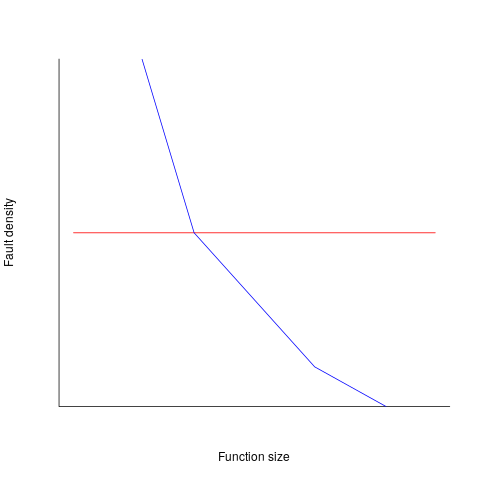
If defect density was independent of function length, the plot of reported faults against function length (in lines of code) would be horizontal; red line below. If every function contained the same number of reported faults, the plotted line would have the form of the blue line below.
Two things need to occur for a fault to be experienced. A mistake has to appear in the code, and the code has to be executed with the ‘right’ input values.
Code that is never executed will never result in any fault reports.
In a function containing 100 lines of executable source code, say, 30 lines are rarely executed, they will not contribute as much to the final total number of reported faults as the other 70 lines.
How does the average percentage of executed LOC, in a function, vary with its length? I have been rummaging around looking for data to help answer this question, but so far without any luck (the llvm code coverage report is over all tests, rather than per test case). Pointers to such data very welcome.
Statement execution is controlled by if-statements, and around 17% of C source statements are if-statements. For functions containing between 1 and 10 executable statements, the percentage that don’t contain an if-statement is expected to be, respectively: 83, 69, 57, 47, 39, 33, 27, 23, 19, 16. Statements contained in shorter functions are more likely to be executed, providing more opportunities for any mistakes they contain to be triggered, generating a fault experience.
Longer functions contain more dependencies between the statements within the body, than shorter functions (I don’t have any data showing how much more). Dependencies create opportunities for making mistakes (there is data showing dependencies between files and classes is a source of mistakes).
The previous analysis makes a large assumption, that the mistake generating a fault experience is contained in one function. This is true for 70% of reported faults (in AspectJ).
What is the distribution of reported faults against function/method size? I don’t have this data (pointers to such data very welcome).
The plot below shows number of reported faults in C++ classes (not methods) containing a given number of lines (from a paper by Koru, Eman and Mathew; code+data):
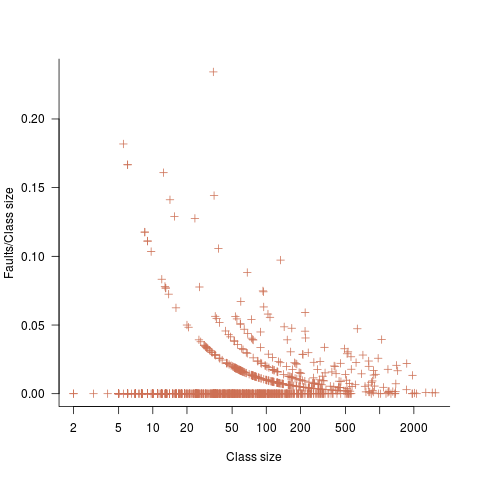
It’s tempting to think that those three curved lines are each classes containing the same number of methods.
What is the conclusion? There is one good reason why shorter functions should have more reported faults, and another good’ish reason why longer functions should have more reported faults. Perhaps length is not important. We need more data before an answer is possible.
Extreme value theory in software engineering
As its name suggests, extreme value theory deals with extreme deviations from the average, e.g., how often will rainfall be heavy enough to cause a river to overflow its banks.
The initial list of statistical topics I thought ought to be covered in my evidence-based software engineering book included extreme value theory. At the time, and even today, there were/are no books covering “Statistics for software engineering”, so I had no prior work to guide my selection of topics. I was keen to cover all the important topics, had heard of it in several (non-software) contexts and jumped to the conclusion that it must be applicable to software engineering.
Years pass: the draft accumulate a wide variety of analysis techniques applied to software engineering data, but, no use of extreme value theory.
Something else does not happen: I don’t find any ‘Using extreme value theory to analyse data’ books. Yes, there are some really heavy-duty maths books available, but nothing of a practical persuasion.
The book’s Extreme value section becomes a subsection, then a subsubsection, and ended up inside a comment (I cannot bring myself to delete it).
It appears that extreme value theory is more talked about than used. I can understand why. Extreme events are newsworthy; rivers that don’t overflow their banks are not news.
Just over a month ago a discussion cropped up on the UK’s C++ standards’ panel mailing list: was email traffic down because of COVID-19? The panel’s convenor, Roger Orr, posted some data on monthly volumes. Oh, data 🙂
Monthly data is a bit too granular for detailed analysis over relatively short periods. After some poking around Roger was able to send me the date&time of every post to the WG21‘s Core and Lib reflectors, since February 2016 (there have been various changes of hosts and configurations over the years, and date of posts since 2016 was straightforward to obtain).
During our email exchanges, Roger had mentioned that every now and again a huge discussion thread comes out of nowhere. Woah, sounds like WG21 could do with some extreme value theory. How often are huge discussion threads likely to occur, and how huge is a once in 10-years thread that they might have to deal with?
There are two techniques for analysing the distribution of extreme values present in a sample (both based around the generalized extreme value distribution):
- Generalized Extreme Value (GEV) uses block maxima, e.g., maximum number of daily emails sent in each month,
- Generalized Pareto (GP) uses peak over threshold: pick a threshold and extract day values for when more than this threshold number of emails was sent.
The plots below show the maximum number of monthly emails that are expected to occur (y-axis) within a given number of months (x-axis), for WG21’s Core and Lib email lists. The circles are actual occurrences, and dashed lines 95% confidence intervals; GEV was used for these fits (code+data):
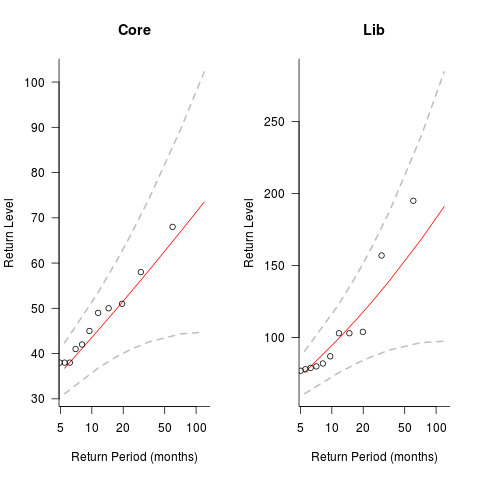
The 10-year return value for Core is around a daily maximum of 70 +-30, and closer to 200 +-100 for Lib.
The model used is very simplistic, and fails to take into account the growth in members joining these lists and traffic lost when a new mailing list is created for a new committee subgroup.
If any readers have suggests for uses of extreme value theory in software engineering, please let me know.
Postlude. This discussion has reordered events. My original interest in the mailing list data was the desire to find some evidence for the hypothesis that the volume of email increased as the date of the next WG21 meeting approached. For both Core and Lib, the volume actually decreases slightly as the date of the next meeting approaches; see code for details. Also, the volume of email at the weekend is around 60% lower than during weekdays.
C++ template usage
Generics are a programming construct that allow an algorithm to be coded without specifying the types of some variables, which are supplied later when a specific instance (for some type(s)) is instantiated. Generics sound like a great idea; who hasn’t had to write the same function twice, with the only difference being the types of the parameters.
All of today’s major programming languages support some form of generic construct, and developers have had the opportunity to use them for many years. So, how often generics are used in practice?
In C++, templates are the language feature supporting generics.
The paper: How C++ Templates Are Used for Generic Programming: An Empirical Study on 50 Open Source Systems contains lots of interesting data 🙂 The following analysis applies to the five largest projects analysed: Chromium, Haiku, Blender, LibreOffice and Monero.
As its name suggests, the Standard Template Library (STL) is a collection of templates implementing commonly used algorithms+other stuff (some algorithms were commonly used before the STL was created, and perhaps some are now commonly used because they are in the STL).
It is to be expected that most uses of templates will involve those defined in the STL, because these implement commonly used functionality, are documented and generally known about (code can only be reused when its existence is known about, and it has been written with reuse in mind).
The template instantiation measurements show a 17:1 ratio for STL vs. developer-defined templates (i.e., 149,591 vs. 8,887).
What are the usage characteristics of developer defined templates?
Around 25% of developer defined function templates are only instantiated once, while 15% of class templates are instantiated once.
Most templates are defined by a small number of developers. This is not surprising given that most of the code on a project is written by a small number of developers.
The plot below shows the percentage instantiations (of all developer defined function templates) of each developer defined function template, in rank order (code+data):
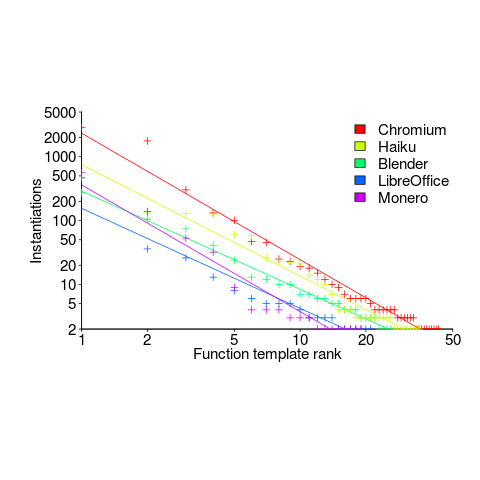
Lines are each a fitted power law, whose exponents vary between -1.5 and -2. Is it just me, or are these exponents surprising close?
The following is for developer defined class templates. Lines are fitted power law, whose exponents vary between -1.3 and -2.6. Not so close here.
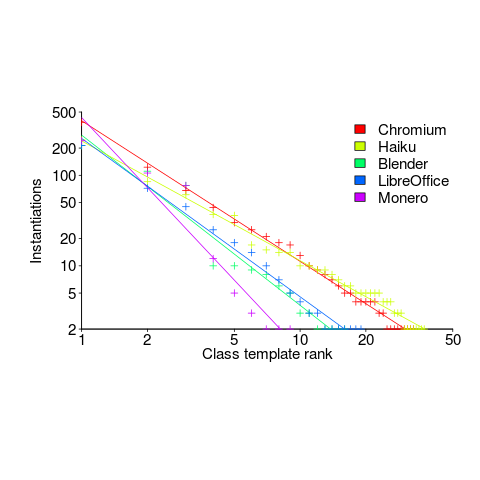
What processes are driving use of developer defined templates?
Every project has its own specific few templates that get used everywhere, by all developers. I imagine these are tailored to the project, and are widely advertised to developers who work on the project.
Perhaps some developers don’t define templates, because that’s not what they do. Is this because they work on stuff where templates don’t offer much benefit, or is it because these developers are stuck in their ways (if so, is it really worth trying to change them?)
How are C functions different from Java methods?
According to the right plot below, most of the code in a C program resides in functions containing between 5-25 lines, while most of the code in Java programs resides in methods containing one line (code+data; data kindly supplied by Davy Landman):
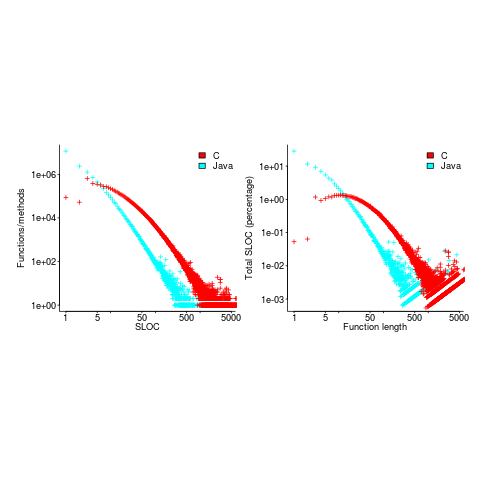
The left plot shows the number of functions/methods containing a given number of lines, the right plot shows the total number of lines (as a percentage of all lines measured) contained in functions/methods of a given length (6.3 million functions and 17.6 million methods).
Perhaps all those 1-line Java methods are really complicated. In C, most lines contain a few tokens, as seen below (code+data):

I don’t have any characters/tokens per line data for Java.
Is Java code mostly getters and setters?
I wonder what pattern C++ will follow, i.e., C-like, Java-like, or something else? If you have data for other languages, please send me a copy.
for-loop usage at different nesting levels
When reading code, starting at the first line of a function/method, the probability of the next statement read being a for-loop is around 1.5% (at least in C, I don’t have decent data on other languages). Let’s say you have been reading the code a line at a time, and you are now reading lines nested within various if/while/for statements, you are at nesting depth  . What is the probability of the statement on the next line being a
 for-loop?
Does the probability of encountering a for-loop remain unchanged with nesting depth (i.e., developer habits are not affected by nesting depth), or does it decrease (aren’t developers supposed to using functions/methods rather than nesting; I have never heard anybody suggest that it increases)?
If you think the for-loop use probability is not affected by nesting depth, you are going to argue for the plot on the left (below, showing number of loops whose compound-statement contains appearing in C source at various nesting depths), with the regression model fitting really well after 3-levels of nesting. If you think the probability decreases with nesting depth, you are likely to argue for the plot on the right, with the model fitting really well down to around 10-levels of nesting (code+data).
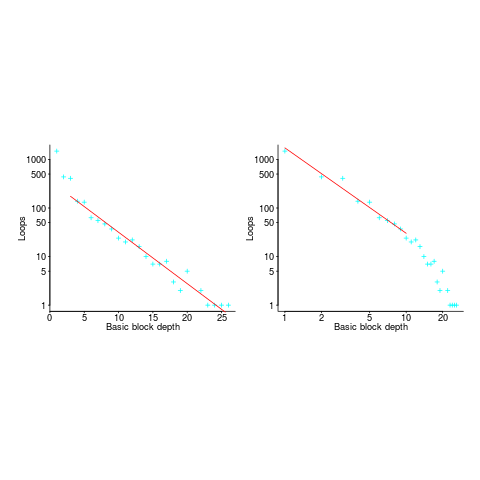
Both plots use the same data, but different scales are used for the x-axis.
If probability of use is independent of nesting depth, an exponential equation should fit the data (i.e., the left plot), decreasing probability is supported by a power-law (i.e, the right plot; plus other forms of equation, but let’s keep things simple).
The two cases are very wrong over different ranges of the data. What is your explanation for reality failing to follow your beliefs in for-loop occurrence probability?
Is the mismatch between belief and reality caused by the small size of the data set (a few million lines were measured, which was once considered to be a lot), or perhaps your beliefs are based on other languages which will behave as claimed (appropriate measurements on other languages most welcome).
The nesting depth dependent use probability plot shows a sudden change in the rate of decrease in for-loop probability; perhaps this is caused by the maximum number of characters that can appear on a typical editor line (within a window). The left plot (below) shows the number of lines (of C source) containing a given number of characters; the right plot counts tokens per line and the length effect is much less pronounced (perhaps developers use shorter identifiers in nested code). Note: different scales used for the x-axis (code+data).
I don’t have any believable ideas for why the exponential fit only works if the first few nesting depths are ignored. What could be so special about early nesting depths?
What about fitting the data with other equations?
A bi-exponential springs to mind, with one exponential driven by application requirements and the other by algorithm selection; but reality is not on-board with this idea.
Ideas, suggestions, and data for other languages, most welcome.
Comparing expression usage in mathematics and C source
Why does a particular expression appear in source code?
One reason is that the expression is the coded form of a formula from the application domain, e.g.,  .
.
Another reason is that the expression calculates an algorithm/housekeeping related address, or offset, to where a value of interest is held.
Most people (including me, many years ago) think that the majority of source code expressions relate to the application domain, in one-way or another.
Work on a compiler related optimizer, and you will soon learn the truth; most expressions are simple and calculate addresses/offsets. Optimizing compilers would not have much to do, if they only relied on expressions from the application domain (my numbers tool throws something up every now and again).
What are the characteristics of application domain expression?
I like to think of them as being complicated, but that’s because it used to be in my interest for them to be complicated (I used to work on optimizers, which have the potential to make big savings if things are complicated).
Measurements of expressions in scientific papers is needed, but who is going to be interested in measuring the characteristics of mathematical expressions appearing in papers? I’m interested, but not enough to do the work. Then, a few weeks ago I discovered: An Analysis of Mathematical Expressions Used in Practice, by Clare So; an analysis of 20,000 mathematical papers submitted to arXiv between 2000 and 2004.
The following discussion uses the measurements made for my C book, as the representative source code (I keep suggesting that detailed measurements of other languages is needed, but nobody has jumped in and made them, yet).
The table below shows percentage occurrence of operators in expressions. Minus is much more common than plus in mathematical expressions, the opposite of C source; the ‘popularity’ of the relational operators is also reversed.
Operator Mathematics C source = 0.39 3.08 - 0.35 0.19 + 0.24 0.38 <= 0.06 0.04 > 0.041 0.11 < 0.037 0.22 |
The most common single binary operator expression in mathematics is n-1 (the data counts expressions using different variable names as different expressions; yes, n is the most popular variable name, and adding up other uses does not change relative frequency by much). In C source var+int_constant is around twice as common as var-int_constant
The plot below shows the percentage of expressions containing a given number of operators (I’ve made a big assumption about exactly what Clare So is counting; code+data). The operator count starts at two because that is where the count starts for the mathematics data. In C source, around 99% of expressions have less than two operators, so the simple case completely dominates.
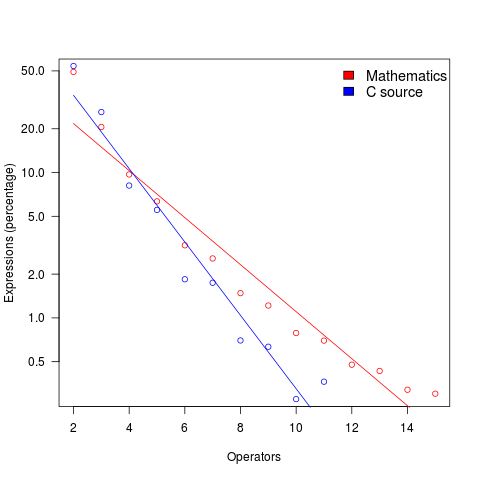
For expressions containing between two and five operators, frequency of occurrence is sort of about the same in mathematics and C, with C frequency decreasing more rapidly. The data disagrees with me again…
2019 in the programming language standards’ world
Last Tuesday I was at the British Standards Institute for a meeting of IST/5, the committee responsible for programming language standards in the UK.
There has been progress on a few issues discussed last year, and one interesting point came up.
It is starting to look as if there might be another iteration of the Cobol Standard. A handful of people, in various countries, have started to nibble around the edges of various new (in the Cobol sense) features. No, the INCITS Cobol committee (the people who used to do all the heavy lifting) has not been reformed; the work now appears to be driven by people who cannot let go of their involvement in Cobol standards.
ISO/IEC 23360-1:2006, the ISO version of the Linux Base Standard, has been updated and we were asked for a UK position on the document being published. Abstain seemed to be the only sensible option.
Our WG20 representative reported that the ongoing debate over pile of poo emoji has crossed the chasm (he did not exactly phrase it like that). Vendors want to have the freedom to specify code-points for use with their own emoji, e.g., pineapple emoji. The heady days, of a few short years ago, when an encoding for all the world’s character symbols seemed possible, have become a distant memory (the number of unhandled logographs on ancient pots and clay tablets was declining rapidly). Who could have predicted that the dream of a complete encoding of the symbols used by all the world’s languages would be dashed by pile of poo emoji?
The interesting news is from WG9. The document intended to become the Ada20 standard was due to enter the voting process in June, i.e., the committee considered it done. At the end of April the main Ada compiler vendor asked for the schedule to be slipped by a year or two, to enable them to get some implementation experience with the new features; oops. I have been predicting that in the future language ‘standards’ will be decided by the main compiler vendors, and the future is finally starting to arrive. What is the incentive for the GNAT compiler people to pay any attention to proposals written by a bunch of non-customers (ok, some of them might work for customers)? One answer is that Ada users tend to be large bureaucratic organizations (e.g., the DOD), who like to follow standards, and might fund GNAT to implement the new document (perhaps this delay by GNAT is all about funding, or lack thereof).
Right on cue, C++ users have started to notice that C++20’s added support for a system header with the name version, which conflicts with much existing practice of using a file called version to contain versioning information; a problem if the header search path used the compiler includes a project’s top-level directory (which is where the versioning file version often sits). So the WG21 committee decides on what it thinks is a good idea, implementors implement it, and users complain; implementors now have a good reason to not follow a requirement in the standard, to keep users happy. Will WG21 be apologetic, or get all high and mighty; we will have to wait and see.
Recent Comments