Answering via a scale to improve estimation accuracy
The human brain differs from the brain of other animals in having two number processing systems: 1) the approximate number system (present in other animals), and 2) language.
Round numbers are often given in answers when using language, to questions having a numeric answer. While use of round numbers may be conversationally appropriate, they decrease the accuracy of the answer.
Numeric values can be specified without using language. For instance, by pointing at a position on a scale representing a sequence of increasing/decreasing values, such as a ruler. Are answers given by pointing at a scale less likely to be round numbers, and more importantly are they likely to be more accurate than answers given using language?
Various studies by psychologists have investigated response differences between answering using language and scales. The analysis below is based on data from the paper: On the round number bias and wisdom of crowds in different response formats for numerical estimation by Honda, Kagawa and Shirasuna. This study asked 1,805 subjects to estimate the number of dots in an image, like the one below, with images containing: 183, 287, 360, 453, 554, 633, 719, 807, or 986 dots (randomly selected):

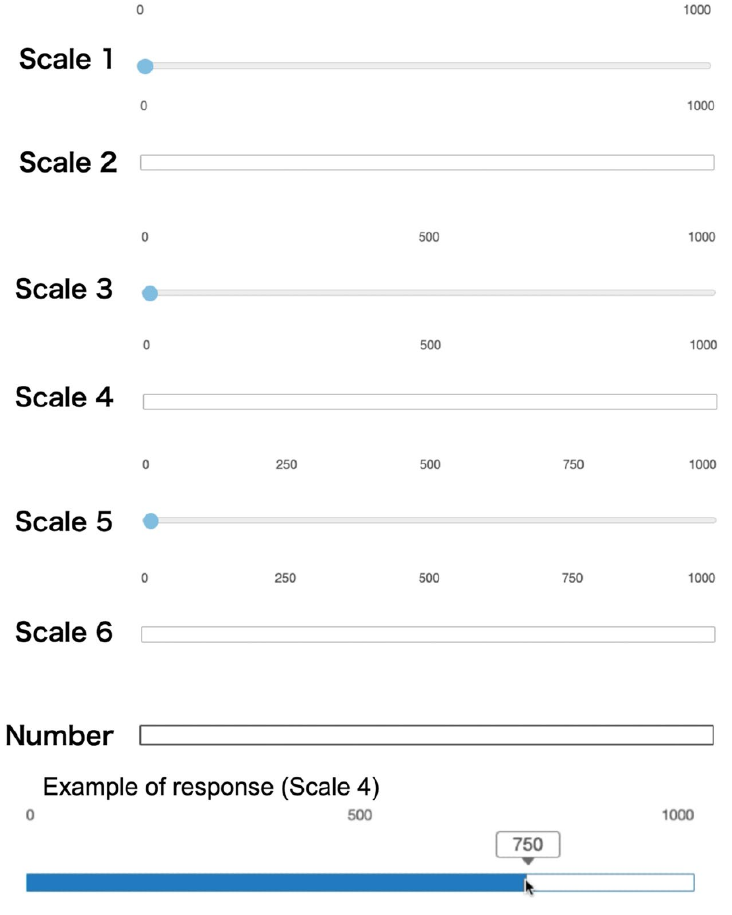
Subjects responded using a randomly selected one of six different scales or using language (i.e., typing a number). The scales differed in axis labeling and some were zero based (subjects had to slide the blue colored circle from zero to a position, rather than clicking on a position); see image below:
The plot below shows the normalised occurrences of estimate values (rounded to the nearest value divisible by five) made using language (red) and one of the scales (blue/green), with grey line showing actual number of dots. There was little difference between the various kinds of scales, and all the scale answers have been aggregated (code+data):
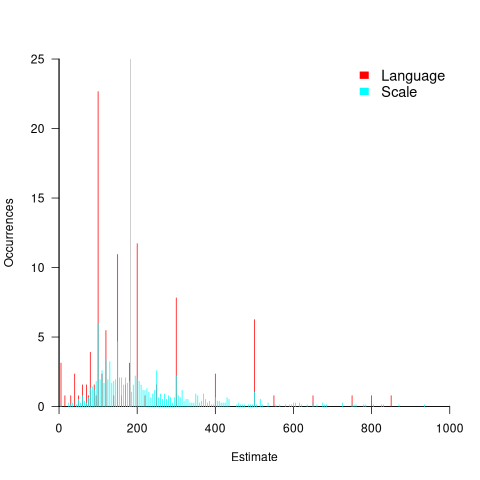
The red spikes clearly show many language given answers are at round numbers. The answers given using a scale are much less likely to be round numbers, with the blue/green lines showing the use of a wider selection of estimates.
Are answers given using language likely to be more or less accurate than answer given using a scale?
The plot above shows that few responses are close to the actual value, which means that no fitted model is going to explain much of the variability in the data. All the regression models I fitted to the difference between answers and actuals found that languages responses were less accurate, on average (code+data). Combining the explanatory variables in a variety of different ways did not significantly affect the quality of the fitted model.
In hand-wavy terms, the average error in the language responses was at most 10% larger than the scale responses.
To summaries, scale responses are likely to be more accurate, but a lot less likely to be a round number.
People are willing to tradeoff accuracy for being able to communicate using a round number. For instance, I once pointed out to a manager that changing all 1-hour estimates to 1.25 hours would significantly improve accuracy; he was unwilling to give up the greater uncertainty implied by the 1-hour estimate.
Will this behavior replicate for software task estimates? Is it possible to shift a scale answer to the closest round number without losing the accuracy advantage?
We will have to wait until somebody does the appropriate study.
Recent Comments