Archive
Trying to sell analysis tools to the Nuclear Regulatory Commission
Over the last few days there has been an interesting, and in places somewhat worrying, discussion going on in the Safety Critical mailing list about the US Nuclear Regulatory Commission. I thought I would tell my somewhat worrying story about dealing with the NRC.
In 1996 the NRC posted a request for information for a tool that I thought my company stood a reasonable chance of being able to meet (“NRC examines source code in nuclear power plant safety systems during the licensing process. NRC is interested in finding commercially available tools that can locate and provide information about the following programming practices…”). I responded, answered the questions on the form I received and was short listed to make a presentation to the NRC.
The presentation took place at the offices of National Institute of Standards and Technology, the government agency helping out with the software expertise.
From our brief email exchanges I had guessed that nobody at the NRC/NIST end knew much about C or static analysis. A typical potential customer occurrence that I was familiar with handling.
Turned up, four or so people from NRC+one(?) from NIST, gave a brief overview and showed how the tool detected the constructs they were interested in, based on test cases I had written after reading their requirements (they had not written any but did give me some code that they happened to have, that was, well, code they happened to have; a typical potential customer occurrence that I was familiar with handling).
Why did the tool produce all those messages? Well, those are the constructs you want flagged. A typical potential customer occurrence that I was familiar with handling.
Does any information have to be given to the tool, such as where to find header files (I knew that they had already seen a presentation from another tool vendor, these managers who appeared to know nothing about software development had obviously picked up this question from that presentation)? Yes, but it is very easy to configure this information… A typical potential customer occurrence that I was familiar with handling.
I asked how they planned to use the tool and what I had to do to show them that this tool met their requirements.
We want one of our inspectors to be able turn up at a reactor site and check their source code. The inspector should not need to know anything about software development and so the tool must be able to run automatically without any options being given and the output must be understandable to the inspector. Not a typical potential customer occurrence and I had no idea about how to handle it (I did notice that my mouth was open and had to make a conscious effort to keep it closed).
No, I would not get to see their final report and in fact I never heard from them again (did they find any tool vendor who did not stare at them in disbelief?)
The trip was not a complete waste of time, a few months earlier I had been at a Java study group meeting (an ISO project that ultimately failed to convince Sun to standarize Java through the ISO process) with some NIST folk who worked in the same building and I got to chat with them again.
A few hours later I realised that perhaps the question I should have asked was “What kind of software are people writing at nuclear facilities that needs an inspector to turn up and check?”
Background to my book project “Empirical Software Engineering with R”
This post provides background information that can be referenced by future posts.
For the last 18 months I have been working in fits and starts on a book that has the working title “Empirical Software Engineering with R”. The idea is to provide broad coverage of software engineering issues from an empirical perspective (i.e., the discussion is driven by the analysis of measurements obtained from experiments); R was chosen for the statistical analysis because it is becoming the de-facto language of choice in a wide range of disciplines and lots of existing books provide example analysis using R, so I am going with the crowd.
While my last book took five years to write I had a fixed target, a template to work to and a reasonably firm grasp of the subject. Empirical software engineering has only really just started, the time interval between new and interesting results appearing is quiet short and nobody really knows what statistical techniques are broadly applicable to software engineering problems (while the normal distribution is the mainstay of the social sciences a quick scan of software engineering data finds few occurrences of this distribution).
The book is being driven by the empirical software engineering rather than the statistics, that is I take a topic in software engineering and analyse the results of an experiment investigating that topic, providing pointers to where readers can find out more about the statistical techniques used (once I know which techniques crop up a lot I will write my own general introduction to them).
I’m assuming that readers have a reasonable degree of numeric literacy, are happy dealing with probabilities and have a rough idea about statistical ideas. I’m hoping to come up with a workable check-list that readers can use to figure out what statistical techniques are applicable to their problem; we will see how well this pans out after I have analysed lots of diverse data sets.
Rather than wait a few more years before I can make a complete draft available for review I have decided to switch to making available individual parts as they are written, i.e., after writing a draft discussion and analysis of each experiment I will published it on this blog (along with the raw data and R code used in the analyse). My reasons for doing this are:
- Reader feedback (I hope I get some) will help me get a better understanding of what people are after from a book covering empirical software engineering from a statistical analysis of data perspective.
- Suggestions for topics to cover. I am being very strict and only covering topics for which I have empirical data and can make that data available to readers. So if you want me to cover a topic please point me to some data. I will publish a list of important topics for which I currently don’t have any data, hopefully somebody will point me at the data that can be used.
- Posting here will help me stay focused on getting this thing done.
Links to book related posts
Distribution of uptimes for high-performance computing systems
Break even ratios for development investment decisions
Agreement between code readability ratings given by students
Changes in optimization performance of gcc over time
Descriptive statistics of some Agile feature characteristics
Impact of hardware characteristics on detectable fault behavior
Prioritizing project stakeholders using social network metrics
Preferential attachment applied to frequency of accessing a variable
Amount of end-user usage of code in Firefox
How many ways of programming the same specification?
Ways of obtaining empirical data in software engineering
What is the error rate for published mathematical proofs?
Changes in the API/non-API method call ratio with program size
Honking the horn for go faster memory (over go faster cpus)
How to avoid being a victim of Brooks’ law
Evidence for the benefits of strong typing, where is it?
Hardware variability may be greater than algorithmic improvement
Extracting the original data from a heatmap image
Entropy: Software researchers go to topic when they have no idea what else to talk about
Maths GCE from 1972 (paper 2)
While sorting through some old papers I came across my GCE maths O level exam papers from the summer of 1972. They are known as GCSE exams these days and are taken by 16 year olds at the end of their final year of compulsory education in the UK. I was lucky enough to have a maths teacher who believed in encouraging students to excel and I (plus five others) took this exam when we were 15. I never got the chance to thank Mr Merritt for the profound effect he had on my life.
For many years the average grades achieved by students in the UK has had a steady upward trend and some people claim the exams are getting easier (others that students are better taught, or at least better taught to pass exams). These days students have calculators and don’t use log tables, so question 3 of Section A is not applicable.
Exam papers in the UK are written by various examining boards. Mine were from the University of London, Syllabus D. I have two papers labeled “Mathematics 2” and “Mathematics 3” and don’t recall if there was ever a “Mathematics 1”. The following are the questions from “Mathematics 2”.
All necessary working must be shown.
- Factorise

Hence, or otherwise, find the exact value of
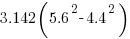
4 marks
- Given that
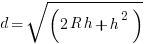 , express
  in terms of
  and
and  .
.
3 marks
- Use four digit tables to evaluate
 .
.
4 marks
- Given that
 is a factor of
  , calculate the value of
  .
.
3 marks
-
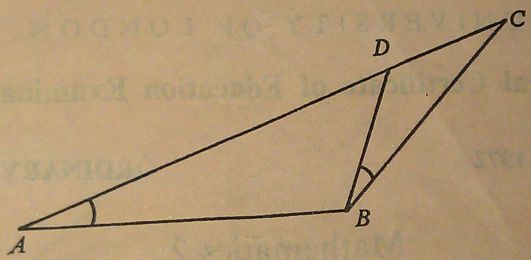
In the diagram ∠DBC = ∠BAD and ADC is a straight line. State which of the two triangles are similar.
If AB = 7 cm, BC = 6 cm and DC = 4 cm, calculate the lengths of AC and BD.
5 marks
- A bicycle wheel has diameter 35 cm. Calculate how many revolutions it makes every minute when the bicycle is travelling at 33 km/h. [ Take
 as 22/7 ]
4 marks
- Calculate the gradient of the curve
 at the point (1, -5). Calculate also the coordinates of the point on the curve where the gradient is 1.
4 marks
-
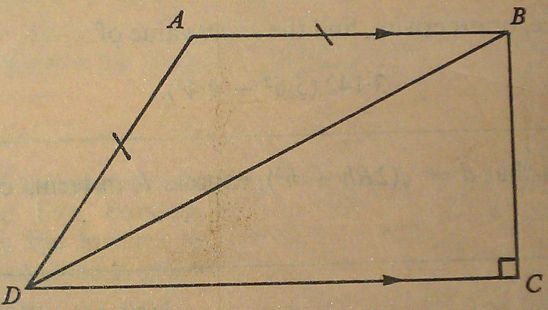
In the diagram, AB is parallel to DC, AB = AD and ∠C = 90°. Prove that ∠DAB = 2∠DBC.
5 marks
as 3.142 when required- A ship is at the point P (54°N, 55°W). Calculate the distance, in nautical miles, of P from the equator.
The ship then sails 500 nautical miles due East to a point Q. Calculate the latitude and longitude of Q.
An aircraft flies due South at a constant height of 10 000 m from the point vertically above P to a point vertically above the equator. Taking the earth to be a sphere of radius 6 370 km, calculate the length of the arc along which the aircraft flies.
17 marks
- Draw a circle of radius 5.5 cm. Using ruler and compasses only, construct a tangent to the circle at any point A on its circumference.
Using a protractor, construct the points A, B and C on this circle so that the angles A, B and C of the triangle ABC are 50°, 56° and 74° respectively.
By a further construction using ruler and compasses only, obtain a point X on the tangent at A which is equidistant from the lines AB and BC.
Measure the length of AX.
17 marks
- (i) Find the smallest positive term in the arithmetic progression 76, 74½, 73 … .
Find also the number of positive terns in the progression and the sum of these positive terms.
(ii) The first and fourth terms in a geometric progression are
 and
and  respectively. Find the second and third terms of the progression.
17 marks
-
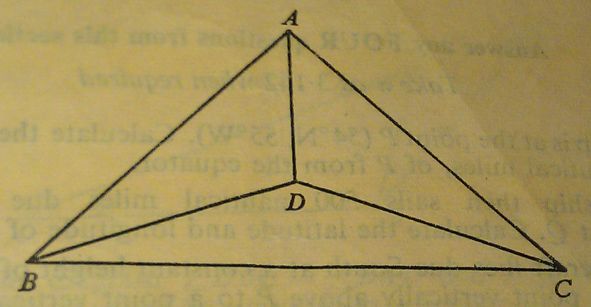
The diagram represents a roof-truss in which AB = AC = 8 m, BC = 11 m, BD = DC and ∠DBC = 20°.
Calculate
(a) the length BD,
(b) the angle ABC,
(c) the length AD.
- Draw the graph of
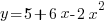 for values of
  from -1 to +4, taking 2 cm as one unit on the x-axis and 1 cm as one unit on the y-axis. From your graph, find the range of values of for which the function
  is greater than 6.
Using the sane axes and scales, draw the graph of
 and write down the coordinates of the points of intersection of the two graphs.
if
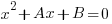 is the quadratic equation of which these coordinates are the roots, determine the values of
  and
and  .
.17 marks
- A particle starts from rest at a point A and moves along a straight line, coming to rest again at another point B. During the motion its velocity,
 metres per second, after time
  is given by
  .
.
Calculate:
(a) the time taken for the particle to reach B.
(b) the distance travelled during the first two seconds,
(c) the time taken for the particle to attain its maximum velocity,
(d) the maximum velocity attained,
(e) the maximum acceleration during the motion.
17 marks
Automatically generating railroad diagrams from yacc files
Reading and understanding a language’s syntax written in the BNF-like notation used by yacc/bison takes some practice. Railroad diagrams are a much more user friendly notation, but require a lot of manual tweaking before they look as good as the following example from the json.org website:
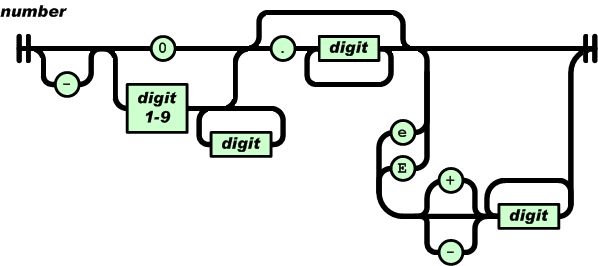
I’m currently working on a language whose syntax is evolving and I want to create a visual representation of it that can be read by non-yacc experts; spending a day of so manually creating a decent looking railroad diagram is not an efficient use of time. What automatic visualization tools are out there that I can use?
A couple of tools that look like they might produce useful results are web based (e.g., bottlecaps.de; working on an internal project for a company means I cannot take this approach). Some tools take EBNF as input (e.g., my28msec.com which is also online based); the Extensions in EBNF obviate the need for many of the low level organizational details that appear in grammars written with BNF, making grammars written using EBNF easier to layout and look good; great if I was working with EBNF. The yacc file input tools I tried (yaccviso, Vyacc) were a bit too fragile and the output was not that good.
Bison has an option to generate a output that can be processed into graphical form (using graphviz as the layout engine). Unfortunately the graphs produced are as visually tangled as the input grammar and if anything harder to follow.
It is possible to produce great looking visual diagrams using a simple tool if you are willing to spend lots of fiddling with the input grammar to control the output. I wanted to take the grammar as written (i.e., a yacc input file) and am willing to accept less than perfect output.
Most of the syntax rules in a yacc grammar are straight forward sequences of tokens that have an obvious one-to-one mapping and there are a few commonly seen idioms. I decided to write a tool that concentrated on untangling the idioms and let the simple stuff look after itself. One idiom that has a visual representation very different from its yacc form is the two productions used to specify an arbitrary long list, e.g., a semicolon separated list of ys is often written as (ok, there might perhaps be times when right recursion is appropriate):
x : y | x ";" y ; |
and I wanted something that looked like (from the sql-lite web site, which goes one better and allows support for the list to be optional:
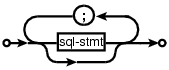
Graph layout is a complicated business and like everybody else I decided to use graphviz to do the heavy lifting (specifically I would generate the layout directives used by dot). All I had to do was write a yacc grammar to dot translator (and not spend lots of time doing it).
The dot language provides a directives that specify the visual properties of nodes and the connections between them. For instance:
n_0[shape=point] n_1[label="sql-stmt"] n_2[label=";"] n_3[shape=point] n_0 -> n_3 n_0 -> n_1 n_1 -> n_3 n_1 -> n_2 n_2 -> n_1 |
is the dot specification of the optional semicolon separated list of sql-stmts displayed above.
Dot takes a list of directives describing the nodes and edges of a graph and makes its own decisions about how to layout the output. It is possible to specify in excruciating detail exactly how to do the layout, but I wanted everything to be automated.
I decided to write the tool in awk because it has great input token handling facilities and I use it often enough to be fluent.
Each grammar rule containing one or more productions is mapped to a single graph. When generating postscript dot puts each graph on a separate page, other output formats appear to loose all but one of the graphs. To make sure each rule fitted on a page I had the text point size depend on the number of productions in a rule, more productions smaller point size. The most common idioms are handled (i.e., list-of and optional construct) with hooks available to handle others. Productions within a rule will often have common token sequences but the current version only checks for matching token sequences at the start of a production and all productions in a rule have to start with the same sequence. Words written all in upper-case are assumed to be language tokens and are converted to lower case and bracketed with quotes. The 300+ lines of conversion tool’s awk source is available for download.
The follow examples are taken from an attempted yacc grammar of C++ done when people still thought such a thing could be created. While the output does have a certain railroad diagram feel to it, the terrain must be very hilly to generate those curvaceous lines.
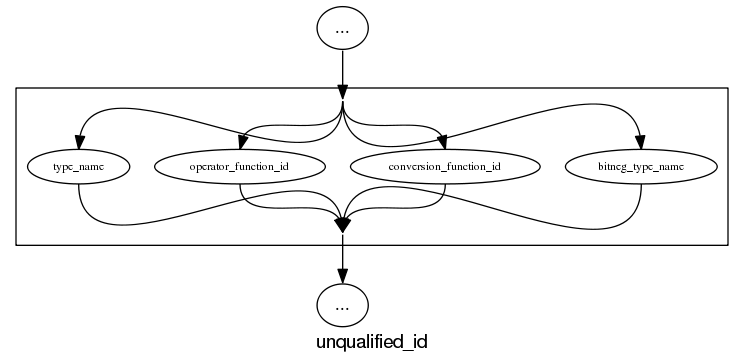
and the run of the mill rules look good, a C++ primary-expression is:
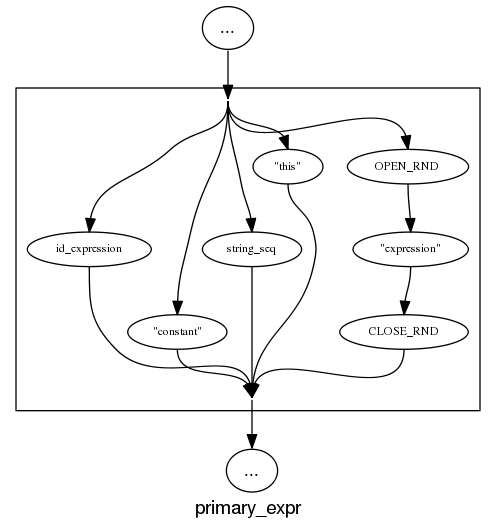
and we can rely on C++ to push syntax rule complexity to the limit, a postfix-expression is:
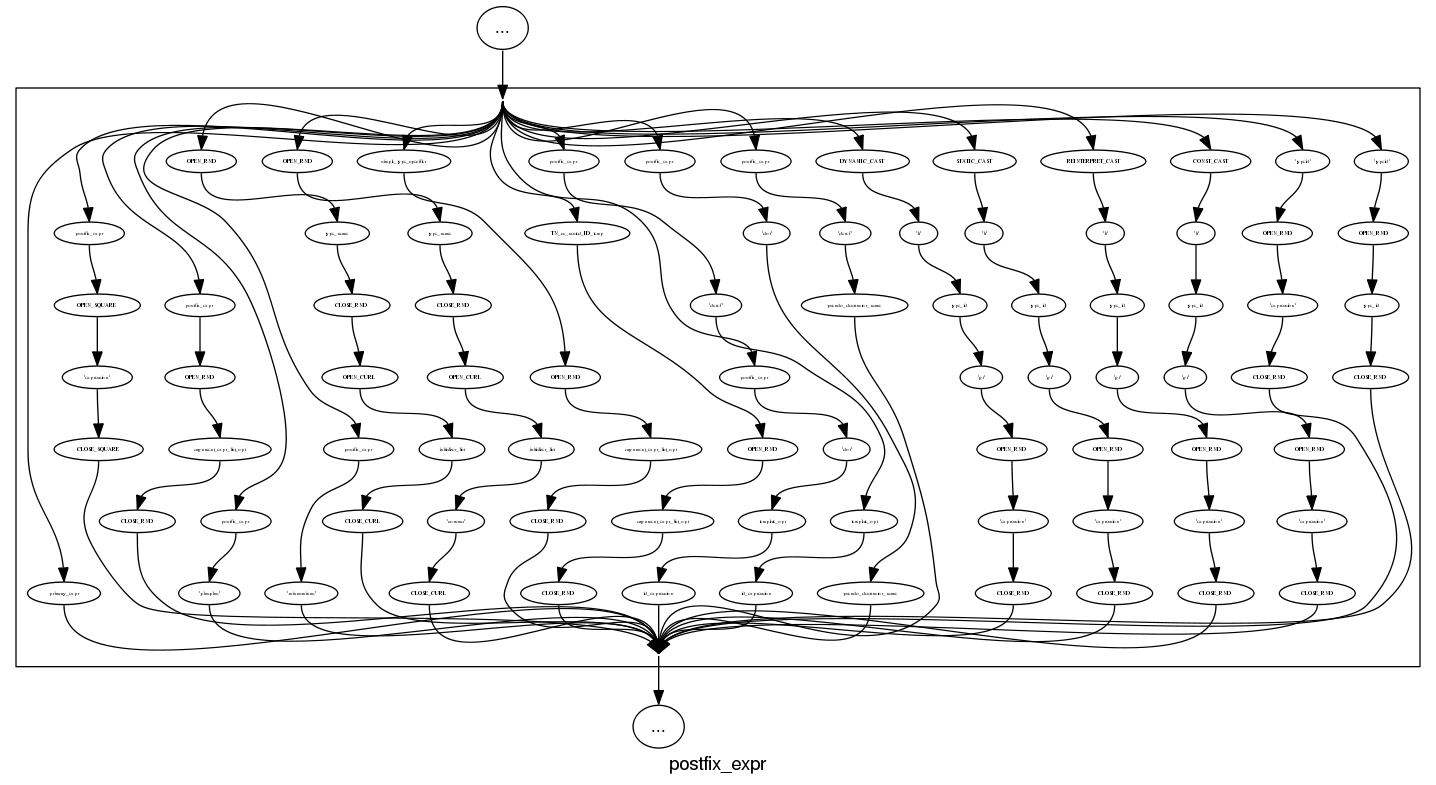
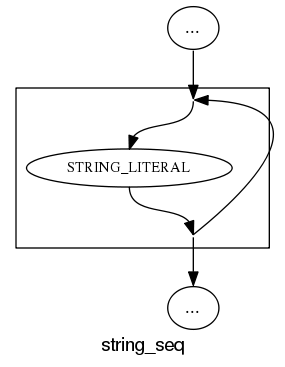
What about the idioms? A simple list of items looks good:
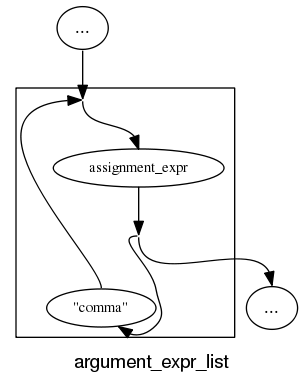
and slightly less good when separators are involved:
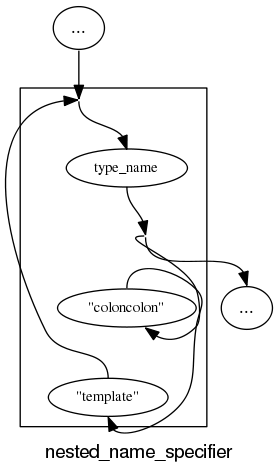
and if we push our luck things start to look tangled:
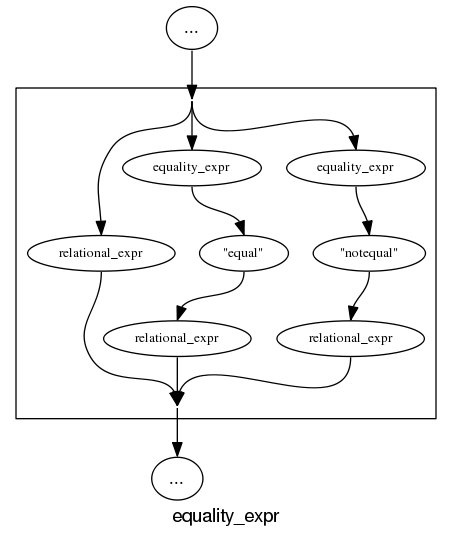
With a bit more work invested on merging token sequences common to two or more rules the following might look a lot less cluttered:
Apart from a few tangled cases the results are not bad for a tool that was a few hours work. I will wait a bit to see if the people I deal with find this visual form of use.
In the meantime I would be interested to hear about my readers experience with visualizing grammars, using dot to this kind of thing and any suggestions they have. As a long time user of dot I know that there are lots of ways of influencing the final layout (e.g., changing the ordering or edges and nodes in its input), I will have to be careful not to get pulled down this rabbit hole.
Why do companies fix faults in software they sell?
Once I buy some software from a company they have my money, if sometime later I find a fault software what incentive does that company have to fix the software and provide me with an update (assuming the software is not so fault ridden that I take advantage of laws allowing me to return a purchase for a refund)?
There are three economic incentives for companies to fix faults:
- because I am paying them a fee for updates that include fixes to known faults,
- because they want to make future sales to me and to others (faults encountered by customers contribute towards the perception of product quality),
- they don’t want to lose money because a fault had consequences that resulted in legal action (this reason is overhyped, in practice software engineering has a missing dead body problem).
Which faults get fixed? Software is surprisingly fault-tolerant and there is no point in fixing faults that customers are unlikely to encounter. This means that once a product has been released and known to be acceptable to many customers, there is no incentive to actively search for faults; this means that the only faults likely to be fixed are the ones reported by customers.
When reporting a fault, customers are often asked to rate its severity. This is a useful technique for prioritizing what gets fixed first, or perhaps what does not get fixed at all. Customers who actively set out to find faults are not appreciated and are labelled as disruptive if they continue doing it. Finding faults is surprisingly easy, finding the faults that have a high probability of being encountered by customers and ranked by them as critical is very hard (this is one of the reasons static analysis tools are not widely used).
What is the motivation for developers to fix faults in Open Source?
- There are companies who provide support services for a fee, just like commercial offerings,
- Open Source is free, gaining more users is not an obvious incentive to fix faults. However, being known as the go-to guys for a given package is a way of attracting companies looking to hire somebody to provide support services or make custom modifications to that package. Fixing faults is a way of getting visibility, it is advertising.
- Developers hate the thought of doing something wrong resulting in a fault in code they have written, and writing faulty code is not socially acceptable behavior in software development circles. These feelings about what constitutes appropriate behavior are often enough to make developers want to spend time fixing faults in code they have written or feel responsible for, provided they have the time. I suspect a lot of faults get fixed by developers when their manager/wife thinks they are working on something more ‘useful’.
Would you buy second hand software from a formal methods researcher?
I have been reading a paper on formally proving software correct (Bridging the Gap: Automatic Verified Abstraction of C by Greenaway, Andronick and Klein) and as often the case with papers on this topic the authors have failed to reach the level of honest presentation required by manufacturers of soap power in their adverts.
The Greenaway et al paper describes a process that uses a series of translation steps to convert a C program into what is claimed to be a high level specification in Isabelle/HOL (a language+support tool for doing formal proofs).
The paper was published by an Australian research group; I could not find an Australian advertising standards code dealing with soap power but did find one covering food and beverages. Here is what the Australian Association of National Advertisers has to say in their Food & Beverages Advertising & Marketing Communications Code:
“2.1 Advertising or Marketing Communications for Food or Beverage Products shall be truthful and honest, shall not be or be designed to be misleading or deceptive or otherwise contravene Prevailing Community Standards, and shall be communicated in a manner appropriate to the level of understanding of the target audience of the Advertising or Marketing Communication with an accurate presentation of all information…”
So what claims and statements do Greenaway et al make?
2.1 “Before code can be reasoned about, it must first be translated into the theorem prover.” A succinct introduction to one of the two main tasks, the other being to prove the correctness of these translations.
“In this work, we consider programs in C99 translated into Isabelle/HOL using Norrish’s C parser … As the parser must be trusted, it attempts to be simple, giving the most literal translation of C wherever possible.”
“As the parser must be trusted”? Why must it be trusted? Oh, because there is no proof that it is correct, in fact there is not a lot of supporting evidence that the language handled by Norrish’s translator is an faithful subset of C (ok, for his PhD Norrish wrote a formal semantics of a subset of C; but this is really just a compiler written in mathematics and there are umpteen PhDs who have written compilers for a subset of C; doing it using a mathematical notation does not make it any more fault free).
The rest of the paper describes how the output of Norrish’s translator is generally massaged to make it easier for people to read (e.g., remove redundant statements and rename variables).
Then we get to the conclusion which starts by claiming: “We have presented a tool that automatically abstracts low-level C semantics into higher-level specifications with automatic proofs of correctness for each of the transformation steps.”
Oh no you didn’t. There is no proof for the main transformation step of C to Isabelle/HOL. The only proofs described in the paper are for the post processing fiddling about that was done after the only major transformation step.
And what exactly is this “high-level specification”? The output of the Norrish translator was postprocessed to remove the clutter that invariably gets generated in any high-level language to high-level language translator. Is the result of this postprocessing a specification? Surely it is just a less cluttered representation of the original C?
Actually this paper does contain a major advance in formally proving software correct, tucked away at the start it says “As the parser must be trusted…”. There it is in black and white, if you have some software that must be trusted don’t bother with formal proofs just simply follow the advice given here.
But wait a minute you say, I am ignoring the get out of jail wording “… shall be communicated in a manner appropriate to the level of understanding of the target audience …”. What is the appropriate level of understanding of the target audience, in fact who is the target audience? Is the target audience other formal methods researchers who are familiar with the level of intellectual honesty within their field and take claims made by professional colleagues with a pinch of salt? Are non-formal methods researchers not the target audience and so have no redress to being misled by the any claims made by papers in this field?
Undefined behavior is a design decision
Every few years or so some group of people in the C/C++ community start writing about the constructs specified as having undefined behavior in those languages. A topic that always seems to be skipped is why a language committee would choose to specify that the behavior in a particular case was undefined.
A quick refresher for readers on the definition of Undefined behavior, from the C Standard: “behavior, upon use of a nonportable or erroneous program construct or of erroneous data, for which this International Standard imposes no requirements”. The two key features are that the behavior applies when an error has occurred and any behavior whatsoever is permitted after one of these errors occurs. Examples of constructs that have undefined behavior are divide by zero, the result of an arithmetic operation on a signed value not being representable in its type (i.e., overflowing) and indexing an array outside of its defined bounds.
The point to note about all undefined behaviors is that the C/C++ language committee could have chosen to specify the behavior that a conforming implementation is required to support. Some language specifications do attempt to explicitly define the behavior for all constructs, e.g., Java, while other languages have a smaller set of undefined behaviors (e.g., Ada, which uses the term Bounded error instead of undefined behavior; there are 35 of them in Ada 2005). To understand why languages take these different approaches we need to look at the language design aims.
The design aims of C included it being implementable for any processor and for the generated code to be efficient (I’m not sure to what extent these might still be major design aims for C++). Computing systems come in all shapes and sizes, some with hundreds of bytes of memory and others with gigabytes, some raise exceptions when certain operations occur while others set processor status flags and others don’t do anything special.
A willingness to accept whatever behavior happens to occur, in an error situation, is the price that has to be paid for efficient execution on a wide range of disparate processors. The C/C++ designers were willing to pay this price while while the Java designers were not, with the Ada designers willing to tolerate less variability than C/C++.
Undefined behavior need not be nasty behavior, an implementation could chose to generate a helpful message or try to recover from it.
There are C tools and compilers (when certain options are specified) that check, at runtime, for various kinds of undefined behavior. I am in the minority in having Boundschecker installed as my default C compiler (as the name suggests it checks that array and pointer accesses to an object are within the defined bounds); for reasons I don’t understand few C/C++ developers are willing to use tools like this. For production code I use a non-boundschecking compiler; I don’t know whether Ada programs are tested with the mandated bounds checking switched on and then have it switched off for the production version (this is what Pascal developers do, in my experience). Of course Java developers have no choice but to permanently live with checking turned on.
The number of companies that make a living selling runtime checking tools is a small percentage of the number of companies based on selling static analysis tools. There continues to be a steady stream of runtime checking tools appearing and quickly disappearing, but until a developers start being sent to jail for faults in their code I don’t foresee the market growing.
Optimizations to figure out when code need not be generated to perform a bounds check because the access is known to be within bounds is an active research area. These days the performance penalty is not so much executing the checking instructions but the disruption to the instruction pipeline caused by the branches that might be taken (if the bounds check fails).
The cost of all the checking required by Java is that the minimal permitted configuration requires at least 256K of memory (Oracle’s K virtual machine, used by the Java Micro Edition which is intended for embedded systems, also makes floating-point optional and allows implementations some freedom in how some constructs are handled). So the Java motto really out to be “Write once, run anywhere with at least 256K and don’t depend on floating-point”.
I have heard stories of Ada code being liberally scattered with various forms of unchecked (how the developer tells the compiler not to do any runtime checking) but have not seen any empirical analysis (a study of goto usage in Ada did not have any trouble finding plenty of uses to analyze).
EU rules that computer languages cannot be copyrighted
The European Court of Justice has published its decision in SAS v WPL; the title of the press release says it all “The functionality of a computer program and the programming language cannot be protected by copyright”. To summarise the background, World Programming Ltd developed a system that was capable of emulating the input/output behavior of programs written in what the SAS Institute Inc were claiming to be their copyrighted scripting language, along with various file formats.
According to the Court of Justice, “the Court holds that neither the functionality of a computer program nor the programming language and the format of data files used in a computer program in order to exploit certain of its functions constitute a form of expression. Accordingly, they do not enjoy copyright protection.”
This EU ruling is not quiet what it seems. The SAS v WPL case is before the High Court in London and the EU Court of Justice has been asked for advice based on European Law. So the UK dispute has not yet been decided, but given that the UK is signed up to adhere by EU laws people who know about the legal stuff seem to think the High Court in London will follow the EU ruling. Assuming this, then…
This ruling is not just bad news for SAS, it is also bad news for their competitors. Competition is likely to lead to better/cheaper products for users of the SAS language, resulting in less incentive for them to move to an alternative (the R language included; incidentally what exactly are The R Foundation for Statistical Computing claiming copyright over in that notice that pops up when R is started?)
The Oracle vs. Google Java API lawsuit involves similar territory. There are plenty of details over at Groklaw and I’m not going to go there.
This ruling makes it much more likely that behave-alike implementations of more ‘corporate languages’ will be created, at least in Europe. Previously the threat of a lawsuit would have been enough to deter most people, irrespective of whether what they wanted to do was legal or not.
What languages might we see implemented any time soon? The one that immediately springs to mind for me is Mathematica, which is the leader in its field and a fork of Maxima that supported the Mathematica language would move it out of the ghetto. Octave and Matlab are already very close, so no change there.
I imagine there are corporate languages scattered over every conceivable application domain. A lot of these domains will be sufficiently specialized that there is a very low probability of somebody creating an open source implementation; if it looks like there is money to be made it has become more likely that an alternative commercial implementation will be created.
It looks like being a compiler writer is back as flavor of the month again 🙂
Incompetence borne of excessive cleverness
I have just got back from the 24 hour Data Science Global Hackathon; I was an on-site participant at Hub Westminster in London (thanks to Carlos and his team for doing such a great job looking after us all {around 50 turned up from the 100 who registered; the percentage was similar in other cities around the world}). Participants had to be registered by 11:00 UTC, self form into 3-5 person teams ready for the start at 12:00 UTC and finish 24 hours later. The world-wide event had been organized by our London hosts who told us they expected the winning team to come from those in the room; Team Outliers (Wang, Jonny, Kannappan, Bob, Simon, yours truely and Fran for the afternoon) started in an optimistic mood.
At 12:00 an air-quality training dataset + test points was made available and teams given the opportunity to submit eight predictions in each of the two 12 hour time periods. The on-line submissions were evaluated by Kaggle (one of the sponsors, along with EMC) to produce a mean estimated error that was used to rank teams.
The day before the event I had seen a press release saying that the task would involve air-quality and a quick trawl of the Internet threw up just the R package I needed, OpenAir; I also read a couple of Wikipedia articles on air pollution.
Team Outliers individually spent the first hour becoming familiar with the data and then had a get-together to discuss ideas. Since I had a marker pen, was sitting next to a white-board and was the only person with some gray hair I attempted to manage the herding of the data science cats and later went on to plot the pollution monitor sites on Google Maps as well as producing some visually impressive wind Roses (these did not contribute anything towards producing a better solution but if we had had a client they could have been used to give the impression we were doing something useful).
People had various ideas about the techniques to use for building the best model and how the measurements present in the training set might be used to predict air quality (the training data had names such as target_N_S, where N and S were small integer values denoting the kind of pollution and the site where the measurement was made). The training set included measurements of wind speed/direction data and hours of sunlight, and a couple of members wanted to investigate if these would make good predictors. Team Outliers had people looking at all the fancy stuff you find in textbooks, e.g., ARIMA for time series, svm for machine learning, and I was looking at getting the data into the form needed by OpenAir.
There were all sorts of problems with the data, just like real life, e.g., missing values (lots of them), some kinds of quality (i.e., pollutants) were only measured at one or two sites and fuzzy values such as the ‘most common month’ (what ever that might be). Some people were looking at how best to overcome this data quality problem.
20:30 arrived, and some great food was laid out for dinner, no actual predictions yet, but they would be arriving real soon now. A couple of hours later my data formatting project crashed and burned (being a 32-bit system, R got upset about my request to create a vector needing 5.2 Gig; no chance of using the R-based OpenAir package which needed data in a format different from the one we were given it in). Fifteen minutes to midnight I decided that we either used the eight submissions permitted in the first 12 hours or lost them, and wrote a dozen lines of R that built a linear model using one predictor variable (which I knew from some earlier plots was far from linear, but the coding was trivial, and the lm function would take no time to build separate models for each of the 30 odd response variables). I submitted the predictions, and we appeared on the score board at number 65 out of 112. Being better than 47 other teams was a bit of a surprise.
Panic over, we realised that the 12 hours ended at 12:00 UTC which was 01:00 BST (British Summer time) and we had another hour. Wang made a couple of submissions that improved our score, and at around 02:00 I went to grab a few hours sleep.
I was back online at 06:00 to find that team Outliers had slipped to 95th place as the Melbourne and San Francisco teams had improved during their daytime. More good food for breakfast at 08:30.
Jonny drew attention to the fact that the mean absolute error in our team’s current score was almost twice as great as that of the sample solution provided with the data. We had long ago dismissed this solution as being too simplistic (it was effectively a database solution in that it calculated the mean value of the various pollutants in the training set at various chunkID and hour points which were used as keys for ‘looking up’ prediction values required by the test dataset). Maybe team members ought to focus their attention on tweaking this very simple approach rather than our ‘cleverer’ approaches.
I suggested modifying the sample solution to use the median rather than the mean (less susceptible to outliers), this boosted our ranking back into the 1960s. Jonny and Simon tried using a rolling mean, no improvement; Wang tried other variations, no improvement.
Team Outliers finished the Hackathon in equal 61st, along with 22 other teams, out of 114 submissions.
What did we do wrong? Mistakes include:
- trying to do too much for people with our various skill levels in the time available. For instance, I don’t regularly reformat large data tables or try to calculate the error in machine learning models and while I can easily knock out the code I still have to sit down and think about what needs to be written, something that somebody who does this sort of thing regularly would just know how to do; other team members seemed very familiar with the theory but were not used to churning out code quickly.
- spending too much time studying all the various kinds of measurements available in the training set, many of which were not available in the test dataset. We should have started off ignoring measurements in the training set that were not available in the test set, perhaps looking to using these later if time permitted.
Members of team Outliers enjoyed themselves but were a little crestfallen that our clever stuff was not as good as such a crude, but insightful, approach. Most of us used R, a few made use of awk, Python, spreadsheets and Unix shell.
Our hosts are looking to run more data science hackathons this year, in particular one related to the music industry in a few months time. If you are interested in taking part, keep an eye on their website.
Update (later the next day)
At least one team achieved some good results using ARIMA. Fran had started building an ARIMA model, had to leave and nobody else picked it up; I should have been paying more attention to ensure that ideas did not disappear when people left.
An academic programming language paper about R
The R language has passed another milestone, a paper aimed at the academic programming language community (or at least one section of this community) has been written about it, Evaluating the Design of the R Language by Morandat, Hill, Osvald and Vitek. Hardly earth shattering news, but it may have some impact on how R is viewed by nonusers of the language (the many R users in finance probably don’t care that R seems to have been labeled as the language for doing statistics). The paper is well written and contains some very interesting information as well as a few mistakes, although it will probably read like gobbledygook to anybody not familiar with academic programming language research. What follows has something of the form of an R users guide to reading this paper, plus some commentary.
The paper has roughly three parts, the first gives an overview of R, the second is a formal definition of a subset and the third an initial report of an analysis of R usage. For me and I imagine you dear reader the really interesting stuff is in the third section.
When giving a language overview to people who know other computer languages it makes sense to leverage that knowledge, this is why the discussion has a world view from the perspective of languages rarely associated with R: Scheme, Haskell and CLOS. I found some of the discussion of R constructs to be much more informative and less confusing than that in nearly all R books/tutorials I have read, but then they are written from a detailed operational programming language perspective. One criticism of this overview is that it does not give any hint as to why R has such a large following (saying that users found it more useful than these languages would send the wrong kind of signal ;-).
What is a formal description of a subset of R (i.e., done purely using mathematics) doing in the second part? Well, until recently very little academic software engineering was empirically based and was populated by people I would classify as failed mathematicians without the common sense needed to be engineers. Things are starting to change but research that measures things, particularly people, is still regarded as not being respectable in some quarters. In this case the formal definition is playing the role of a virility symbol showing that the authors are obviously regular guys who happen to be indulging in a bit of empirical research.
A surprising number of papers measuring the usage of real software contain formal definitions of a subset of the language being measured. Subsets are used because handling the complete language is a big project that usually involves one or more people getting a PhD out of the work. The subset chosen have to look plausible to readers who understand the mathematics but not the programming language, broadly handle all the major constructs but not get involved with all the fiddly details that need years of work and many pages to describe.
The third part contains the real research, which is really about one implementation of R and the characteristics of R source in the CRAN and Bioconductor repositories, and contains lots of interesting information. Note: the authors are incorrect to aim nearly all of the criticisms in this subsection at R, these really apply to the current implementation of R and might not apply to a different implementation.
In a previous post I suggested some possibilities for speeding up the execution of R programs that depended on R usage characteristics. The Morandat paper goes a long way towards providing numbers for some of these usage characteristics (e.g., 37% of function parameters are assigned to and 36% of vectors contain a single value).
What do we learn from this first batch of measurements? R users rarely use many of the more complicated features (e.g., object oriented constructs {and this paper has been accepted at the European Conference on Object-Oriented Programming}), a result usually seen for other languages. I was a bit surprised that R programs were only 40% smaller than equivalent C programs. I think part of the reason is that some of the problems used for benchmarking are not the kind that would usually be solved using R and I did not see any ‘typical’ R programs being coded up in C for comparison, another possibility is that the authors were not thinking in R when writing the code.
One big measurement topic the authors missed is comparing their general findings with usage measurements of other languages. I think they will find lots of similar patterns of usage.
The complaint that R has been defined by the successive releases of its only implementation, rather than a written specification, applies to all widely used languages, at least in their early days. Back in the day a major reason for creating language standards for Pascal and then C was so that other implementations could be created; the handful of major languages whose specification was written before the first implementation (e.g., PL/1, Ada) have/are dieing out. Are multiple implementations needed in an Open Source world? The answer seems to be no for Perl and yes for PHP, Ruby etc. The effort needed to create a written specification for the R language might be better invested improving the efficiency of the current implementation so that a better alternative is not needed.
Needless to say the authors suggested committing the fatal programming language research mistake.
The authors have created an interesting set of tools for static and dynamic analysis of R and I look forward to reading more about their findings in future papers.
Recent Comments