Archive
Ordering of members in Oracle/Google Java copyright lawsuit
Oracle have specified some details in their ‘Java’ copyright claims against Google. One item that caught my eye was the source of a class copyrighted by Oracle and the corresponding class being used by Google. An experiment I ran at the 2005 and 2008 ACCU conferences studied how developers create/organize data structures from a given specification and sheds some light on developer behavior in this area (I am not a lawyer and have never been involved in a copyright case, so I will not say anything about legal issues).
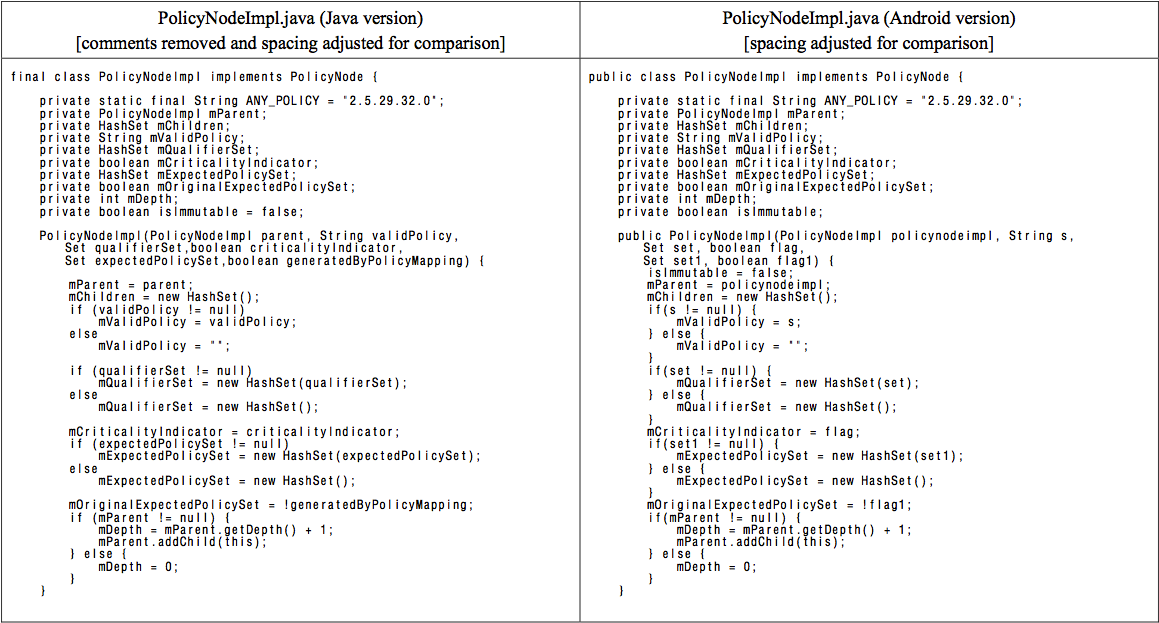
Two of the hypothesis investigated by the ACCU experiment were, 1) within aggregate types (e.g., structs or classes) members having the same type tend to be placed together (e.g., all the chars followed by all the ints followed by all the floats), and 2) the relative ordering of members follows the order of the corresponding items in the specification (e.g., if the specification documents the date and then the location and this information occurs within the same structure the corresponding date member will appear before the location member).
The first hypothesis was investigated by analyzing C source and found that members having the same type are very likely to be grouped together. Looking at the private definitions in the Oracle code we see that members having a HashSet or boolean type are not grouped together with other members of the same type; one possibility was that the class grew over time and new members were appended rather than intermixed with members already present. The corresponding Google code also has the HashSet or boolean intermixed with members having different types. At least one implementation exists where members having the same type are grouped together.
The second hypothesis was investigated by running an experiment which asked developers to create an API from a specification, with everybody seeing the same specification except the ordering of the information was individually randomized for each developer. The results showed that when creating a struct or class (each subject was allowed to create the API in a language of their choice, with C, C++ and Java actually being used) developers tended to list members in the same relative order as the information appeared in the specification.
If the Apache implementors of the code used by Google based their specification on the Oracle code, it is to be expected that the ordering of the members would be very similar, which is it.
There has been a lot of talk of clean room implementation being used for the Java-like code within Dalvik. Did somebody sit down and write a specification of the Oracle PolicyNode class that was then given to somebody else to implement?
The empirical evidence (i.e., members having the same type are not adjacent but intermixed with other types and relative member ordering is the same) suggests that the implementation of at least the private members of the PolicyNode class being used by Google was based directly on the Oracle code.
These members are defined to be private so Google cannot argue that they are part of an API (various people are claiming that being part of an API has some impact on copyright, I have no idea if this is true).
Can Google get around any copyright issue simply by reordering the member definitions? I have no idea.
It would appear that like the patent lawsuit this copyright lawsuit could prove to be very interesting to watch.
Language vulnerabilities TR published
ISO has just published the first Technical Report from the Programming Language Vulnerabilities working group (ISO/IEC TR 24772 Information technology — Programming languages — Guidance to avoiding vulnerabilities in programming languages through language selection and use). Having worked on programming language coding guidelines for many years, I was an eager participant during the first few years of this group. Unfortunately, this committee succumbed to an affliction that affects many groups working in this area, a willingness to uncritically include any reasonable sounding proposal that came its way.
Coding guidelines are primarily driven by human factors with implementation issues coming to the fore in some situations and guideline selection involves a cost/benefit trade-off. Early versions of the TR addressed these topics directly. As work progressed many members of WG23 (our official designation is actually ISO/IEC JTC 1/SC 22/WG 23) seemed to want a concrete approach, i.e., an unstructured list of guidelines, rather than a short list of potential problem areas derived by careful analysis.
A major input came from Larry Wagoner’s analysis of fault reports from various sources; he produced a list of the most common problems, and it was generally agreed that these be used as the base from which to derive the general guidelines.
Work began on writing the text to cover the faults listed by Larry, coalescing similar constructs where appropriate. Many of the faults occurred in programs written in C and some attempt was made to generalize the wording to be applicable to other languages (the core guidelines were intended to be language independent).
Over time suggestions were sent to the group’s convener and secretary for consideration (these came from group members and interested outsiders). Unfortunately, many of these proposals were accepted for inclusion without analysing the likelihood of them being a common source of faults in practice or the possibility that use of alternative constructs would be more fault-prone.
Some members of the group were loath to remove text from the draft document if it was decided that the issue discussed was not applicable. This text tended to migrate to a newly created Section 7 “Applications Issues”, a topic outside our scope of work).
The resulting document is a mishmash of guidelines likely to be relevant to real code and others that are little more than platitudes (e.g., ‘Demarcation of Control Flow’ and ‘Structured Programming’) or examples of very specific problems that occasional occur (i.e., not common enough to be worth mentioning such as ‘Enumeration issues’).
I eventually threw up my hands in despair at trying to stem the flow of ‘good’ ideas that kept being added, and stopped being actively involved.
Would I recommend TR 24772 to people? It does contain some very useful material. The material I think should have been culled is generally not bad, it just has a very low value and for most developers is probably not worth spending time on.
Footnote. ISO makes its money from selling standards and does not like to give them away for free. Those of us who work on standards want them to be used and would like them to be freely available. There is a precedent for TRs being made freely available, and hopefully this will eventually happen to TR 24772. In the meantime, there are documents on the WG23 web site that essentially contain all of the actual technical text.
Predictor vs. control metrics
For some time I have been looking for a good example to illustrate the difference between predicting some software attribute and controlling that attribute. A recent study comparing two methods of predicting a person’s height looks like it might be what I am after.
The study compared the accuracy of using information derived from a person’s genes to information on their parents’ height.
If a person is not malnourished or seriously ill while growing, then their genes control how tall they will finish up as an adult. Tinker with the appropriate genes while a person is growing and their final height will be different; tinker after they have reached adulthood and height is unlikely to change,
Around 150 years ago Francis Galton developed a statistical technique that enabled a person’s final adult height to be estimated from their parent’s height. Parent height is a predictor, not a controller, of their children’s height.
A few metrics have been found empirically to correlate with faults in code and a larger number, having no empirical evidence of a correlation, have been proposed as fault ‘indicators’. Unfortunately many software developers and most managers are blind to the saying “correlation does not imply causation”.
I’m sure readers would agree that once a baby is born changes to their parents height has no effect on their final adult height. Following this line of argument we would not expect changing source code to reduce the number of faults predicted by some metric to actually reduce the number of faults (ok, fiddling with the source might result in a fault being spotted and fixed).
The interesting part of the study was the finding that the prediction based on existing knowledge about the genetics of height explained 4-6% of subjects’ sex- and age-adjusted height variance, while Galton’s method based on parent height explained 40%. Today, 60 years after the structure of DNA was discovered our knowledge of what actually controls height is nowhere near as encompassing as an attribute that is purely a predictor.
Today, do we have have a good model of what actually happens when code is written? I think not.
How much time and money is being wasted changing software to improve its fit to predictor metrics rather than control metrics (I have little idea what any of these might be)? I dread to think.
So what if it is undecidable or NP!
An all too frequent refrain I hear when discussing how to solve a problem is “… but it is undecidable” and this is often followed by the statement that it is not worth attempting to solve the problem. Sometimes NP-completeness gets mentioned in the mix of mumbo-jumbo that is talked about this such problems.
Just because a problem is undecidable does not mean that developers should not attempt to write code to solve it. When a problem is undecidable there exists at least one set of inputs for which the algorithm you use cannot be relied on to give a correct answer and however much you rework the algorithm at least one such set of input will always exist (this set of input may change from algorithm to algorithm).
Undecidability theorems do not say anything about what percentage of all possible input sets have this ‘not known if answer is correct’ property. If there are other theorems addressing this question I don’t know about them (and I don’t claim to be an expert or up to date on this topic).
Mathematicians (well at least those working on Zermelo-Fraenkel set theory) spend lots of time trying to find problems that are undecidable and would be overjoyed to find an instance of a problem/dataset where undecidability actually occurred.
Undecidability is an interesting property; however I think educationalists should stop overselling it and give their students some practical advice such as “Don’t worry, these situations are extremely rare and perhaps many orders of magnitude less likely to generate a fault than the traditional fault generation methods.”
NP’ness deals with how execution time grows as the problem input size grows. It is easy to jump to the conclusion that problems known to be in P are ‘good’ and those believed to be in NP are ‘bad’; and that NP problems take so long to solve they are not worth consideration. For small input sets the constant multipliers in the non-polynomial time equation may mean that the actual execution time is acceptable; this is something that requires a bit of experimentation to find out.
Sometimes a NP problem can be solved in an acceptable amount of time.
The reverse situation is also true. While polynomial execution time does not grow as fast as non-polynomial (which could be exponential or worse) execution time, for small input sets the constant multipliers in the polynomial time equation may result in it starting off with a huge overhead, with problem size only becoming a significant factor for very large inputs.
Sometimes P problems cannot be solved in an acceptable amount of time.
Thinking in R: vectors
While I have been using the R language/environment for over five years or so, whenever I needed to do some statistical calculations, until recently I was only a casual user. A few months ago I started to use R in more depth and made a conscious decision to try and do things the ‘R way’.
While it is claimed that R is a functional language with object oriented features these are sufficiently well hidden that the casual user would be forgiven for thinking R was your usual kind of domain specific imperative language cooked up by a bunch of people who had not done this sort of thing before.
The feature I most wanted to start using in an R-like way was vectors. A literal value in R is not a scalar, it is a vector of length 1 and the built-in operators take vector operands and return a vector result, e.g., the result of the multiplication (c is the concatenation operator and in the following case returns a vector of containing two elements)
> c(1, 2) * c(3, 4) [1] 3 8 > |
The language does contain a for-loop and an if-statement, however the R-way is to use the various built-in functions operating on vectors rather than explicit loops.
A problem that has got me scratching my head for a better solution than the one I have is the following. I have a vector of numbers (e.g., 1 7 1 2 9 3 2) and I want to find out how many of each value are contained in the vector (i.e., 1 2, 2 2, 3 1, 7 1, 9 1).
The unique function returns a vector containing one instance of each value contained in the argument passed to it, so that removes duplicates. Now how do I get a count of each of these values?
When two vectors of unequal length are compared the shorter operand is extended (or rather the temporary holding its value is extended) to contain the same number of elements as the longer operand by ‘reusing’ values from the shorter operand (i.e., when indexing reaches the end of a vector the index is reset to the beginning and then moves forward again). This means that in the equality test X == 2 the right operand is extended to be a vector having the number of elements as X, all with the value 2. Some of these comparisons will be true and others false, but importantly the resulting vector can be used to index X, i.e., X[X == 2] returns a vector of 2’s, one for each occurrence of 2 in X. We can use length to obtain the number of elements in a vector.
The following function returns the number of instances of n in the vector X (now you will see why thinking the ‘R way’ needs practice):
num_occurrences = function(n)
   {
   length(X[X == n])  # X is a global variable
} |
My best solution to the counting problem, so far, uses the function lapply, which applies its second argument to every element of its first argument, as follows:
unique_X = unique(X) # I know, real staticians use <- for assignment X_counts = lapply(unique_X, num_occurrences) |
Using lapply feels like a bit of a cheat to me. Ok, the loop is in compiled C code rather than interpreted R code, but an R function is being called for every unique value.
I have been rereading Matter Computational which has gotten me looking for a solution like those in the first few chapters of this book (and which will probably be equally obscure).
Any R experts out there with suggestions for a non-lapply solution?
Oracle/Google ‘Java’ patents lawsuit
At the technical level the Oracle ‘Java’ lawsuit against Google is not really about Java at all. The patents cited in the lawsuit (5,966,702, 6,061,520, 6,125,447, 6,192,476, RE38,104, 6,910,205 and 7,426,720) involve a variety of techniques that might be used in the implementation of a virtual machine supporting JIT compilation for software written in any language; Oracle does not get into the specifics of which parts of Android make use of these patented techniques (Google has not released the Dalvik source code). With regard to the claimed copyright infringement, I have no idea what Oracle claim has been copied; as I understand it Android uses Apache’s Harmony code for its Dalvik VM runtime library, but there is a possibility that it might have used some of Oracle’s gpl’ed code.
No doubt Google’s lawyers will be asking for specific details and once these are provided they have three options: 1) find prior art that invalidates the patent, 2) recode the implementation so it does not infringe the patent or 3) negotiate a license with Oracle.
My only experience in searching for prior art was as an adviser to the Monitoring Trustee appointed by the European Commission in the EU/Microsoft competition court case; Microsoft’s existing patents were handled by a patent lawyer and I looked at some of the non-patented innovations being claimed by Microsoft.
The obvious tool to use in a search for prior art is Google and this worked well for me provided the information was created after the mid to late 1990s. The cut-off date for historical searches seemed to be around 1993 (this all happened before Google Books was released). Other sources of information included old books (I had not moved in 15 years and my book collection had not been culled), computer manuals and one advisor found what he was looking for in some old computer magazines bought on e-bay.
Some claimed innovations appeared so blindingly obvious that it was difficult to believe that anybody would bother mentioning it in a print. Oracle’s patent 6,910,205
“Interpreting functions utilizing a hybrid of virtual and native machine instructions” (actually a continuation of 6,513,156, filed five years earlier in 1997) describes an obvious method of handling the interface between interpreted and JIT compiled code.
My only implementation experience in this area does predate the Oracle patent (I wrote a native code generator for the UCSD Pascal p-code machine in the mid-80s) but the translation occurred before program execution and so is not appropriate prior art. Virtual machines fell out of favor in the late 80s and when they were revived by Java 10 years later I was no longer working on compilers
Fans of Lisp are always claiming that everything was first done by the Lisp community and there were certainly Lisp compilers around in the 1980s, but I’m not sure if any of them worked during program execution.
Of course Groklaw have started following this case. Kodak has shown that it is possible to win in court over Java related patents. The SunOracle/Microsoft Java lawsuit in the late 1990s was a contract dispute and not about patents/copyright, but still about money/control.
I’m not aware of any previous language implementation patent lawsuits that have gone to court. It will be interesting to see how much success Google have in finding prior art and whether it is possible to implement a JVM that does not make use of any of the techniques specified in the Oracle patents (I suspect that they have a few more that they have not yet cited).
Behavior patterns in Colonel Blotto
People look for patterns and expect others to follow patterns of behavior. Some preliminary data from a game of Colonel Blotto run by a group of Cornell University graduate students provides a vivid example of the existence of these behavior patterns.
In the Cornell implementation of the Colonel Blotto game, there are 10 fields and 100 soldiers. A player specifies how many soldiers are posted to each of the 10 fields. Players don’t know what the opposing players will do. In each field the battle is decided by whoever has the most soldiers with equal numbers resulting in a draw. Whoever wins the most battles wins the war.
One possible soldiers per field sequence is 10 10 10 10 10 10 10 10 10 10 and another is 1 11 11 11 11 11 11 11 11 11. The second sequence will lose in the first field, but win the other 9, and therefore win the war. A third sequence is 9 11 12 12 12 12 8 8 8 8 which beats the second sequence but only draws against the first.
The number of ways of placing  indistinguishable soldiers into
  fields is:

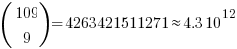
The following original analysis assumes that the soldiers are distinguishable, which they are not and so the number calculated is way too large (thanks to Forbes at The Virtuosi for pointing this out): There are 10 ways of placing the first soldier, 10 ways of placing the second and so on, giving  possible arrangements.
Some arrangements obviously always lose (25 25 25 25 0 0 0 0 0 0) and won’t be played; it seems reasonable to assume that no field will contain zero (I will talk about putting 0 in one field later), so having a field contain 1 is a draw at best. Lets assume that all fields contain at least 2 soldiers, which means we have 80 left to arrange giving  possibilities; a very big drop in possibilities but still a huge number.
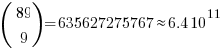
The more soldiers appearing in a field the more likely a win will occur there, but after a while the law of diminishing returns kicks in and losses occurring in understaffed fields will be greater. Lets assume that people decide never to put more than 20 soldiers in a field; how many possibilities does this rule out? If one field initially contains 21 soldiers and the others 2 each the remaining 61 soldiers create  unused possibilities, putting 21 soldiers in the second field generates a bit less than new possibilities; lets round up and say there are a total of
  unused possibilities. Compared to the unused is small enough to be ignored.
is such a big number that Chimpanzees randomly typing away since the dawn of time are unlikely to create any discernible pattern in the landscape.
If the players in this game had given random answers what would be the mean number of points scores and its variance?
Comparing the soldier sequence given by player A against the sequence given by player B produces 11 possible scores, {0, 10}, {1, 9} … {5, 5} … {10, 0}, five of them resulting in a win for A, five in a win for B and one in a draw. With 2 points for a win, 1 point for a draw and 0 points for a loss the expected number of points for each of the two players is 1, so for  players the expected mean of each player is . In a game containing 550 players (the number that had played when I extracted the score results today; 347 had played in the preliminary Cornell data set) we would expect the average score to be 550.
The variance can be calculated from:
![Var(X) = E[X^2] - E[X]^2](https://shape-of-code.com/wp-content/plugins/wpmathpub/phpmathpublisher/img/math_981_10ef7d904d4c247085b083f7a763b015.png "Var(X) = E[X^2] - E[X]^2")
![E[X^2] = (5/11) 0^2 + (1/11) 1^2 + (5/11) 2^2 = 21/11](https://shape-of-code.com/wp-content/plugins/wpmathpub/phpmathpublisher/img/math_981_0c575aade39de873edea4b12e2e88914.png "E[X^2] = (5/11) 0^2 + (1/11) 1^2 + (5/11) 2^2 = 21/11")
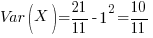
The standard deviation about our mean is 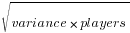 or 22.4.
Plotting a histogram of points scored, at the time of writing, we get the following:
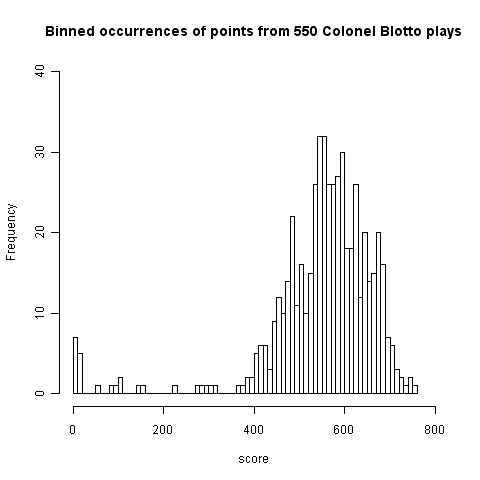
This has a peak at 550 where we would expect it and its width is two standard deviations 🙂 However those ‘side-lobes’ were not expected and they are asymmetric. I think the reason for these unexpected ‘side-lobes’ is that some players give multiple answers, attempting to improve their ranking (some strategy name are suggestive of retries with modified strategies) and consequently decreasing the total points of other players. A search space of sequences is so large that we would not expect players to be able to learn from the results of previously submitted sequences unless many of the previously submitted sequences followed some pattern that they could recognise.
What pattern of behavior might players follow? I can imagine players starting low/high and then shifting to high/low, perhaps following this sequence two or more times.
A preliminary summary of some of the data seen so far by Alex Alemi gave me enough information to figure out a sequence, in three attempts, that ranked 1st (a typo on my part prevented it being on the second attempt); my sequence of player names is averages, aver_p6, low_high_dip, followed by a bit of tuning: low_high_dipish, lohilohi_slide, followed by two experiments: the_well, heat_map, and user fooly started getting close and I tuned the sequence a bit more lohilohi_sliiide.
I used the sequences from the top 25 ranked players for my analysis and did not make any attempt to deduce other player patterns. My first attempt averaged the number of soldiers in each field, ranked 62nd as I write (aver_p6). Then I spotted that several distribution patterns existed, I picked what looked like the most promising and averaged over it (by eye) to get the then current to number 1 (currently languishing in 8th).
Had I put a bit more thought into things I could also have used the heat map near the bottom of the post (thanks to Alex Alemi for letting me post a copy here; “With Y soldiers in slot X, what percentage of the existing strategies do you beat in slot X.”):
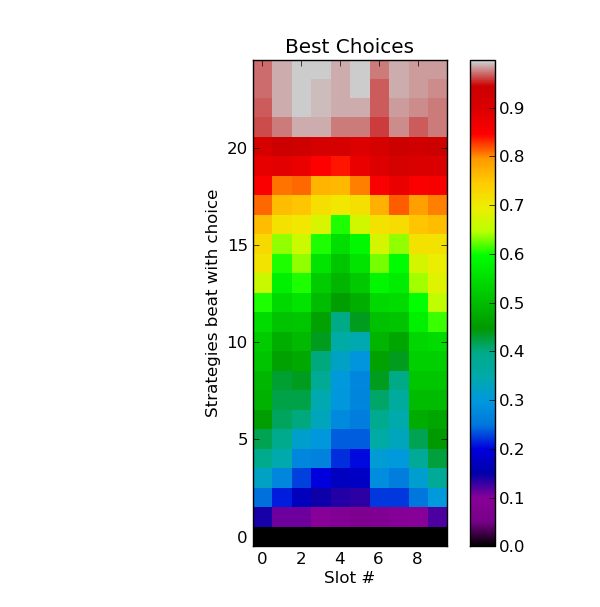
This shows one pattern (in light blue) where players are following the pattern low-high-low-high-low with the second low being very precipitous. The patterns visible in green are more complicated, but still contain a recurring low-high theme.
I know next to nothing about autocorrelation and so do not have any bright ideas about how to use of this data to improve my score. The heat_map sequence (7 8 9 12 15 16 9 11 7 6) attempts to follow the light blue pattern and is ranked 296 as I write, just under half way down the rankings and something to be expected from following an average.
Once a major pattern has been deduced ‘extra’ soldiers will be needed to outnumber the other players most of the time. One option is to be willing to always lose in one field (e.g., the one usually requiring the most soldiers) and use the freed up resources to win elsewhere. I have only made one attempt using this strategy (the_well: 5 6 7 11 19 0 14 20 13 5, ranked 72 as I write).
It is possible that common patterns of behavior are created through reinforcement. Early players create an initial configuration of results and slightly later players attempt to find it, perhaps visualizing a pattern where none actually exists. If enough people follow the same trail they will create the pattern that others can will try to follow. Results from other Colonel Blotto games exhibit a pattern of behavior that is different from the one in the Cornell dataset (I have only seen what is publicly available)
Is unreachable code primarily created by a fault?
Many coding guidelines recommend against the presence of unreachable code in source; the argument being that while the code itself is harmless its presence suggests something has gone wrong somewhere else. As a member of the MISRA C++ coding guidelines committee I unsuccessfully argued against this recommendation being included on the grounds of lack of evidence that unreachable code was a significantly strong indicator of a fault and the complications caused by wanting allow certain kinds of what appeared to be unreachable code (e.g., that used by defensive programming practices).
I was recently reading the PhD thesis of Yichen Xie and found some very interesting analysis of correlation between various kinds of dead code (redundant code was one of the kinds) and faults.
Yichen Xie took a course grained approach to finding a correlation between redundant code and faults. He simply counted the numbers of files that did/did not contain redundant code and the number of corresponding files known to contain what he called a hard bug. The counts were as follows (statistical analysis using the contingency table method gives a probability of well below 0.01 for these values being generated by the null hypothesis):
Hard Bugs Dead Code Yes No Totals Yes 133 135 268 No 418 1369 1787 Totals 551 1504 2055 |
These counts show that if one of the 2,055 files was picked at random the expectation of it containing a Hard Bug is 27%, for one of the files containing unreachable code the expectation is 50% and for files not containing unreachable code it is 23%. So picking a file containing unreachable code almost doubles the expectation of a Hard Bug being found in that file.
These measurements do not attempt to make a connection between the unreachable code contained in a file and any fault contained within that file. How would the counts change if they were based on their being some form of logical connection between the redundant code and the fault? The counts suggest at least a 50% false positive rate, but then faults that generate unreachable code may be the result of high level semantic issues that are less likely to be detected by a casual reading of the source or by static analysis tools.
The hoped for consequence of a coding guideline requiring the removal of unreachable code is that developers analyze the code to understand why the code is unreachable and that in many cases this will result in a fault being uncovered and fixed; the worst case scenario is that they simply delete the unreachable code.
This research has caused me to upgrade the significance I give to unreachable code but I remain unconvinced that the false positive rate is sufficiently low for it to be a worthwhile coding guideline.
Adding negative information to source
An interesting paper on untangling skill and luck in sports and business made the interesting observation that if, for some activity, it is easy to lose on purpose then skill dominates over luck, while if it is difficult to lose on purpose luck dominates over skill.
This got me thinking about skill in software development and how it might be used to ‘loose on purpose’ (I will leave the question of luck in software development to another post).
What does winning and loosing mean in software development? Winning might mean producing a program quickly, cheaply, that is the most efficient or is the most maintainable. I’m not sure that there is much skill involved in being the slowest or most expensive developer to write code, or to create a very inefficient program.
Everybody has ideas about how to write maintainable code (there is generally little or no experimental evidence to back up these ideas) and from time to time joke articles about writing unmaintainable code are written.
There are practical reasons for wanting to create non-maintainable or difficult to comprehend code, for instance to make it difficult for a third party (who might be a customer or black hat) to figure out how a program operates. So called obfuscating transformations are an active area of research and tools are available to transform source and binary; the effectiveness of some techniques for making source difficult to maintain is debatable and obfuscating source may have little impact on the generated binary.
These tools primarily operate by removing information, e.g., rewriting identifiers to meaningless sequences of characters, mapping structured loops to sequences of goto and folding constant expressions. Removing information does not require any skill relating to software maintainability.
I would claim that being able to add negative information to a program is evidence of skill for software maintenance.
Some example of the kinds of negative information I would add include:
- Invented ‘magic’ numbers, i.e., numeric literals that look as if they are derived from an application domain requirement. For instance, a reader of the expression
x*12is likely to assume that12is a constant specific to some aspect of the application; this is an instance where novice developers are trained to invent a symbolic name (e.g.,max_eggs_in_box) to denote the given value. So if the original code contained the expressionx*6I would modify it tox*12and then figure out how to later divide the result by two. Code modified to contain many12s, or other such ‘invented’ constants, is likely to cause readers to waste lots of time head scratching. - Replace identifiers with names that have no semantic connection with the information they contain. Well chosen identifier names can significantly reduce the effort needed to comprehend source and I’m sure that suitable chosen names would help sow lots of confusion. An experiment I ran a few years ago found that developers use identifier names to make decisions about binary operator precedence; lots of scope for creating confusion here!
- I don’t have enough experience to know whether restructuring class hierarchies will have a worthwhile impact on maintainability, developers have learned to handle poorly designed class hierarchies and I am not sure I can make things much worse than they have already encountered.
Adding redundant code is a commonly used technique. To be effective this code would have to modify variables used in the original program, which means that it would have to occur in a condition that is never executed; a constant conditional expression would fool nobody and the condition would have to rely on a variable being tested against a value that could never occur. This requires application knowledge not code maintenance skills.
Compression and encryption (of strings in source and as much code as possible in executables) are other existing techniques that do not involve maintenance related skills.
Shell languages are probably a distinct category of computer language
While reading a book on the Windows PowerShell some of the language design decisions struck me as distinctly odd, if not completely wrong. Thinking about them for a few days I started to appreciate the language designers point of view.
Computer shell languages satisfy a different need and exist within a different culture than ‘programming’ languages. I have been trying to put my finger on what it is about these two language categories that makes them different; the points I have come up with include:
- Little if any declaration of variables in shell languages (also true of scripting languages). Is this because ‘programs’ are expected to be short with few uses of any particular variable, or variables always having a single type, or always being scalar or perhaps the requirement to support an interactive approach to writing programs?
- Existing practice is for the
<and>characters to be used to denote input/output redirection. Using these characters to denote both indirection and the binary less-then/greater-than operations would require some fancy disambiguation rules/analysis. PowerShell uses-lt,-le,-gtand-gefor the relational operators and other shells often use something similar; this usage visually jumps out at people use to thinking of the minus character as denoting the start of a command line option. - Function calls have the syntax of a command line, i.e., any arguments appear in a whitespace separated list to the left of the function/command name (no use of round brackets or comma).
- Shell languages seem to contain many more special case behaviors than 'programming' languages. Perhaps this is because shell languages tend to evolve much more rapidly over time compared to programming languages (ok, Perl is an example of what is generally considered to be a programming language that has evolved a lot and it certainly has plenty of special corner cases).
- Shell languages often include support for checking the initialization status of a variable while most programming languages treat use of an uninitialized variable as having undefined behavior.
- Programming languages are designed to build and manipulate much more complex and larger data structures than are generally handled by shell languages.
While shell languages are invariable interpreted and compiling some of the functionality they support would be very difficult, I don't see this implementation issue as being significant.
Many of the differences highlighted above could also said to apply to scripting languages. Is there a category along the continuum between shell and 'programming' languages where something called a scripting language exists or does the term script imply a usage rather than a recognizable set of design decisions?
Recent Comments