Archive
The complexity of three assignment statements
Once I got into researching my book on C I was surprised at how few experiments had been run using professional software developers. I knew a number of people on the Association of C and C++ Users committee, in particular the then chair Francis Glassborow, and suggested that they ought to let me run an experiment at the 2003 ACCU conference. They agreed and I have been running an experiment every year since.
Before the 2003 conference I had never run an experiment that had people as subjects. I knew that if I wanted to obtain a meaningful result the number of factors that could vary had to be limited to as few as possible. I picked a topic which has probably been the subject of more experiments that any other topics, short term memory. The experimental design asked subjects to remember a list of three assignment statements (e.g., X = 5;), perform an unrelated task that was likely to occupy them for 10 seconds or so, and then recognize the variables they had previously seen within a list and recall the numeric value assigned to each variable.
I knew all about the factors that influenced memory performance for lists of words: word frequency, word-length, phonological similarity, how chunking was often used to help store/recall information and more. My variable names were carefully chosen to balance all of these effects and the information content of the three assignments required slightly more short term memory storage than subjects were likely to have.
The results showed none of the effects that I was expecting. Had I found evidence that a professional software developer’s brain really did operate differently than other peoples’ or was something wrong with my experiment? I tried again two years later (I ran a non-memory experiment the following year while I mulled over my failure) and this time a chance conversation with one of the subjects after the experiment uncovered one factor I had not controlled for.
Software developers are problem solvers (well at least the good ones are) and I had presented them with a problem; how to remember information that appeared to require more storage than available in their short term memories and accurately recall it shortly afterwards. The obvious solution was to reduce the amount of information that needed to be stored by simply remembering the first letter of every variable (which one of the effects I was controlling for had insured was unique) not the complete variable name.
I ran another experiment the following year and still did not obtain the expected results. What was I missing now? I don’t know and in 2008 I ran a non-memory based experiment. I still have no idea what techniques my subjects are using to remember information about three assignment statements that are preventing me getting the results I expect.
Perhaps those researchers out there that claim to understand the processes involved in comprehending a complete function definition can help me out by explaining the mental processes involved in remembering information about three assignment statements.
Code generation via machine learning
Commercial compiler implementors have to produce compilers that are capable of being used on a typical developer computer. A whole bunch of optimization techniques were known for years but could not be used because few computers had the available memory capacity (in the days when 2M was a lot of memory your author once attended a talk that presented some impressive results and was frustrated to learn that the typical memory footprint was 160M, who would ever imagine developers having so much memory to work within?) These days the available of gigabytes of storage has means that likely computer storage capacity is rarely a reason not to use some optimization technique, although the whole program optimization people are still out in the cold.
What is new these days is the general availability of multiple processors. The obvious use of multiple processors is to have make distribute the compilation load. The more interesting use is having the compiler apply different sets of optimizations techniques on different processors, picking the one that produces the highest quality code.
Optimizing code generation algorithms don’t appear to leave anything to chance and individually they generally don’t. However, selecting an order in which to apply individual optimization algorithms is something of a black art. In some cases code transformations made by one algorithm can interfere with the performance of another algorithm. In some cases the possibility of the interference is known and applies in one direction, choosing the appropriate relative ordering of the two algorithms solves the problem. In other cases the way in which two algorithms interfere with each other depends on the code being translated, now the ordering of the two algorithms becomes problematic. The obvious solution is to try both orderings and pick the one that produces the best result.
Several research groups have investigated the use of machine learning in compiler optimization. cTuning.org is a new project that aims to bring together groups interested in self-tuning adaptive computing systems based on statistical and machine learning techniques.
Commercial pressure is always forcing compiler implementors to produce faster code and use of machine learning techniques can produce some impressive results. Now that multi-processor systems are common it will not be long before compilers writers start to make use of the extra resources now available to them.
The safety critical people have problems trying to show the correctness of compiler output that has been generated by ‘fixed’ algorithms. It is not hard to envisage that in 10 years time all large production quality compilers will be using machine learning.
Finding the ‘minimum’ faulty program
A few weeks ago I received an inquiry about running a course/workshop on compiler writing. This does not does not happen very often and it reminded me that many years ago the ACCU asked if I would run a mentored group on compiler writing, I was busy writing a book at the time. The inquiry got me thinking it would be fun to run a compiler writing mentored group over a 6-9 month period and I emailed the general ACCU reflector asking if anybody was interested in joining such a group (any reader wanting to join the group has to be a member of the ACCU).
Over the weekend I had a brainwave for a project, automatic compiler test generation coupled with a program source code minimizer (I need a better name for this bit). Automatic test generation sounds great in theory but in practice whittling down the source code of those programs that result in a fault being exhibited, to create a usable sized test case that is practical for debugging purposes can be a major effort. What is needed is a tool to automatically do the whittling, i.e., a test case minimizer.
A simple algorithm for whittling down the source of a large test program is to continually throw away that half/third/quarter of the code that is not needed for the fault to manifest itself. A compiler project that took as input source code, removed half/third/quarter of the code and generated output that could be compiled and executed is realistic. The input/reduce/output process could be repeated until the generated source was considered to have reached some minima. Ok, this will soak up some cpu time, but computers are cheap and people are expensive.
Where does the test source code come from? Easy, it is generated from the same yacc grammar that the compiler, written by the mentored group member, uses to parse its input. Fortunately such a generation tool is available and ready to use.
The beauty is using the same grammar to generate tests and parse input. This means there is no need to worry about which language subset to use initially and support for additional language syntax can be added incrementally.
Experience shows that automatically generated test programs quickly uncover faults in production compilers, even when working with language subsets. Compiler implementors are loath to spend time cutting down a large program to find the statement/expression where the fault lies, this project will produce a tool that does the job for them.
So to recap, the mentored group is going to write one or more automatic source code generators that will be used to stress test compilers written by other people (e.g., gcc and Microsoft). Group members will also write their own compiler that reads in this automatically generated source code, throws some of it away and writes out syntactically/semantically correct source code. Various scripts will be be written to glue this all together.
Group members can pick the language they want to work with. The initial subset could just include supports for integer types, if-statements and binary operators.
If you had trouble making any sense all this, don’t join the group.
A fault in the C Standard or existing compilers?
Software is not the only entity that can contain faults. The requirements listed in a specification are usually considered to be correct, almost by definition. Of course the users of software implementing a specification may be unhappy with the behavior specified and wish that some alternative behavior occurred. A cut and dried fault occurs when two requirements conflict with each other.
The C Standard can be read as a specification for how C compilers should behave. Despite over 80 man years of effort and the continued scrutiny of developers over 20 years, faults continue to be uncovered. The latest potential fault (it is possible that the fault actually occurs in many existing compilers rather than the C Standard) was brought to my attention by Al Viro, one of the Sparse developers.
The issue involved the following code (which I believe the standard considers to be strictly conforming, but all the compilers I have tried disagree):
int (*f(int x))[sizeof x]; // A prototype declaration int (*g(int y))[sizeof y] // A function definition { return 0; } |
These function declarations are unusual in that their return type is a pointer to an array of integers, a type rarely encountered in this context (the original question involved a return type of pointer to function returning … and was more complicated).
The specific issue was the scope of the parameter (i.e., x and y), is the declaration still in scope at the point that the second occurrence of the identifier is encountered?
As a principle I think that the behavior, whatever it turns out to be, should be the same in both cases (neither the C standard or its rationale state such a principle).
Taking the function prototype case first:
The scope of the parameter x “… terminates at the end of the function declarator.” (sentence 409).
and does function prototype scope include the return type (the syntax calls the particular construct a declarator and there are at least two of them, one nested inside the other, in a function prototype declaration)?
Sentence 1592 says Yes, but sentence 279 and 1845 say No.
None of these references are normative references (standardize for definitive).
Moving on to the function definition case:
Where does the scope of the parameter x begin (sentence 418)?
“… scope that begins just after the completion of its declarator.”
and where does the scope end (sentence 408)?
“… which terminates at the end of the associated block.”
and what happens between the beginning and ending of the scope (sentence 412)?
“Within the inner scope, the identifier designates the entity declared in the inner scope;”
This looks very straight forward, there are no ‘gaps’ in the scope of the parameter definition appearing in a function definition. Consistency with the corresponding function prototype case requires that function declarator be interpreted to include the return type.
There is a related discussion involving a previous Defect Report 345 submitted a while ago.
The problem is that many existing compilers do not treat parameter scope in this way. They operate as-if there was a ‘gap’ in the parameter scope of function definition (probably because the code implementing this functionality is shared with that implementing function prototypes, which have been interpreted to not include the return type).
What happens next? Probably lots of discussion on the C Standard email reflector. Possible outcomes include somebody finding wording that requires a ‘gap’ in the scope of parameters in function definitions, it agreed that such a gap ought to be specified by the standard (because this is how existing code behaves because this is how compilers operate), or that the standard is correct as is and any compiler that behaves differently needs to be fixed.
Using local context to disambiguate source
Developers can often do a remarkably good job of figuring out what a snippet of code does without seeing (i.e., knowing anything about) most of the declarations of the identifiers involved. In a previous post I discussed how frequency of occurrence information could be used to help parse C without using a symbol table. Other information that could be used is the context in which particular identifiers occur. For instance, in:
f(x); y = (f)z; |
while the code f(x); is probably a function call, the use of f as the type in a cast means that f(x) is actually a definition an object x having type f.
A project investigating the analysis of partial Java programs uses this context information as its sole means of disambiguating Java source (while they do build a symbol table they do not analyze the source of any packages that might be imported). Compared to C Java parsers have it easy, but Java’s richer type system means that semantic analysis can be much more complicated.
On a set of benchmarks the researchers obtained a very reasonable 91.2% accuracy in deducing the type of identifiers.
There are other kinds of information that developers probably use to disambiguate source: the operation that the code is intended to perform and the identifier names. Figuring out the ‘high level’ operation that code performs is a very difficult problem, but the names of Java identifiers have been used to predict object lifetime and appear to be used to help deduce operator precedence. Parsing source by just looking at the identifiers (i.e., treating all punctuators and operators as whitespace) has been on my list of interesting project to do for some time, but projects that are likely to provide a more immediate interesting result keep getting in the way.
Measuring developer coding expertise
A common measure of developer experience is the number of years worked. The only good that can be said about this measure is that it is easy to calculate. Studies of experts in various fields have found that acquiring expertise requires a great deal of deliberate practice (10,000 hours is often quoted at the amount of practice put in by world class experts).
I think that coding expertise is acquired by reading and writing code, but I have little idea of the relative contributions made by reading and writing and whether reading the same code twice count twice or is there a law of diminishing returns on rereading code?
So how much code have developers read and written during their professional lives? Some projects have collected information on the number of ‘delivered’ lines of code written by developers over some time period. How many lines does a developer actually write for every line delivered (some functions may be rewritten several times while others may be deleted without every being making it into a final delivery)? Nobody knows. As for lines of code read, nobody has previously expressed an interest in collecting this kind of information.
Some experiments, involving professional developers, I have run take as their starting point that developer performance improves with practice. Needing some idea of the amount of practice my subjects have had reading and writing code I asked them to tell me how much code they think they have read and written, as well as the number of years they have worked professionally in software development.
The answers given by my subjects were not very convincing:
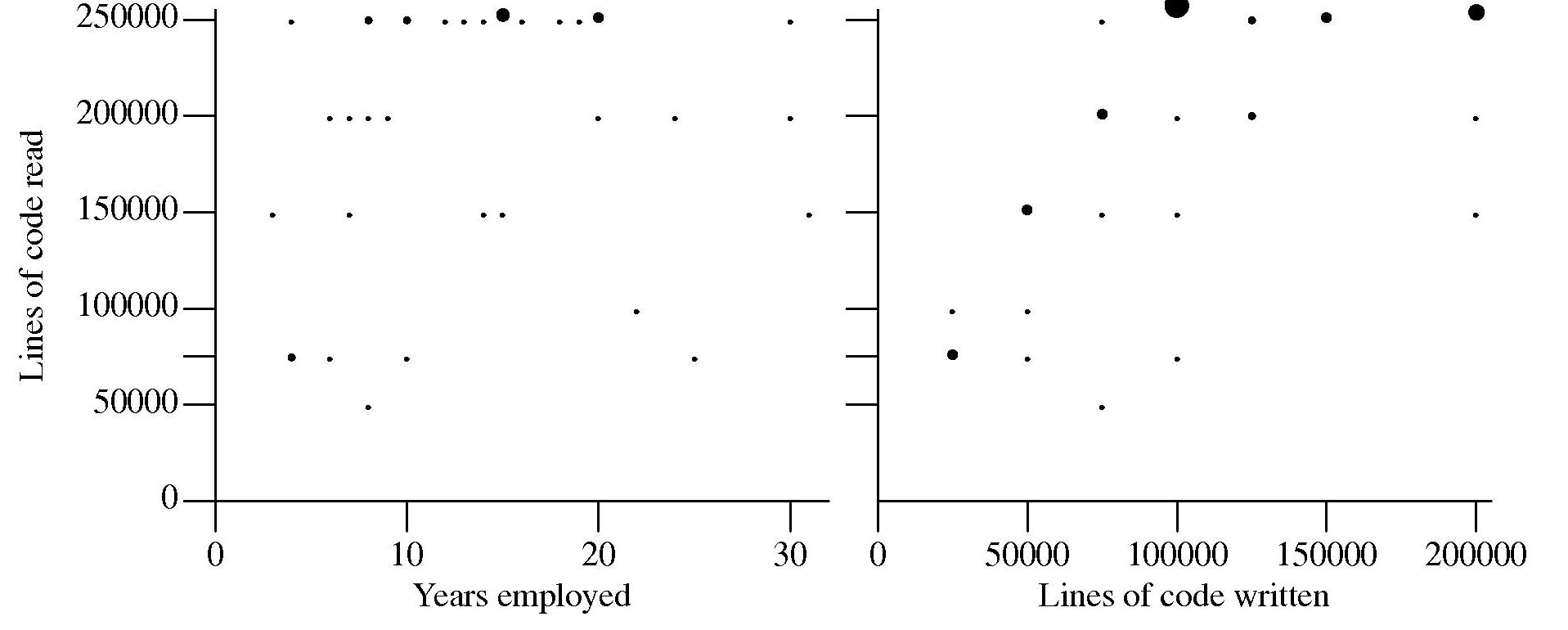
Estimates of the ratio code read/written varied by more than five to one (the above graph suffers from a saturation problem for lines of code read, I had not provided a tick box that was greater than 250,000). I cannot complain, my subjects volunteered part of their lunch time to take part in an experiment and were asked to answer these questions while being given instructions on what they were being asked to do during the experiment.
I have asked this read/written question a number of times and received answers that exhibit similar amounts of uncertainty and unlikeliness. Thinking about it I’m not sure that giving subjects more time to answer this question would improve the accuracy of the answers. Very few developers monitor their own performance. The only reliable way of answering this question is by monitoring developer’s eye movements as they interact with code for some significant duration of time (preferably weeks).
Unobtrusive eye trackers may not be sufficiently accurate to provide a line-of-code level of resolution and the more accurate head mounted trackers are a bit intrusive. But given their price more discussion on this topic is currently of little value 🙁
The probability of encountering a given variable
If I am reading through the body of a function, what is the probability of a particular variable being the next one I encounter? A good approximation can be calculated as follows: Count the number of occurrences of all variables in the function definition up to the current point and work out the percentage occurrence for each of them, the probability of a particular variable being seen next is approximately equal to its previously seen percentage. The following graph is the evidence I give for this approximation.
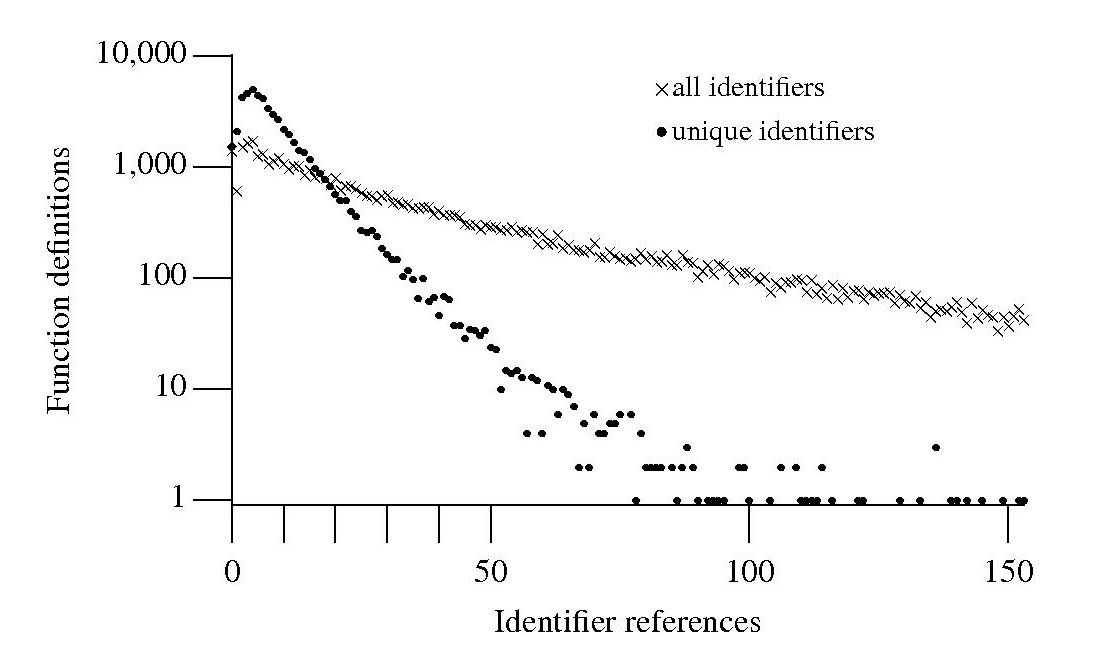
The graph shows a count of the number of C function definitions containing identifiers that are referenced a given number of times, e.g., if the identifier x is referenced five times in one function definition and ten times in another the function definition counts for five and ten are both incremented by one. That one axis is logarithmic and the bullets and crosses form almost straight lines hints that a Zipf-like distribution is involved.
There are many processes that will generate a Zipf distribution, but the one that interests me here is the process where the probability of the next occurrence of an event occurring is proportional to the probability of it having previously occurred (this includes some probability of a new event occurring; follow the link to Simon’s 1955 paper).
One can think of the value (i.e., information) held in a variable as having a given importance and it is to be expected that more important information is more likely to be operated on than less important information. This model appeals to me. Another process that will generate this distribution is that of Monkeys typing away on keyboards and while I think source code contains lots of random elements I don’t think it is that random.
The important concept here is operated on. In x := x + 1; variable x is incremented and the language used requires (or allowed) that the identifier x occur twice. In C this operation would only require one occurrence of x when expressed using the common idiom x++;. The number of occurrences of a variable needed to perform an operation on it, in a given languages, will influence the shape of the graph based on an occurrence count.
One graph does not provide conclusive evidence, but other measurements also produce straightish lines. The fact that the first few entries do not form part of an upward trend is not a problem, these variables are only accessed a few times and so might be expected to have a large deviation.
More sophisticated measurements are needed to count operations on a variable, as opposed to occurrences of it. For instance, few languages (any?) contain an indirection assignment operator (e.g., writing x ->= next; instead of x = x -> next;) and this would need to be adjusted for in a more sophisticated counting algorithm. It will also be necessary to separate out the effects of global variables, function calls and the multiple components involved in a member selection, etc.
Update: A more detailed analysis is now available.
Using third party measurement data
Until today, to the best of my knowledge, all the source code analysis papers I have read were written by researchers who had control of the code analysis tools they used and had some form of localised access to the source. By control of the code analysis tools I mean that the researchers specified the tool options and had the ability to check the behavior of the tool, in many cases the source of the tool was available to them and often even written by them, and the localised access may have involved downloading lots of code from the web.
I have just been reading about a broad brush analysis of comment usage based on data provided by a commercial code repository that offers API access to some basic code metrics.
At first, I was very frustrated by the lack of depth to the analysis provided in the paper, but then I realised that the authors’ intent was to investigate a few broad ideas about comment usage in a large number of projects (around 10,000). The authors complained in their blog about some of the referees comments and having to submit a shorter paper. I can see where the referees are coming from, the papers are lacking in depth of analysis, but they do contain some interesting results.
I was very interested in Figure 2:
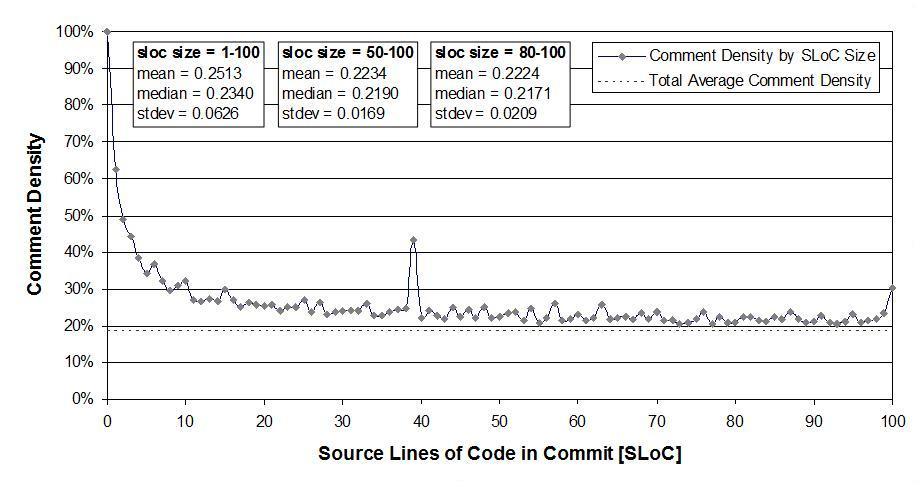
which plots the comment density of the lines in a source code commit. I would expect the ratio to be higher for small commits because a developer probably has a relatively fixed amount to say about updates involving a smallish number of lines (which probably fixes a problem). Larger commits are probably updated functionality and so would have a comment density similar to the ‘average’.
The problem with relying on third parties to supply the data is that obtaining the answers to follow up questions invariably involves lots of work, e.g., creating an environment to perform the measurements needed for the follow-up questions. However, the third party approach can significantly reduce the amount of work needed to get to a point where the interestingness of the results can be gauged.