Archive
How many ways of programming the same specification?
How many different ways are there of writing a program to implement a given specification? Non-trivial specifications probably have an enormous number of possible programming solutions. What about really simple specifications, say something based on the 3n+1 problem (write a programs that takes a list of integers and outputs their ‘3n+1’ length; ‘3n+1’ length algorithm: for integer  , if is even divide it by
  and assign the result to , otherwise is odd, multiply it by
  and add
  to give the new value of ; repeat the process, counting the number of iterations until reaches )?.
I can think of a dozen or so (slightly) different ways that I might write a program to solve this problem. If I really had to I could probably come up with a few hundred different solutions, but I think the source code of these programs would not look like something I would normally write. If I was to run a competition how many different answers might I get? If you twisted my arm I might have said 500. What do you think?
Meine van der Meulen studied the N-version programing for his PhD thesis (N groups independently write a program to the same specification, compare the output of the N programs and select the ‘best’ answer; cannot find a copy of the thesis online). This was empirical work and van der Meulen posted the above 3n+1 problem to a programming competition website and used the 95,497 submitted solutions for his analysis; he also kindly sent me a copy of the solutions (11,674 solutions were written in Pascal, the rest were in C).
Not all the solutions correctly solve the problem. I ignored this ‘detail’. There are also many duplicates (as in identical source code).
I am interested in differently coded solutions. I defined different as the sequence of operators/punctuators making up the program being different (or at least having a different MD5 checksum), so identifiers and comments are ignored. Should permutations in the order of independent adjacent statements really be counted as different? For the sack of keeping my life simple they current are. This definition of differently coded reduces the original 63,823 C programs down to 6,301. Wow, how are 6k+ different programs possible?
The original specification did not mention performance, but lots of developers did all sorts of weird and wonderful stuff to improve runtime performance. The most common optimization technique used (apart from some inventive ways of checking for odd/even) was to cache previous answers along with the solution for all the intermediate steps that were passed through on the way to 1 (the path from the starting value to 1 is very erratic and sometimes goes through values greater than the starting value) and check this cache to see whether it contains the current value of.
A common measure of program size is lines of code. What is the size distribution, in LOC, for these 6,301 programs? One program has been labeled an outlier and excluded from the analysis (most of its 8,345 lines were taken up with initializing a data structure with precomputed solutions).
The following plots lines of code against the number of programs containing that many lines (download code and data).
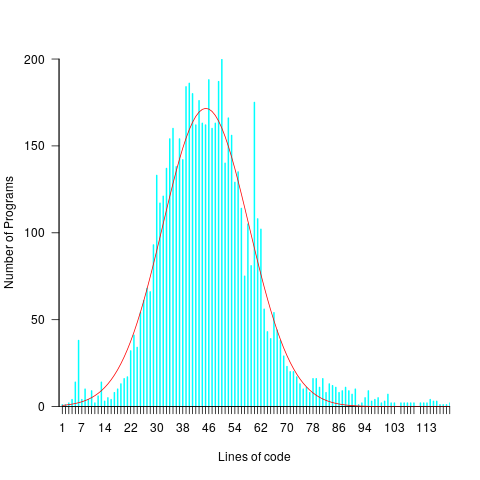
The mean program length is 46.3 lines, standard deviations 15.4. The red curve is a Normal distribution whose mean/sd has been tweaked to give a better visual fit (a Shapiro-Wilk test dispels any hope tht the distribution might be Normal). There is no reason to think that the data will be fitted by any known distribution and I’m not going to overfit on one data-point. If pushed I will wave my arms and describe the distribution as Normalish with added spikes and a fat right tail.
That spike around 60 lines is interesting. Is this group of solutions all doing the same thing but with different statement orderings? I have previously written about how gcc/llvm do a good job of turning the core of the algorithm into the same machine code. Perhaps a future version of these compilers will be able to tell us whether the programs clumping around 60 LOC are doing the same thing.
How widely used is a language?
How widely used is a language? Nobody really knows and since there is nothing anybody can do to control usage (both IBM and the US DOD have tried) the question is probably of only academic interest.
Languages are used in a variety of ways and contexts, and it is possible that while one language currently occupies the greatest number of programmer hours, a different one has the greatest number of lines of code ever written in it, another the greatest number of lines of code currently in existence, and a fourth utilize the most CPU time.
Some languages are very popular for particular kinds of applications or within industries. For example, COBOL is still strong in corporate data centers; Fortran in engineering applications; C in embedded applications and operating systems; C++ and Java for writing desktop applications; Perl, PHP, etc. for web based applications.
There are various methods of measuring language popularity, each subject to a different bias over what is measured, that might be used, including:
- counting the number of job advertisements that mention the language. Money counts, so this may be a solid indicator. However, beware, companies like to paint a rosy picture and sometimes mention languages they don’t use just to attract people to apply for the job.
- measuring the financial value of companies making a living through selling tools for a particular language. As an ex-compiler writer I know that compared to applications software, compilers make very little money (compiler companies invariably go bust or get bought by a hardware vendor looking for leverage). Microfocus is the only (primarily) compiler based company to have grown to a significant size and exist independently for a long period of time
- the number of books sold that teach or describe the language. This will be biased towards the more recently popular languages.
- estimates of the number of existing lines of code written in the language—which will underestimate languages not often found in public searches, e.g., there is very little Cobol source available on the web (is this because the kind of people who write Cobol are not the kind to make it publicly available or are the applications so specialized that web distribution is not considered worthwhile?)
- counts of language references (i.e., to the name of the language) found using a web search engine.
Some of the above material exists in a section of a Wikipedia article I wrote some time ago.
Recent Comments