Archive
Programming Languages: nothing changes
While rummaging around today I came across: Programming Languages and Standardization in Command and Control by J. P. Haverty and R. L. Patrick.
Much of this report could have been written in 2013, but it was actually written fifty years earlier; the date is given away by “… the effort to develop programming languages to increase programmer productivity is barely eight years old.”
Much of the sound and fury over programming languages is the result of zealous proponents touting them as the solution to the “programming problem.”
I don’t think any major new sources of sound and fury have come to the fore.
… the designing of programming languages became fashionable.
Has it ever gone out of fashion?
Now the proliferation of languages increased rapidly as almost every user who developed a minor variant on one of the early languages rushed into publication, with the resultant sharp increase in acronyms. In addition, some languages were designed practically in vacuo. They did not grow out of the needs of a particular user, but were designed as someone’s “best guess” as to what the user needed (in some cases they appeared to be designed for the sake of designing).
My post on this subject was written 49 years later.
…a computer user, who has invested a million dollars in programming, is shocked to find himself almost trapped to stay with the same computer or transistorized computer of the same logical design as his old one because his problem has been written in the language of that computer, then patched and repatched, while his personnel has changed in such a way that nobody on his staff can say precisely what the data processing Job is that his machine is now doing with sufficient clarity to make it easy to rewrite the application in the language of another machine.
Vendor lock-in has always been good for business.
Perhaps the most flagrantly overstated claim made for POLs is that they result in better understanding of the programming operation by higher-level management.
I don’t think I have ever heard this claim made. But then my programming experience started a bit later than this report.
… many applications do not require the services of an expert programmer.
Ssshh! Such talk is bad for business.
The cost of producing a modern compiler, checking it out, documenting it, and seeing it through initial field use, easily exceeds $500,000.
For ‘big-company’ written compilers this number has not changed much over the years. Of course man+dog written compilers are a lot cheaper and new companies looking to aggressively enter the market can spend an order of magnitude more.
In a young rapidly growing field major advances come so quickly or are so obvious that instituting a measurement program is probably a waste of time.
True.
At some point, however, as a field matures, the costs of a major advance become significant.
Hopefully this point in time has now arrived.
Language design is still as much an art as it is a science. The evaluation of programming languages is therefore much akin to art criticism–and as questionable.
Calling such a vanity driven activity an ‘art’ only helps glorify it.
Programming languages represent an attack on the “programming problem,” but only on a portion of it–and not a very substantial portion.
In fact, it is probably very insubstantial.
Much of the “programming problem” centers on the lack of well-trained experienced people–a lack not overcome by the use of a POL.
Nothing changes.
The following table is for those of you complaining about how long it takes to compile code these days. I once had to compile some Coral 66 on an Elliot 903, the compiler resided in 5(?) boxes of paper tape, one box per compiler pass. Compilation involved: reading the paper tape containing the first pass into the computer, running this program and then reading the paper tape containing the program source, then reading the second paper tape containing the next compiler pass (there was not enough memory to store all compiler passes at once), which processed the in-memory output of the first pass; this process was repeated for each successive pass, producing a paper tape output of the compiled code. I suspect that compiling on the machines listed gave the programmers involved plenty of exercise and practice splicing snapped paper-tape.
Computer Cobol statements Machine instructions Compile time (mins) UNIVAC II 630 1,950 240 RCA 501 410 2,132 72 GE 225 328 4,300 16 IBM 1410 174 968 46 NCR 304 453 804 40 |
What is empirical software engineering?
Writing a book about empirical software engineering requires making decisions about which subjects to discuss and what to say about them.
The obvious answer to “which subjects” is to include everything that practicing software engineers do, when working on software systems; there are some obvious exclusions like traveling to work. To answer the question of what software engineers do, I have relied on personal experience, my own and what others have told me. Not ideal, but it’s the only source of information available to me.
The foundation of an empirical book is data, and I only talk about subjects for which public data is available. The data requirement is what makes writing this book practical; there is not a lot of data out there. This lack of data has allowed me to avoid answering some tricky questions about whether something is, or is not, part of software engineering.
What approach should be taken to discussing the various subjects? Economics, as in cost/benefit analysis, is the obvious answer.
In my case, I am a developer and the target audience is developers, so the economic perspective is from the vendor side, not the customer side (e.g., maximizing profit, not minimizing cost or faults). Most other books have a customer oriented focus, e.g., high reliability is important (with barely a mention of the costs involved); this focus on a customer oriented approach comes from the early days of computing where the US Department of Defense funded a lot of software research driven by their needs as a customer.
Again the lack of data curtails any in depth analysis of the economic issues involved in software development. The data is like a patchwork of islands, the connections between them are under water and have to be guessed at.
Yes, I am writing a book on empirical software engineering that contains the sketchiest of outlines on what empirical software engineering is all about. But if the necessary data was available, I would not live long enough to get close to completing the book.
What of the academic take on empirical software engineering? Unfortunately the academic incentive structure strongly biases against doing work of interest to industry; some of the younger generation do address industry problems, but they eventually leave or get absorbed into the system. Academics who spend time talking to people in industry, to find out what problems exist, tend to get offered jobs in industry; university managers don’t like loosing their good people and are incentivized to discourage junior staff fraternizing with industry. Writing software is not a productive way of generating papers (academics are judged by the number and community assessed quality of papers they produce), so academics spend most of their work time babbling in front of spotty teenagers; the result is some strange ideas about what industry might find useful.
Academic software engineering exists in its own self-supporting bubble. The monkeys type enough papers that it is always possible to find some connection between an industry problem and published ‘research’.
Warp your data to make it visually appealing
Data plots can sometimes look very dull and need to be jazzed up a bit. Now, nobody’s suggesting that the important statistical properties of the data be changed, but wouldn’t it be useful if the points could be moved around a bit, to create something visually appealing without losing the desired statistical properties?
Readers have to agree that the plot below looks like fun. Don’t you wish your data could be made to look like this?

Well, now you can (code here, inspired by Matejka and Fitzmaurice who have not released their code yet). It is also possible to thin-out the points, while maintaining the visual form of the original image.
The idea is to perturb the x/y position of very point by a small amount, such that the desired statistical properties are maintained to some level of accuracy:
check_prop=function(new_pts, is_x)
{
if (is_x)
   return(abs(myx_mean-stat_cond(new_pts)) < 0.01)
else
   return(abs(myy_mean-stat_cond(new_pts)) < 0.01)
}


mv_pts=function(pts)
{
repeat
   {
   new_x=pts$x+runif(num_pts, -0.01, 0.01)
   if (check_prop(new_x, TRUE))
      break()
   }

repeat
   {
   new_y=pts$y+runif(num_pts, -0.01, 0.01)
   if (check_prop(new_y, FALSE))
      break()
   }

return(data.frame(x=new_x, y=new_y))
} |
The distance between the perturbed points and the positions of the target points then needs to be calculated. For each perturbed point its nearest neighbor in the target needs to be found and the distance calculated. This can be done in  using kd-trees and of course there is an R package, RANN, do to this (implemented in the
 nn2 function). The following code tries to minimize the sum of the distances, another approach is to minimize the mean distance:
mv_closer=function(pts)
{
repeat
   {
   new_pts=mv_pts(pts)
   new_dist=nn2(rabbit, new_pts, k=1)
   if (sum(new_dist$nn.dists) < cur_dist)
      {
      cur_dist <<- sum(new_dist$nn.dists)
      return(new_pts)
      }
   }

} |
Now it’s just a matter of iterating lots of times, existing if the distance falls below some limit:
iter_closer=function(tgt_pts, src_pts)
{
cur_dist <<- sum(nn2(tgt_pts, src_pts, k=1)$nn.dists)
cur_pts=src_pts
for (i in 1:5000)
   {
   new_pts=mv_closer(cur_pts)
   cur_pts=new_pts
   if (cur_dist < 13)
      return(cur_pts)
   }
return(cur_pts)
} |
This code handles a single statistical property. Matejka and Fitzmaurice spent more than an hour on their implementation, handle multiple properties and use simulated annealing to prevent being trapped in local minima.
An example, with original points in yellow:
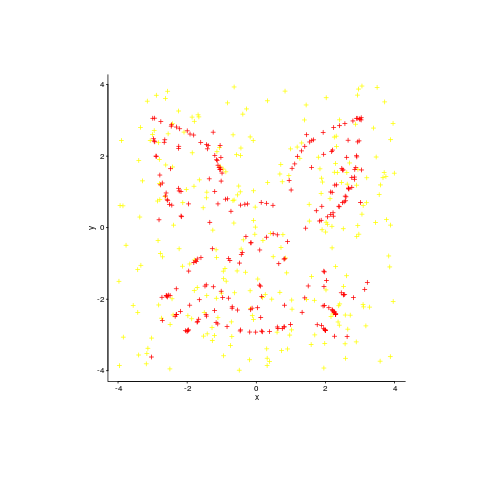
Enjoy.
Array bound checking in C: the early products
Tools to support array bound checking in C have been around for almost as long as the language itself.
I recently came across product disks for C-terp; at 360k per 5 1/4 inch floppy, that is a C compiler, library and interpreter shipped on 720k of storage (the 3.5 inch floppies with 720k and then 1.44M came along later; Microsoft 4/5 is the version of MS-DOS supported). This was Gimpel Software’s first product in 1984.
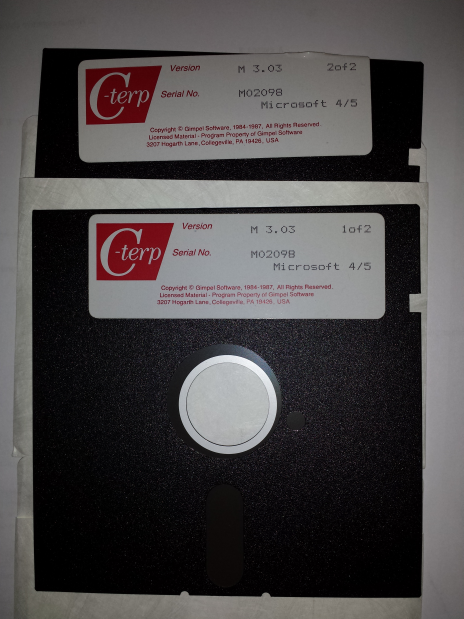
The Model Implementation C checker work was done in the late 1980s and validated in 1991.
Purify from Pure Software was a well-known (at the time) checking tool in the Unix world, first available in 1991. There were a few other vendors producing tools on the back of Purify’s success.
Richard Jones (no relation) added bounds checking to gcc for his PhD. This work was done in 1995.
As a fan of bounds checking (finding bugs early saves lots of time) I was always on the lookout for C checking tools. I would be interested to hear about any bounds checking tools that predated Gimpel’s C-terp; as far as I know it was the first such commercially available tool.
Hedonism: The future economics of compiler development
In the past developers paid for compilers, then gcc came along (followed by llvm) and now a few companies pay money to have a bunch of people maintain/enhance/support a new cpu; developers get a free compiler. What will happen once the number of companies paying money shrinks below some critical value?
The current social structure has an authority figure (ISO committees for C and C++, individuals or companies for other languages) specifying the language, gcc/llvm people implementing the specification and everybody else going along for the ride.
Looking after an industrial strength compiler is hard work and requires lots of know-how; hobbyists have little chance of competing against those paid to work full time. But as the number of companies paying for support declines, the number of people working full-time on the compilers will shrink. Compiler support will become a part-time job or hobby.
What are the incentives for a bunch of people to get together and spend their own time maintaining a compiler? One very powerful incentive is being able to decide what new language features the compiler will support. Why spend several years going to ISO meetings arguing with everybody about whether the next version of the standard should support your beloved language construct, it’s quicker and easier to add it directly to the compiler (if somebody else wants their construct implemented, let them write the code).
The C++ committee is populated by bored consultants looking for an outlet for their creative urges (the production of 1,600 page documents and six extension projects is driven by the 100+ people who attend meetings; a lot fewer people would produce a simpler C++). What is the incentive for those 100+ (many highly skilled) people to attend meetings, if the compilers are not going to support the specification they produce? Cut out the middle man (ISO) and organize to support direct implementation in the compiler (one downside is not getting to go to Hawaii).
The future of compiler development is groups of like-minded hedonists (in the sense of agreeing what features should be in a language) supporting a compiler for the bragging rights of having created/designed the languages features used by hundreds of thousands of developers.
Average maintenance/development cost ratio is less than one
Part of the (incorrect) folklore of software engineering is that more money is spent on maintaining an application than was spent on the original development.
Bossavit’s The Leprechauns of Software Engineering does an excellent job of showing that the probably source of this folklore did not base their analysis on any cost data (I’m not going to add to an already unwarranted number of citations by listing the source).
I have some data, actually two data sets, each measuring a different part of the problem, i.e., 1) system lifetime and 2) maintenance/development costs. Both sets of measurements apply to IBM mainframe software, so a degree of relatedness can be claimed.
Analyzing this data suggests that the average maintenance/development cost ratio, for a IBM applications, is around 0.81 (code+data). The data also provides a possible explanation for the existing folklore in terms of survivorship bias, i.e., most applications do not survive very long (and have a maintenance/development cost ratio much less than one), while a few survive a long time (and have a maintenance/development cost ratio much greater than one).
At any moment around 79% of applications currently being maintained will have a maintenance/development cost ratio greater than one, 68% a ratio greater than two and 51% a ratio greater than five.
Another possible cause of incorrect analysis is the fact we are dealing with ratios; the harmonic mean has to be used, not the arithmetic mean.
Existing industry practice of not investing in creating maintainable software probably has a better cost/benefit than the alternative because most software is not maintained for very long.
Early compiler history
Who wrote the early compilers, when did they do it, and what were the languages compiled?
Answering these questions requires defining what we mean by ‘compiler’ and deciding what counts as a language.
Donald Knuth does a masterful job of covering the early development of programming languages. People were writing programs in high level languages well before the 1950s, and Konrad Zuse is the forgotten pioneer from the 1940s (it did not help that Germany had just lost a war and people were not inclined to given German’s much public credit).
What is the distinction between a compiler and an assembler? Some early ‘high-level’ languages look distinctly low-level from our much later perspective; some assemblers support fancy subroutine and macro facilities that give them a high-level feel.
Glennie’s Autocode is from 1952 and depending on where the compiler/assembler line is drawn might be considered a contender for the first compiler. The team led by Grace Hopper produced A-0, a fancy link-loader, in 1952; they called it a compiler, but today we would not consider it to be one.
Talking of Grace Hopper, from a biography of her technical contributions she sounds like a person who could be technical but chose to be management.
Fortran and Cobol hog the limelight of early compiler history.
Work on the first Fortran compiler started in the summer of 1954 and was completed 2.5 years later, say the beginning of 1957. A very solid claim to being the first compiler (assuming Autocode and A-0 are not considered to be compilers).
Compilers were created for Algol 58 in 1958 (a long dead language implemented in Germany with the war still fresh in people’s minds; not a recipe for wide publicity) and 1960 (perhaps the first one-man-band implemented compiler; written by Knuth, an American, but still a long dead language). The 1958 implementation sounds like it has a good claim to being the second compiler after the Fortran compiler.
In December 1960 there were at least two Cobol compilers in existence (one of which was created by a team containing Grace Hopper in a management capacity). I think the glory attached to early Cobol compiler work is the result of having a female lead involved in the development team of one of these compilers. Why isn’t the other Cobol compiler ever mentioned? Why is the Algol 58 compiler implementation that occurred before the Cobol compiler ever mentioned?
What were the early books on compiler writing?
“Algol 60 Implementation” by Russell and Randell (from 1964) still appears surprisingly modern.
Principles of Compiler Design, the “Dragon book”, came out in 1977 and was about the only easily obtainable compiler book for many years. The first half dealt with the theory of parser generators (the audience was CS undergraduates and parser generation used to be a very trendy topic with umpteen PhD thesis written about it); the book morphed into Compilers: Principles, Techniques, and Tools. Old-timers will reminisce about how their copy of the book has a green dragon on the front, rather than the red dragon on later, trendier (with less parser theory and more code generation) editions.
Collecting all of the publicly available source code
Collecting together all the software ever written is impossible, but collecting everything that can be found would create something very useful (since I have always been interested in source code analysis, my opinion is biased).
Collecting together source available on the internet is easy. Creating a copy of Github is one of the first actions of anybody with ambitions of collecting lots of source (back in the day it was collecting shareware 5″ 1/4, then 3″ 1/2 floppy discs, then CDs and then DVDs).
The very hard to collect items “exist” on line-printer paper, punched cards, rolls of punched tape and mag tape. These are the items where serious collectors should concentrate their efforts (NASA lost a lot of Voyager data when magnetic particles fell off the plastic strips of tape reels in storage, because the adhesive had degraded).
The Internet Archive is doing a great job of collecting and making available ‘antique’ source code (old computer games is a popular genre; other collectors concentrate on being able to execute ROM images of games), but they are primarily US based.
Collecting the World’s source code requires collection organizations in every country. Collecting old code is a people intensive business and requires lots of local knowledge.
A new source code collection organization has recently been setup in France; the Software Heritage currently aims to collect all software that is publicly available. So far they have done what everybody else does, made a copy of Github and a couple of the well-known source repos.
I hope this organization is not just the French government throwing money at another one-upmanship US vs. France project.
If those involved are serious about collecting source code, rather than enjoying the perks of a tax-funded show project, they will realise that lots of French specific source code is dotted around the country needing to be collected now (before the media decomposes and those who know how to read it die).
Gentleman scientists in software engineering
The Royal Society was formed in 1660 as a “College for the Promoting of Physico-Mathematical Experimental Learning”. A lot of very important research was done by members of this society, who were independently wealthy or held a university post.
For a while now, I have thought that the only way software engineering is going to advance to become a real engineering/scientific discipline is via gentleman scientists (unless industry really does need more clueless button pushers).
I was talking at the LondonR meeting on Tuesday (slides) and got chatting with familiar faces from hackathons. It seems that they had also had ideas for researching particular problems in software engineering, and liked the idea of a group of Gentleman scientists.
The problem we have is that none of us wants to do the organizing (a common problem). We must be able to do better than meeting in a pub.
I think the main qualifications for being a member of the group of Gentleman scientists for the “Promoting of Software Experimental Learning” would be something like:
- enjoying the pleasure of gaining knowledge about how the world works, i.e., no flights of fancy,
- interested in finding answers to questions whose answers are not yet known, i.e., doing real research, not personal learning,
- have the funds to support what you do, i.e., you want funding, you find it,
- being proficient in a necessary skill, i.e., you cannot be a beginner in all the required skills.
If the Danish Gentlemen scientists can send rockets into space, I’m sure the inhabitants of London and surrounds (no nationality restrictions here) can make major discoveries in software engineering (nobody has really found any yet, they are all waiting to be found).
Doing software research is not expensive, in monetary terms. It requires that those involved know something about real-life software issues and have the time and inclination to research possible solutions. People in industry are ideally placed to do the research. There are academic research groups doing interesting work in this area (they are in the minority). There are no groups we could join that are within easy traveling distance of London’ish based people (I would claim none in the UK).
The rationale for having a group of like-minded people meeting together include: it provides a structure and focus, sharing ideas is interesting and helps refine them, it’s an enjoyable night out, and a network is good for sharing/finding resources.
What might be the outputs of this group/network/society/asylum? Blog posts, talks, reports, books: the intent is to produce stuff that practicing software developers will find useful.
When the Royal Society started, Latin was the language of scholars. It’s motto ‘Nullius in verba’ catches the sentiment, but ‘take nobody’s word for it’ does not sound catchy. Something to work on.
I will keep readers posted on any progress (e.g., finding a venue and organizing a night). If any readers knows of an existing group like this, please let me know (not looking to build an empire).
Economics chapter added to “Empirical software engineering using R”
The Economics chapter of my Empirical software engineering book has been added to the draft pdf (download here).
This is a slim chapter, it might grow a bit, but I suspect not by a huge amount. Reasons include lots of interesting data being confidential and me not having spent a lot of time on this topic over the years (so my stash of accumulated data is tiny). Also, a significant chunk of the economics data I have is used to discuss issues in the Ecosystems and Projects chapters, perhaps some of this material will migrate back once these chapters are finalized.
You might argue that Economics is more important than Human cognitive characteristics and should have appeared before it (in chapter order). I would argue that hedonism by those involved in producing software is the important factor that pushes (financial) economics into second place (still waiting for data to argue my case in print).
Some of the cognitive characteristics data I have been waiting for arrived, and has been added to this chapter (some still to be added).
As always, if you know of any interesting software engineering data, please tell me.
I am after a front cover. A woodcut of alchemists concocting a potion appeals, perhaps with various software references discretely included, or astronomy related (the obvious candidate has already been used). The related modern stuff I have seen does not appeal. Suggestions welcome.
Ecosystems next.
Recent Comments