Archive
Software memory management
I recently wrote about how computer memory capacity limits were a serious constraint for compiler writers. One technique used to increase the amount of memory available to a compiler (back in the days when pointers usually contained 16-bits) is software based paged memory management. Yes, compiler writers were generally willing to take the runtime performance hit to increase effectively accessible memory by around a factor of 10-25 (e.g., a 2 byte number used as an index into an array of 20 to 50 byte records).
The code to iterate over a data structure stored under the control of a software memory manager looks like the following (taken from a C to Pascal translator):
Var Flds : Sw_Ptr; (* in practice an integer *) T_Node : Sw_Node; (* in practice a pointer to a record *) Begin While Flds <> Sw_Nil Do (* Sw_Nil is the memory managers Nil value *) Begin Sw_Node_Ref(Cpswfile, Flds, T_Node, Mm_Readonly); If T_Node.Pn^.Node_Is<>N_Is_Field Then Verify_Error(Ve_Cputils, Ve_Scan_Fld); Scan(T_Node.Pn^.Field_Node.Ftype); Flds := T_Node.Pn^.Field_Node.Next; End; End; |
Where Sw_Node_Ref is a procedure in the memory management package that ensures the record denoted by Flds (whose value was obtained by a previous called to Sw_New_Node) is available in memory and returned in T_Node. Had Mm_ReadWrite rather than Mm_Readonly been specified the memory manager would assume that the record had been modified and when the page containing the record was swapped out of main memory it would write the contents of the page containing it to the swapfile (specified by the first argument, Cpswfile).
A call to Sw_Node_Ref only guarantees that the record is at the returned location until the next memory management procedure is called. This takes advantage of common usage which is: read a record, do something with its contents and then move on to the next one. The procedure Sw_Node_Ptr is available for when a record needs to be held in main memory across multiple Sw_ calls; this procedure locks a record in the limited capacity memory pool until explicitly freed (a Pascal style Mark/Release system was also available).
Multiple records were overlayed on a page (invariably 512 bytes) of storage. Some implementations used a fancy tool to create the overlay while others did it manually. The size of the pool in main memory used to hold swapped-in pages was specified when the memory manager was initialized; the maximum number of records that could be created by a call to Sw_New_Node was only limited by the maximum value of an integer and available disk space.
I learned about this implementation technique while on secondment at Intermetrics in the early 1980s, and they told me it came from the PQCC project of the mid 1970s. There is a paper in the Proceedings of the 1982 SIGPLAN symposium describing the system/library used by Intermetrics, which rambles on about nothing in particular and fails to say anything about software memory management (it is too useful an idea for a commercial company to tell anybody else); I don’t know of any other published description. Everybody I know who left Intermetrics to work on other compilers created their own implementation of a software memory management package.
Compiling to reduce the impact of soft errors on program output
Optimizing compilers have traditionally made code faster and smaller (sometimes a choice has to be made between faster/larger and slower/smaller). The huge growth in the use of battery power devices has created a new attribute for writers of optimizers to target, finding code sequences that minimise power consumption (I previously listed this as a major growth area in the next decade). Radiation (e.g., from cosmic rays) can cause a memory or processor bit to flip, known as a soft error, and I have recently been reading about how code can be optimized to reduce the probability that soft errors will alter the external behavior of a running program.
The soft error rate is usually quoted in FITs (Failure in Time), with 1 FIT corresponding to 1 error per  hours per megabit, or
  errors per bit-hour. A PC with 4 GB of DRAM (say 1000 FIT/Mb which increases with altitude and is 10 times greater in Denver, Colorado) has a MTBF (mean time between failure) of
  hours, around once every 33 hours. Calculating the FIT for processors is complicated.
Uncorrected soft errors place a limit on the maximum number of computing nodes that can be usefully used by one application. At around 50,000 nodes, a system will be spending half its time saving checkpoints and restarting from previous checkpoints after an error occurs.
Why not rely on error correcting memory? Super computers containing terabytes are built containing error correcting memory, but this does not make the problem go away, it ‘only’ reduces it by around two orders of magnitude. Builders of commodity processors don’t use much error correction circuitry because it would increase costs/power consumption/etc for an increased level of reliability that the commodity market is not interested in; vendors of high-end processors add significant amounts of error correction circuitry.
Most of the compiler research I am aware of involves soft errors occurring on the processor, and this topic is discussed below; there has been some work on assigning variables deemed to be critical to a subset of memory that is protected with error correcting hardware. Pointers to other compiler research involving memory soft errors welcome.
A commonly used technique for handling hardware faults is redundancy, usually redundant hardware (e.g., three processors performing the same calculating and a majority vote used to decide which of the outputs to accept). Software only approaches include the compiler generating two or more independent machine code sequences for each source code sequence whose computed values are compared at various check points and running multiple copies of a program in different threads and comparing outputs. The
Shoestring compiler (based on llvm) takes a lightweight approach to redundancy by not duplicating those code sequences that are less affected by register bit flips (e.g., the value obtained from a bitwise AND that extracts 8 bits from a 32-bit register is 75% less likely to deliver an incorrect result than an operation that depends on all 32 bits).
The reliability of single ‘thread’ generated code can be improved by optimizing register lifetimes for this purpose. A value is loaded into a register and sometime later it is used one or more times. A soft error corrupting register contents after the last use of the value it contains has no impact on program execution, the soft error has to occur between the load and last use of the value for it to possibly influence program output. One group of researchers modified a compiler (Trimaran) to order register usage such that the average interval between load and last usage was reduced by 10%, compared to the default behavior.
Developers don’t have to wait for compiler or hardware support, they can improve reliability by using algorithms that are robust in the presence of ‘faulty’ hardware. For instance, the traditional algorithms for two-process mutual exclusion are not fault-tolerant; a fault-tolerant mutual exclusion algorithm using  variables, where a single fault may occur in up to
  variables is available.
Abramowitz and Stegun mark II
Like me I imagine many readers have owned a copy of Handbook of Mathematical Functions (or to use its more well known name “Abramowitz and Stegun”, after its two editors). Some time ago I heard that an updated handbook was being created, time passed and last year the “NIST Handbook of Mathematical Functions” was published, the companion web site has been slowing evolving over the years.
I did not hear anybody raving about the updated handbook and it was priced at more than twice that of the original (whose copyright was in the public domain and thus open to Dover to print a low cost edition {and others to make available online}, NIST are claiming copyright over the updated version which is published by Cambridge University press), so did not rush out to buy a copy.
I recently placed a large order with Amazon US and was tempted by a temporary price reduction to buy the NIST handbook (tip for Europeans: it is often possible to make big savings by ordering from amazon.com, which seems to ship from Germany and arrives a few days later than orders placed with amazon.co.uk),
Summary recommendation:
- Should somebody who has the original handbook buy the update? Probably not.
- If somebody had a choice of either, which should they pick? I would go for the original handbook.
The major difference between the handbooks are that the substantial number of precomputed tables of values of functions are not included in the update and there are 12 new chapters covering subjects not included (or not given much prominence) in the original. A not so important difference is the switch from black&white to color in the update, this works well in the online version (on the CD shipped with the book) but works poorly in print form; if a book is intended to be printed its color usage needs to be optimized for reflected light which has different characteristics than the transmitted light of a display..
The argument for removing the tables of values is that software packages can now be used to obtain these. In practice I rarely use the tables of values for this purpose; I use the tables to find the range of function input values that will generate a given rang of output values, or to see how output values change with changes in input values. For me omitting these tables in the update was a big mistake; ok the number of significant digits could have been reduced (to say five) to save some paper. The new chapters often contain various tables of numbers, but they are not extensive, but a conscious decisions seems to have been made to remove tables from existing chapters.
From a user interface point of view I don’t like the glossy paper used in the update, presumably caused by the switch to color which does not work well in the printed version; the angle of the page has to be constantly shifted to reduce glare from overhead lights and the handbook is noticeably heavier even though the page count is down by around 20% (886 vs 1030, excluding index which is substantially improved in the update).
The original has lots of tables, matte pages that don’t glare and is surprisingly light for such a big book. Time will tell whether I find the new chapters useful.
Predictive Modeling: 15th COW workshop
I was at a very interesting workshop on Predictive Modelling and Search Based Software Engineering on Monday/Tuesday this week, and I am going to say something about the talks that interested me. The talks were recorded, and the videos will appear on the website in a few weeks. The CREST Open Workshop (COW) runs roughly once a month and the group leader, Mark Harman, is always on the lookout for speakers, do let him know if you are in the area.
- Tim Menzies talked about how models built from one data set did well on that dataset but often not nearly as well on another (i.e., local vs global applicability of models). Academics papers usually fail to point out that any results might not be applicable outside the limited domain examined, in fact they often give the impression of being generally applicable.
Me: Industry likes global solutions because it makes life simpler and because local data is often not available. It is a serious problem if, for existing methods, data on one part of a companies’ software development activity is of limited use in predicting something about a different development activity in the same company and completely useless at predicting things at a different company.
- Yuriy Brun talked about something that is so obviously a good idea, it is hard to believe that it had not been done years ago. The idea is to have your development environment be aware of what changes other software developers have made to their local copies of source files you also have checked out from version control. You are warned as soon your local copy conflicts with somebody else’s local copy, i.e., a conflict would occur if you both check in your local copy to the central repository. This warning has the potential to save lots of time by having developers talk to each about resolving the conflict before doing any more work that depends on the conflicting change.
Crystal is a plug-in for Eclipse that implements this functionality, and Visual Studio support is expected in a couple of releases time.
I have previously written about how multi-core processors will change software development tools, and I think this idea falls into that category.
- Martin Shepperd presented a very worrying finding. An analysis of the results published in 18 papers dealing with fault prediction found that the best predictor (over 60%) of agreement between results in different papers was co-authorship. That is, when somebody co-authored a paper with another person, any other papers they published were more likely to agree with other results published by that person than with results published by somebody they had not co-authored a paper with. This suggests that each separate group of authors is doing something different that significantly affects their results; this might be differences in software packages being used, differences in configuration options or tuning parameters, so something else.
It might be expected that agreement between results would depend on the techniques used, but Shepperd et al’s analysis found this kind of dependency to be very small.
An effect is occurring that is not documented in the published papers; this is not how things are supposed to be. There was lots of interest in obtaining the raw data to replicate the analysis.
- Camilo Fitzgerald talked about predicting various kinds of feature request ‘failures’ and presented initial results based on data mined from various open source projects; possible ‘failures’ included a new feature being added and later removed and significant delay (e.g., 1 year) in implementing a requested feature. I have previously written about empirical software engineering only being a few years old and this research is a great example of how whole new areas of research are being opened up by the availability of huge amounts of data on open source projects.
One hint for PhD students: It is no good doing very interesting work if you don’t keep your web page up to date, so people can find out more about it
I talked to people who found other presentations very interesting. They might have failed to catch my eye because my interest or knowledge of the subject is low or I did not understand their presentation (a few gave no background or rationale and almost instantly lost me); sometimes the talks during coffee were much more informative.
What I know of Dennis Ritchie’s involvement with C
News that Dennis Ritchie died last weekend surfaced today. This private man was involved in many ground breaking developments; I know something about one of the languages he designed, C, so I will write about that. Ritchie has written about the development of C language.
Like many language designers the book he wrote “The C Programming Language” (coauthored with Brian Kernighan in 1978) was the definitive reference for users; universally known as K&R. The rapid growth in C’s popularity led to lots of compilers being written, exposing the multiple ways it was possible to interpret some of the wording in K&R.
In 1983 ANSI set up a committee, X3J11, to create a standard for C. With one exception Ritchie was happy to keep out of the fray of standardization; on only one occasion did he feel strongly enough to step in and express an opinion and the noalias keyword disappeared from the draft (the restrict keyword surfaced in C99 as a different kind of beast).
A major contribution to the success of the C Standard was the publication of an “ANSI Standard” version of K&R (there was a red “ANSI C” stamp on the front cover and the text made use of updated constructs like function prototypes and enumeration types), its second edition in 1988. Fans of the C Standard could, and did, claim that K&R C and ANSI C were the same language (anybody using the original K&R was clearly not keeping up with the times).
Ritchie publicly admitted to making one mistake in the design of C. He thinks that the precedence of the & and | binary operators should have been greater than the == operator. I can see his point, but an experiment I ran a few years ago suggested it is amount of experience using a set of operator precedence rules that is the primary contributor to developer knowledge of the subject.
Some language designers stick with their language, enhancing it over the years (e.g., Stroustrup with C++), while others move on to other languages (e.g., Wirth with Pascal, Modula-2 and Oberon). Ritchie had plenty of other interesting projects to spend his time on and took neither approach. As far as I can tell he made little or no direct contribution to C99. As head of the research department that created Plan 9 he must have had some input to the non-Standard features of their C compiler (e.g., no support for #if and support for unnamed structures).
While the modern C world may not be affected by his passing, his ability to find simple solutions to complicated problems will be a loss to the projects he was currently working on.
Memory capacity and commercial compiler development
When I started out in the compiler business in the 80s, many commercial compilers were originally written by one person. A very good person who dedicated himself (I have never heard of a woman doing this) to the job (i.e., minimal social life) could produce a commercially viable product for a non-huge language (e.g., Fortran, Pascal, C, etc, but not C++, Ada, etc) in 12-18 months. Companies who decide to develop a compiler in-house tend to use a team of people, and take longer, because that is how they work, and they don’t want to depend on one person, and anyway such a person might not be available to them.
Commercially viable compiler development stayed within the realm of an individual effort until sometime in the early 90s. What put the single individual out of business was the growth in computer memory capacity into the hundreds of megabytes and beyond. Compilers have to be able to run within the limits of developer machines; you won’t sell many compilers that require 100M of memory if most of your customers don’t have machines with 100M+ of memory.
Code optimizers eat memory, and this prevented many optimizations that had been known about for years appearing in commercial products. Once the machines used for software development commonly contained 100M+ of memory, compiler vendors could start to incorporate these optimizations into their products.
Improvements in processor speed also helped. But developers are usually willing to let the compiler take a long time to optimize the code going into a final build, provided development compiles run at a reasonable speed.
The increase in memory capacity created the opportunity for compilers to improve, and when some did improve they made it harder for others to compete. Suddenly an individual had to spend that 12-18 months, plus many more months implementing fancy optimizations; developing a commercially viable compiler outgrew the realm of individual effort.
Some people claim that the open source model was the primary driver in killing off commercial C compiler development. I disagree. My experience of licensing compiler source was that companies preferred a commercial model they were familiar with, and reacted strongly against the idea of having to make available any changes they made to the code of an open source program. GCC (and recently llvm) succeeded because many talented people contributed fancy optimizations and these could be incorporated because developer machines contained lots of memory. If storage had not dramatically increased, gcc would probably not be the market leader it is today.
Does the UK need the PL/1 Standard?
Like everything else language standards are born and eventually die. IST/5, the UK programming language committee, is considering whether the British Standard for PL/1 should be withdrawn (there are two standards, ISO 6160:1979 which has been reconfirmed multiple times since 1979, most recently in 2008, and a standardized subset ISO 6522:1992, also last confirmed in 2008).
A language standard is born through the efforts of a group of enthusiastic people. A language standard dies because there is no enthusiast (a group of one is often sufficient) to sing its praises (or at least be willing to be a name on a list that is willing to say, every five years, that the existing document should be reconfirmed).
It is 20 years since IST/5 last had a member responsible for PL/1, but who is to say that nobody in the UK is interested in maintaining the PL/1 standard? Unlike many other programming language ISO Standards there was never an ISO SC22 committee responsible for PL/1. All of the work was done by members of the US committee responsible for programming language PL 22 (up until a few years ago this was ANSI committee X3). A UK person could have paid his dues and been involved in the US based work; I don’t have access to a list of committee meeting attendees and so cannot say for sure that there was no UK involvement.
A member of IST/5, David Muxworthy, has been trying to find somebody in the UK with an interest in maintaining the PL/1 standard. A post to the newsgroup comp.lang.pl1 eventually drew a response from a PL/1 developer who said he would not be affected if the British Standard was withdrawn.
GNU compiler development is often a useful source of information. In this case the PL/1 web page is dated 2007.
In 2008 John Klensin, the ISO PL/1 project editor, wrote: “No activities or requests for additions or clarifications during the last year or, indeed, the last decade. Both ISO 6160 and the underlying US national document, ANS X3.53-1976 (now ANSI/INCITS-53/1976), have been reaffirmed multiple times. The US Standard has been stabilized and the corresponding technical activity was eliminated earlier this year”.
It looks like the British Standard for PL/1 is not going to live past the date of its next formal review in 2013. Thirty four years would then be the time span, from publication of last standard containing new material to formal withdrawal of all standards, to outlive. I wonder if any current member of either of the C or C++ committees will live to see this happen to their work?
Automatically improving code
Compared to 20 or 30 years ago we know a lot more about the properties of algorithms and better ways of doing things often exist (e.g., more accurate, faster, more reliable, etc). The problem with this knowledge is that it takes the form of lots and lots of small specific details, not the kind of thing that developers are likely to be interested in, or good at, remembering. Rather than involve developers in the decision-making process, perhaps the compiler could figure out when to substitute something better for what had actually been written.
While developers are likely to be very happy to see what they have written behaving as accurately and reliably as they had expected (ignorance is bliss), there is always the possibility that the ‘less better’ behavior of what they had actually written had really been intended. The following examples illustrate two relatively low level ‘improvement’ transformations:
- this case is probably a long-standing fault in many binary search and merge sort functions; the relevant block of developer written code goes something like the following:
while (low <= high)
   {
   int mid = (low + high) / 2;
   int midVal = data[mid];

   if (midVal < key)
      low = mid + 1
   else if (midVal > key)
      high = mid - 1;
   else
      return mid;
   }
The fault is in the expression
(low + high) / 2which overflows to a negative value, and returns a negative value, if the number of items being sorted is large enough. Alternatives that don’t overflow, and that a compiler might transform the code to, include:low + ((high - low) / 2)and(low + high) >>> 1. - the second involves summing a sequence of floating-point numbers. The typical implementation is a simple loop such as the following:
sum=0.0;
for i=1 to array_len
   sum += array_of_double[i];
which for large arrays can result in
sumlosing a great deal of accuracy. The Kahan summation algorithm tries to take account of accuracy lost in one iteration of the loop by compensating on the next iteration. If floating-point numbers were represented to infinite precision the following loop could be simplified to the one above:sum=0.0; c=0.0; for i = 1 to array_len { y = array_of_double[i] - c; // try to adjust for previous lost accuracy t = sum + y; c = (t - sum) - y; // try and gets some information on lost accuracy sum = t; }
In this case the additional accuracy is bought at the price of a decrease in performance.
Compiler maintainers are just like other workers in that they want to carry on working at what they are doing. This means they need to keep finding ways of improving their product, or at least improving it from the point of view of those willing to pay for their services.
Many low level transformations such as the above two examples would be not be that hard to implement, and some developers would regard them as useful. In some cases the behavior of the code as written would be required, and its transformed behavior would be surprising to the author, while in other cases the transformed behavior is what the developer would prefer if they were aware of it. Doesn’t it make sense to perform the transformations in those cases where the as-written behavior is least likely to be wanted?
Compilers already do things that are surprising to developers (often because the developer does not fully understand the language, many of which continue to grow in complexity). Creating the potential for more surprises is not that big a deal in the overall scheme of things.
C compiler validation is 21 today!
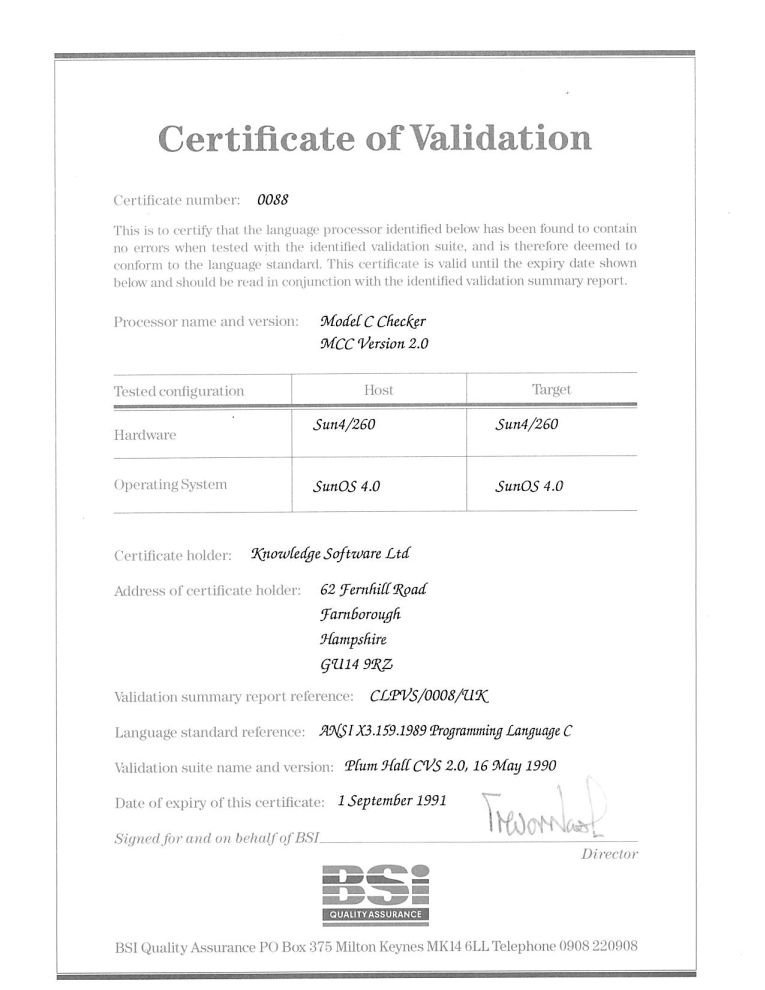
Today, 1 September 2011, is the 21th anniversary of the first formally validated C compilers. The three ‘equal first’ validated compilers were the Model Implementation C Checker from Knowledge Software, Topspeed C from JPI (run by the people who created Turbo Pascal) and the INMOS C compiler (derived from the Norcroft C compiler written by Alan Mycroft+others, the author of the longest response document seen during the review of the C89 draft standard).
Back in the day the British Standards Institution testing group run by John Souter were the world leaders in compiler validation and were very proactive in adding support for a new language. NIST, the equivalent US body, did not offer such a service until a few years later. Those companies in a position to have their compilers validated (i.e., the compiler passed the validation suite) were pressing BSI to be first; the ‘who is first’ issue was resolved by giving all certificates the same date (the actual validation process of a person from BSI, Neil Martin now Director of Test in the Winterop Team at Microsoft, turning up to ‘witness’ the compiler passing the tests happened several weeks earlier).
Testing C compilers was different from other language compilers in that sufficient demand existed to support commercial production and maintenance of test suites (the production of validation suites for previous language compilers had been government funded). After a review of the available test suites BSI chose to use the Plum Hall suite; after a similar review NIST chose to use the Perennial suite (I got involved in trying to figure out for NIST how well this suite covered the requirements contained in the C Standard).
For a while C compiler validation was big business (as in big fish, very small pond). But the compiler validation market is dependent on there being lots of compilers, which requires market fragmentation and to a lesser extent lots of different OSs and hardware platforms (each needing a separate validation). The 1990s saw market consolidation, gcc becoming good enough for commercial use and a shift of developer mind share to C++. Dwindling revenue resulted in BSI’s compiler validation group being shut down after a few years and NIST’s followed in 1998.
Is compiler validation relevant today? When the first C Standard was published a lot of compilers in common use had some significant behavioural differences compared to what the Standard specified. Over time these compilers have either disappeared or been upgraded (a potential customer once asked me the benefits I saw in them licensing the Knowledge Software front end and the reply to one of my responses, “you can tell your customers that the compiler is standard’s compliant”, was that this was not a benefit as they had been claiming this for years). Improvements in Intel’s x86 processor also had a hand in improving compiler Standard’s conformance; the various memory models used by the x86 processor was a huge headache for compiler writers whose products often behaved very differently under different memory models; the arrival of the Pentium with its flat 32-bit address space meant this issue disappeared over time.
These days I suspect that the major compilers targeting platforms where portability is expected (portability is often not a big expectation in the embedded world) are sufficiently compatible that developers are willing to overlook small differences with the Standard. Differences in third party libraries, GUIs and other frameworks have been the big headache for many years now.
Would the ‘platform portability’ compilers, that’s probably gcc, Microsoft, products using EDG’s front end, and perhaps llvm in the coming years, pass the latest version of the PlumHall and Perennial suites?
- The gcc team do not have access to either company’s suite. The gcc regression tests are a poor substitute for a proper compiler validation suite (even though they cost many thousands of dollars commercial compiler writers often buy both companies products because they are good value for money as a testing resource {the Fortran 78 validation suite source gives some idea of how much work is actually involved). I would expect gcc to fail some of the tests but have no idea how many or serious the failures would be.
- Microsoft have said they don’t have plans to support C99 (it took a lot of prodding to get them interested in formally validating against C90).
- I think the llvm team are in the same position as gcc, but perhaps somebody at Apple has access to one or more of the commercial suites (I don’t know).
- EDG are into standard’s conformance and I would expect them to pass both suites.
The certificate is printed on high quality, slightly yellow paper; the template wording is in a subdued gray ink while the customer information is in a very bold black ink. I don’t know whether this is to make life difficult for counterfeiters, but I could not get any half decent photographs and the color scanner had to be switched to black&white.
Validation was good for one year and I saw no worthwhile benefit in paying BSI £5,000 to renew for another year. Few people knew about the one year rule and I did not enlighten them. In the Ada compiler market the one year rule was a major problem, but lets leave that for another time.
sparse can now generate executables
How can you be confident that a source code analysis tool is correct when its analysis of a file does not result in any warning being generated? The best way I know of addressing this issue is for the analysis tool to be capable of generating an executable from the source. Executing a moderately large program requires that the translator get all sorts of complicated analysis correct and provides a huge boost to confidence of correctness compared to an analysis tool that does not have this ability.
Congratulations to the maintainers of sparse (a Linux kernel specific analysis tool started by Linus Torvalds in 2003) for becoming one of the very small number of source code analysis tools capable of generating executable programs.
The Model C Implementation is another tool capable of generating executables. I would love to be able to say that the reason for this was dedication to perfection by the project team, however, the truth is that it started life as a compiler and became an analyzer later.
Clang, the C front end+analyzer to llvm is often referred to as a static analyzer. While it does perform some static checking (like gcc does when the -Wall option is specified) a lot more checks needs to be supported before it can be considered on a par with modern static analysis tools.
GCC’s Treehydra project works via a plug-in to the compiler. This project has yet to live up to its potential, so we can delay discussion of whether it should be classified as a standalone system or an executable generator.
I cannot think of any other ‘full language’ static analysis tools capable of generating executable programs (the C-semantics tool restricts its checks to those required by the C Standard, and I think tools need to do a lot more than this to be considered static analysis tools). Corrections to my lack of knowledge welcome.
I was a little concerned that there were plans afoot to migrate sparse to becoming the build compiler for the Linux kernel. Linus answered my query by saying that this was never a goal.
Recent Comments