Archive
Investigating an LLM generated C compiler
Spending over $20,000 on API calls, a team at Anthropic plus an LLM (Claude Opus version 4.6) wrote a C compiler capable of compiling the Linux kernel and other programs to a variety of cpus. Has Anthropic commercialised monkeys typing on keyboards, or have they created an effective sheep herder?
First of all, does this compiler handle a non-trivial amount of the C language?
Having written a variety of industrial compiler front ends, optimizers, code generators and code analysers (which paid off the mortgage on my house), along with a book that analysed of the C Standard, sentence by sentence (download the pdf), I’m used to finding my way around compilers.
Claude’s C compiler source appears to be surprisingly well written/organised (based on a few hours reading of the code). My immediate thought was that this must be regurgitation of pieces from existing compilers. Searches for a selection of comments in the source failed to find any matches. Stylistically, the code is written by an entity that totally believes in using abstractions; functions call functions that call functions, that call …, eventually arriving at a leaf function that just assigns a value. Not at all like a human C compiler writer (well, apart from this one).
There are some oddities in an implementation of this (small) size. For instance, constant folding includes support for floating-point literals. Use of floating-point is uncommon, and opportunities to fold literals rare. Perhaps this support was included because, well, an LLM did the work. But it increases the amount of code that can be incorrect, for little benefit. When writing a compiler in an implementation language different from the one being compiled, differences between the two languages can have an impact. For instance, Claude C uses Rust’s 128-bit integer type during constant folding, despite this and most other C compilers only supporting at most 64-bit integer types.
A README appears in each of the 32 source directories, giving a detailed overview of the design and implementation of the activities performed by the code. The average length is 560 lines. These READMEs look like edited versions of the prompts used.
To get a sense of how the compiler handled rarely used language features and corner cases, I fed it examples from my book (code). The Complex floating point type is supported, along with Universal Character Names, fiddly scoping rules, and preprocessor oddities. This compiler is certainly non-trivial.
The compiler’s major blind spot is failing to detect many semantic constraints, e.g., performing arithmetic on variables having a struct type, or multiple declarations of functions and variables with the same name in the same scope (the parser README says “No type checking during parsing”; no type checking would be more accurate). The training data is source code that compiles to machine code, i.e., does not contain any semantic errors that a compiler is required to flag. It’s not surprising that Claude C fails to detect many semantic errors. There is a freely available collection of tests for the 80 constraint clauses in the C Standard that can be integrated into the Claude C compiler test suite, including the prompts used to generate the tests.
A compiler is an information conveyor belt. Source is first split into tokens (based on language specific rules), which are parsed to build a tree representation and a symbol table, which is then converted to SSA form so that a sequence of established algorithms can be used to lower the level of abstraction and detect common optimizations patterns, the low-level representation is mapped to machine code, and written to a file in the format for an executable program.
The prompts used to orchestrate the information processing conveyor belt have not been released. I’m guessing that the human team prompted the LLM with a detailed specification of the interfaces between each phase of the compiler.
The compiler is implemented in Rust, the currently fashionable language, and the obvious choice for its PR value. The 106K of source is spread across 351 files (average 531 LOC), and built in 17.5 seconds on my system.
LLMs make mistakes, with coding benchmark success rates being at best around 90%. Based on these numbers, the likelihood of 351 files being correctly generated, at the same time, is 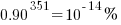 (with 99% probability of correctness we get
 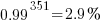 ). Splitting the compiler into, say, 32 phases each in a directory containing 11 files, and generating and testing each phase independently significantly increases the probability of success (or alternatively, significantly reduces the number of repetitions of the generate code and test process). The success probability of each phase is:
  , and if the same phase is generated 13 times, i.e.,
 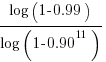 , there is a 99% probability that at least one of them is correct.
Some code need not do anything other than pass on the flow of information unchanged. For instance, code to perform the optimization common subexpression elimination does exist, but the optimization is not performed (based on looking at the machine code generated for a few tests; see codegen.c). Detecting non-functional code could require more prompting skill than generating the code. The prompt to implementation this optimization (e.g., write Rust code to perform value numbering) is very different from the prompt to write code containing common subexpressions, compile to machine code and check that the optimization is performed.
There is little commenting in the source for the lexer, parser, and machine code generators, i.e., the immediate front end and final back end. There is a fair amount of detailed commenting in source of the intervening phases.
The phases with little commenting are those which require lots of very specific, detailed information that is not often covered in books and papers. I suspect that the prompts for this code contains lots of detailed templates for tokenizing the source, building a tree, and at the back end how to map SSA nodes to specific instruction sequences.
The intermediate phases have more publicly available information that can be referenced in prompts, such as book chapters and particular papers. These prompts would need to be detailed instructions on how to annotate/transform the tree/SSA conveyed from earlier phases.
Formal methods and LLM generated mathematical proofs
Formal methods have been popping up in the news again, or at least on the technical news sites I follow.
Both mathematics and software share the same pattern of usage of formal methods. The input text is mapped to some output text. Various characteristics of the output text are checked using proof assistant(s). Assuming the mapping from input to output is complete and accurate, and the output has the desired characteristics, various claims can then be made about the input text, e.g., internally consistent. For software systems, some of the claims of correctness made about so-called formally verified systems would make soap powder manufacturers blush.
Mathematicians have been using LLMs to help find proofs of unsolved maths problems. Human written proofs are traditionally checked by other humans reading them to verify that the claimed proof is correct. LLMs generated proofs are sometimes written in what is called a formal language, this proof-as-program can then be independently checked by a proof assistant (the Lean proof assistant is a popular choice; Rocq is popular for proofs about software).
Software developers are well aware that LLM generated code contains bugs, and mathematicians have discovered that LLM generated proof-programs contain bugs. A mathematical proof bug involves Lean reporting that the LLM generated proof is true, when the proof applies to a question that is different from the actual question asked. Developers have probably experienced the case where an LLM generates a working program that does not do what was requested.
An iterative verification-and-refinement pipeline was used for LLMs well publicised solving of International Mathematical Olympiad problems.
A cherished belief of fans of formal methods is that mathematical proofs are correct. Experience with LLMs shows that a sequence of steps in a generated proof may be correct, but the steps may go down a path unrelated to the question posed in the input text. Also, proof assistants are programs, and programs invariably contain coding mistakes, which sometimes makes it possible to prove that false is true (one proof assistant currently has 83 bug reports of false being proved true).
It is well known, at least to mathematicians, that many published proofs contain mistakes, but that these can be fixed (not always easily), and the theorem is true. Unfortunately, journals are not always interested in publishing corrections. A sample of 51 reviews of published proofs finds that around a third contain serious errors, not easily corrected.
Human written proofs contain intentional gaps. For instance, it is assumed that readers can connect two steps without more details being given, or the author does not want to deter reviewers with an overly long proof. If LLM generated proofs are checked by proof assistants, then the gap between steps needs to be of a size supported by the assistant, and deterring reviewers is not an issue. Does this mean that LLM generated proof is likely to be human unfriendly?
Software is often expressed in an imperative language, which means it can be executed and the output checked. Theorems in mathematics are often expressed in a declarative form, which makes it difficult to execute a theorem to check its output.
For software systems, my view is that formal methods are essentially a form of  -version programming, with
  . Two programs are written, with one nominated to be called the specification; one or more tools are used to analyse both programs, checking that their behavior is consistent, and sometimes other properties. Mistakes may exist in the specification program or the non-specification program.
Using LLMs to help solve mathematical problems is a rapidly evolving field. We will have to wait and see whether end-to-end LLM generated proofs turn out to be trustworthy, or remain as a very useful aid.
Proving software correct
Users want confidence that software is ‘correct’; what constitutes correct depends on who you talk to and can vary between doing what the user expects and behaving according to a specification (which may include behavior that users did not expect or want).
The gold standard for software correctness is that achieved by mathematical proofs, or at least what most people believe is achieved by such proofs, i.e., a statement that is shown through a sequence of steps to be derived from a set of axioms. The sequence of steps used in most real proofs operate at a much higher level than axioms and rely on the reader to fill in the gaps left between each step. Ever since theorems were first stated they sometimes contained faults, i.e., were not correct theorems, and as mathematicians have continued to increase the size and complexity of theorems being ‘proved’ the technical and social issues involved in believing a published proof have grown in complexity.
Software proofs usually operate by translating the source in to some mathematical formalism and using a theorem prover to show that one or more properties are met. Perhaps the most famous use of such a proof that had an outcome different than that predicted is the 1996 Ariane 5 rocket crash; various proofs had been obtained for the Ariane 4 software showing that the value of some variables would never exceed given limits, these proofs involved input values that depended on the performance of the rocket and because Ariane 5 was more powerful than Ariane 4 the proofs were no longer valid (management would have found this out had they recheck the proofs using the larger values). Update: My only knowledge of this work comes from a conversation I recall with somebody working in the formal verification area, I no longer have contact with them and the company they worked for no longer exists; Pascal Cuoq’s comment below suggests they may have overstated the formal nature of the work, I have no means of double checking.
Purveyors of ‘software proof’ systems will tell you about the importance of feeding in the correct input values and will tell you about the known proofs they have managed to verify using their system. The elephant in the room that rarely gets mentioned is the correctness of the program that translates source code into the mathematical formalism used. These translators often handle that subset of the language which is relatively easy to map to the target formalism, the MALPAS C to IL translator is one exception to this (ok, yes my company wrote this translator so the opinion might be a little biased).
The method commonly associated with claims of correctness proof for a translator or compiler is slightly different from that described above for applications. This method involves manually writing some mathematics, using the chosen formalism, that ‘implements’ the translator/compiler. Strangely there are people who think that doing this is sufficient to claim the compiler is ‘verified’ or ‘proved correct’. As any schoolboy knows it is possible to write mathematics that contains mistakes and the writing of a mathematical implementation is just the first step in a process intended to increase confidence in a claim of correctness.
One of the questions that might be asked of a ‘mathematics implementation’ of a compiler is: does it faithfully interpret source code syntax/semantics according to the syntax/semantics specified in the appropriate language document?
Answering this question requires that the language syntax/semantics be specified in some mathematical notation that is amenable to formal analysis. Various researchers have created mathematical models for languages such as Ada, CHILL and C. However, these models are not recognized as being definitive, that status belongs to the corresponding ISO Standard written in English prose. The Modula-2 standard is specified using both English prose and equivalent mathematical notation with both having equal status as the definition of the language (any inconsistency between the two is decided why analyzing what behavior was intended); there were lots of plans to do stuff with this mathematics but the ISO language committee struggled just to produce a tool capable of printing the mathematics.
The developers of the Compcert system refer to it as a formally verified C compiler front-end when the language actually verified is called Clight, which they describe as a subset of the C language. This is very interesting work and I hope they continue to refine it and add support for more C-like constructs. But let’s be clear, the one thing missing from this project is any proof of a connection to the requirements contained in the C Standard.
I don’t know what it is about formal verification but those involved can at the same time be both very particular about the language they use in their mathematics and completely over the top in the claims they make about what their tools do. A speaker from Polyspace at one MISRA C conference claimed his tool could detect 100% of the coding guidelines specified in MISRA C, a surprising achievement for a runtime tool (as it was then) enforcing requirements mainly aimed at source code; I eventually got him to agree that the tool detected 100% of the constructs specified by the small subset of guidelines they had implemented.
I doubt that the Advertising Standard Authority would allow adverts containing the claims made by some formal verification advocates to appear in print or on TV; if soap manufacturers have to follow ASA rules then so should formal verification researchers.
Without a language specification written in a form amenable to mathematical analysis any claims of correctness have to be based on the traditional means of reading English prose very carefully and writing lots of tests to probe every obscure corner of the language specification. This was the approach used for the production of the Model Implementation of C, a system designed to detect all unspecified, implementation defined and undefined uses in C programs (it used a compiler, linker and interpreter). One measure of how well an implementor has studied the standard is how many faults they have discovered in it (some people claim this is a quality of standard issue, but the similar number of defects reported against the Ada and C Standards show that at least for Ada this is not true); here are some from the Model Implementation project.
Performance on independently written tests can be a good indicator of implementation correctness, depending on the quality of the tests. Both the Perennial and PlumHall C validation suites are of high quality, while suites such as the gcc testsuite are rather ad-hoc, have poor coverage and tend to be runtime oriented. The problem with high quality validation suites is that they cost enough money to put them out of reach of many research groups (I suspect another problem is that such groups don’t understand the benefits of using such suites or think they can do just as good a job in a few weeks).
Recently a new formal verification tool for C has appeared that performs all its verification checking at program runtime, i.e., after the user source has been translated to executable form. It is still very early days for kcc (they have yet to chose a name and the command used to invoke the translator is currently being used), they have an initial system up and running and are keen to continue improving it.
I am interested in the system because of what it might evolve into, including:
- a means of quickly checking the behavior of obscure bits of code (I get asked all sorts of weird questions and my brain is not always willing to switch to C language lawyer mode),
- a means of checking the consistency of the requirements in the C Standard, which will require another tool making use of the formalism built up by kcc,
- a tool which would help developers understand which parts of the C Standard they need to look at to understand some construct (the tool currently has a trace mode that needs lots of work).
Recent Comments