Archive
A free pdf that is not the C++ Standard
One of the most annoying things about working on programming language standards is to see the exorbitant price ISO charge for the final published document created by experts toiling away for free over many years. This practice is unlikely to change.
Once a document has been through a successfully ballot (i.e., accepted for publication as a Standard) ISO has very strict rules about what changes can be made to it prior to actual publication (only typos of the most very innocuous kind can be fixed). Of course programming language committees live on after the publication of a Standard by ISO and it is very useful for them if the document they start deliberating on is one that has had all the typos corrected, not just the really innocuous ones.
The list of typos in the 2011 C++ Standard have been fixed in the freely down loadable committee document N3337 that is not the official C++ Standard, however uncannily similar it may look (no ISO gobbledygook at the front for instance). The equivalent committee document for C is not yet available on the WG14 site.
If you really do need a copy of the C++ Standard the 2011 (i.e., latest) document in pdf form is available for $30 from ANSI; the 2011 C Standard is also available for the same price. Don’t worry about the ANSI version being dated 2012 rather than 2011; National Standards bodies must sell the ISO version at ISO prices but are allowed to publish localized versions for which they can set their own price (so you pay less and get various US specific acronyms and verbiage printed on the front cover).
Generating code that looks like it is human written
I am very interested in understanding the patterns of developer behavior that lead to the human characteristics that can be found in code. To help me get some idea of how well I understand this behavior I have decided to build a tool that generates source code that appears to be written by human programmers. I hope to reach a point where I can offer a challenge to tell the difference between generated code and human written code.
The three main production techniques I plan to use are, in increasing order of relatedness to humans production techniques, are:
- Random generation based on percentage occurrence of language constructs obtained from measurements of existing source. This is the simplest approach and the one furthest away from common developer behavior; even so there are things that can be learned from this information. For instance, the theory that developers are more likely to create a function once code becomes heavily nested code implies that the probability of encountering an if-statement decreases as nesting depth increases; measurements show the probability of encountering an if-statement remaining approximately constant as depth of nesting increases.
- Behavior templates. People have habits in everyday life and also when writing software. While some habits are idiosyncratic and not encountered very often there are some that appear to be generally used. For instance, developers tend to assign a fixed role to every variable they define (e.g., stepper for stepping through a succession of values and most-recent holder holding the latest value encountered in going through a succession of values).
I am expecting/hoping that generation by behavioral templates will result in code having some of the probabilistic properties seen in human code, removing the need for purely random generation driven by low level language probability measurements. For instance, the probability of a local variable appearing in a function is proportional to the percentage of its previous occurrences up to that point in the source of the function (
percentage = occurrences_of_X / occurrences_of_all_local_variables) and I am hoping that this property appears as emergent behavior from generating using the role of variable template. - Story telling. A program is like the plot of a story, it has a cast of characters (e.g., classes, functions, libraries) that perform various actions and interact with each other in order to achieve various goals, there are subplots (intermediate results are calculated, devices are initialized, etc), there are resource limits, etc.
While a lot of stories are application domain specific there are subplots common to many stories; also how a story is told can be heavily influenced by the language used, for instance Prolog programs have a completely different structure than those written in procedural languages such as Java. I want to stay away from being application specific and I don’t plan to tackle languages too far outside the common-or-garden procedural variety.
Researchers have created automatic story generators; the early generators were template based while more recent systems have used an agent based approach. Story based generation of code is my ideal, but I am a long way away from having enough knowledge of developer behavior to be more than template based.
In a previous post I described a system for automatically generating very simply C programs. I plan to build on this system to incrementally improve the ‘humanness’ of the generated code. At some point, hopefully before the end of this year, I will challenge people to tell the difference between automatically generated and human written code.
The language I have studied the most is C and this will be the main target. I don’t want to be overly C specific and am trying to decide on a good second language (i.e., lots of source available for measurement, used by lots of developers and not too different from C). JavaScript is the current front runner, it is a class-less object oriented language which is not ‘wildly’ OO (the patterns of usage in human written OO code continue to evolve at a rapid rate which can make a lot of human C++/Java code look automatically generated).
As well as being a test bed for understanding of human generated code other uses for an automatic generator include compiler stress testing and providing code snippets to an automated fault fixing tool.
Unique values generated by expressions of a given complexity
The majority of integer constants appearing in source code can be represented using a few bits. CPU designers use this characteristic when designing instruction sets, creating so called short-form or quick instructions that perform some operation involving small integer values, e.g., adding a value between 1 and 8 to a register. Writers of code optimizers are always looking for sequences of short-form instructions that are faster/smaller than the longer forms (the INMOS Transputer only had a short form for load immediate).
I have recently been looking at optimizing expressions written for a virtual machine that only supports immediate loads of decimal values between 1 an 9, and binary add/subtract/multiply/divide, e.g., optimizing an expression containing four operators, ((2*7)+9)*4+9 which evaluates to 101, to one containing three operators, (8+9)*6-1 also evaluates to 101. Intermediate results can have fractional values, but I am only interested in expressions whose final result has an integer value (i.e., zero fractional part).
A little thought shows that the value of an expression containing a subexpression whose value includes a fractional value (e.g., 1/3) can always be generated by an expression containing the same or a fewer number of operators and no intermediate fractional value intermediate results (e.g., 9/(1/5) can be generated using 9*5, i.e., the result of any divide operation always has to be an integer if the final result is to be a unique integer. Enumerating the unique set of values generated by expressions containing a given number of operators shows that divide is redundant for expressions containing six of fewer operators and only adds 11 unique values for seven operators (379,073 possibilities without divide)
Removing support for the minus operator only reduces the size of the result set by around 10%. Possibly being worthwhile time saving for expressions containing many operators or searching for an expression whose result value is very large.
There does not appear to be a straightforward (and fast) algorithm that returns the minimal operation expression for a given constant.
I wrote an R program to exhaustively generate all integer values returned by expressions containing up to seven operators. To find out how many different values, integer/real, could be calculated I wrote a maxima program (this represents fractional values using a rational number representation and exceeds 4G byte of storage for expressions containing more than five operators).
The following figure shows the number of different values that can be generated by an expression containing a given number of operators (blue), the number of integer values (black), the number of positive integer values (red), the smallest positive integer that cannot be calculated by an expression containing the given number of operators (green) (circles are for add/subtract/multiply/divide, squares for add/multiply). Any value below a green line is guaranteed to have a solution in the in the given number of operators (or fewer). The blue diamond line is the mean value of a random expression containing the given number of operators.
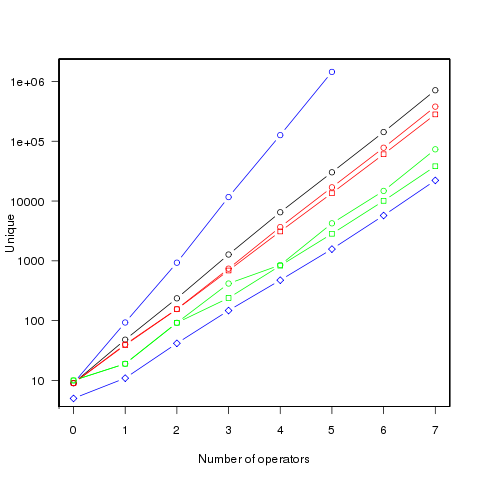
Limiting the operators to just add/multiply reduces the number of unique value possibilities. The difference increases linearly’ish to around 35% for seven operators.
The following uses colors to show the minimum number of operators needed to generate the given value, 1 is in the bottom left, 100,000 in the top right; red for one operator, yellow for two, green for three and so on.
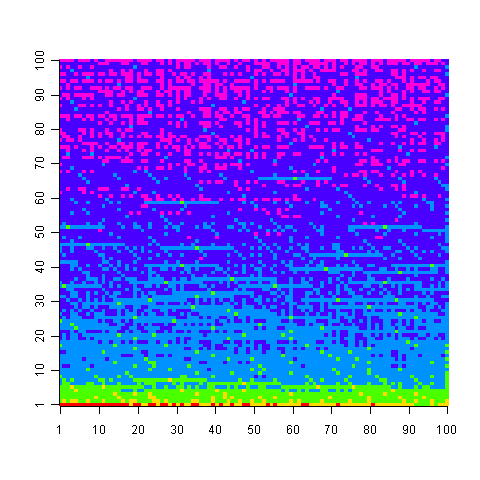
Knowing that N can be calculated using p operators does not mean that N-1 can also be generated using p operators; it is possible to generate 729 using two operators (i.e., 9*9*9), three operators are required to generate 92 and four to generate 417.
Values under the green line (first figure) are known to have solutions in the given number of operators; quickly obtaining the solution is another matter. There is at least a 50/50 chance that a randomly generated expression containing the given number of operators, and producing an integer value, will calculate a value on or below the diamond blue line. The overhead of storing precomputed minimal operator expressions is not that great for small numbers of operators.
Suggestions for a fast/low storage algorithm (random generation + modification through a cost function performs quite well) for large integer values welcome.
Update. Values from the first figure have been accepted by the On-Line Encyclopedia of Integer Sequences as entries: A181898, A181957, A181958, A181959 and A181960.
Matching context sensitive rules and generating output using regular expressions
I have previously written about generating words that sound like an input word. My interest in reimplementing this project from many years ago was fueled by a desire to find out exactly how flexible modern regular expression libraries are (the original used a bespoke tool). I had a set of regular expressions describing a mapping from one or more letters to one or more phonemes and I wanted to use someone else’s library to do all the heavy duty matching.
The following lists some of the mapping rules. The letters between [] are the ones that are ‘consumed’ by the match and any letters/characters either side are the context required for the rule to match. The characters between // are phonemes represented using the Arpabet phonetic transcription.
@[ew]=/UW/ [giv]=/G IH V/ [g]i^=/G/ [ge]t=/G EH/ su[gges]=/G JH EH S/ [gg]=/G/ b$[g]=/G/ [g]+=/JH/ # space - start of word # $ - one or more vowels # ! - two or more vowels # + - one front vowel # : - zero or more consonants # ^ - one consonant # ; - one or more consonants # . - one voiced consonant # @ - one special consonant # & - one sibilant # % - one suffix |
After some searching I settled on using the PCRE (Perl Compatible Regular Expressions) library, which contains more functionality than you can shake a stick at.
My plan was to translate each of the 300+ rules, using awk, into a regular expression, concatenate all of these together using alternation and let PCRE handle all of the matching details; which is what I did and it worked. Along the way a few problems had to be solved…
How can the appropriate phoneme(s) be generated when a rule matches? The solution is to use what PCRE calls callouts. During matching if the sequence (?C77) is encountered in the pattern a developer defined function (set up prior to calling pcre_execute) is called with information about the current state of the match. In this example the information would include the value 77 (values between 0 and 255 are supported). By embedding a unique number in the subpattern for each rule (and writing the appropriate phoneme sequence out to a configuration file that is read on program startup) it is possible to generate the appropriate output (because there are more than 255 rules a pair of callouts are needed to specify larger values).
How can the left/right letter context be handled? Most regular expression matching works by consuming all of the matched characters, making them unavailable for matching by other parts of the regular expression during that match. PCRE supports what it calls left and right assertions, which require a pattern to match but don’t consume the matched characters, leaving them to be matched by some other part of the pattern. So the rule [ge]t is mapped to the regular expression ge(?=t) which consumes a ge followed by a t but leaves the t for matching by another part of the pattern.
One problem occurs for backward assertions, which are restricted to matching the same number of characters for all alternatives of the pattern. For example the backward assertion (?<=(a|ab)e) is not supported because one path through the pattern is two characters long while the other is three characters long. The rule @[ew] cannot be matched using a backward assertion because @ includes letter sequences of different length (e.g., N, J, TH). The solution is to use a callout to perform a special left context match (specified by the callout number) which works by reversing the word being matched and the left context pattern and performing a forward (rather than backward) match.
The final pattern is over 10,000 characters long and looks something like (notice that everything is enclosed in () and terminated by a + to force the longest possible match, i.e., the complete word:
(((a(?=$)(?C51)))|((?<=^)(are(?=$)(?C52)))| ... |(z(?C106)(?C55)))+ |
Now we need a method of using the letter to phoneme rules to map phonemes to letters. In some cases a phoneme sequence can be mapped to multiple letter sequences and I wanted to generate all of the possible letter sequences (e.g., cat -> K AE T -> cat, kat, qat). PCRE does support a matching function capable of returning all possible matches. However this function does not support some of the functionality required, so I decided to 'force' the single match function to generate all possible sequences by using a callout to make it unconditionally fail as the last operation of every otherwise successful match, causing the matching process to backtrack and try to find an alternative match. Not the most efficient of solutions but it saved me having to learn a lot more about the functionality supported by PCRE.
For a given sequence of phonemes it is simple enough to match it using a regular expression created from the existing rules. However, any match also needs to meet any left/right letter context requirements. Because we are generating letters left to right we have a left context that can be matched, but no right context.
The left context is matched by applying the technique used for variable length left contexts, described above, i.e., the letters generated so far are reversed and these are matched using a reversed left context pattern.
An efficient solution to matching right context would be very fiddly to implement. I took the simple approach of ignoring the right letter context until the complete phoneme sequence had been matched; the generated letter sequence out of this matching process is feed as input to the letter-to-phoneme function and the returned phoneme sequence compared against the original generating phoneme sequence. If the two phoneme sequences are identical the generated letter sequence is included in the final set of returned letter sequences. Not very computer efficient, but an efficient use of my time.
I could not resist including some optimzations. For instance, if a letter sequence only matches at the start or end of a word then the corresponding phonemes can only match at the start/end of the sequence.
I have skipped some of the minor details, which you can read about in the source of the tool.
I would be interested to hear about the libraries/tools used by readers with experience matching patterns of this complexity.
Generating sounds-like and accented words
I have always been surprised by the approaches other people have taken to generating words that sound like a particular word or judging whether two words sound alike. The aspell program letter sequence is in its dictionary; the Soundex algorithm is often used to compare whether two words sound alike and has the advantage of being very simple and delivers results that many people seem willing to accept. Over 25 years ago I wrote some software that used a phoneme based approach and while sorting through a pile of papers recently I came across an old report used as the basis for that software. I decided to implement a word sounds-like tool to show people how I think sounds-like should be done. To reduce the work involved this initial tool is based on what I already know, which in some cases is very out of date.
Phonemes are the basic units of sound and any sounds-like software needs to operate on a word’s phoneme sequence, not its letter sequence. The way to proceed is to convert a word’s letter sequence to its phoneme sequence, manipulate the phoneme sequence to create other sequences that have a spoken form similar to the original word and then convert these new sequences back to letter sequences.
A 1976 report by Elovitz, Johnson, McHugh and Shore contains a list of 329 rules for converting a word’s letter sequence into a phoneme sequence. It seemed to me that this same set of rules could be driven in reverse to map a phoneme sequence back to a letter sequence (the complications involved in making this simple idea work will be discussed in another article).
Once we have a phoneme sequence how might it be modified to create similar sounding words?
The distinctive feature theory assigns ten or so features to every phoneme, these denote details such as such things as manner and place of articulation. I decided to use these features as the basis of a distance metric between two phonemes (e.g., the more features two phonemes had in common the more similar they sounded). The book “Phonology theory and analysis” by Larry M. Hyman contains the required table of phoneme/distinctive features. Yes, I am using a theory from the 1950s and a book from the 1970s, but to start with I want to recreate what I know can be done before moving on to use more modern theories/data.
In practice this approach generates too many letter sequences that just don’t look like English words. The underlying problem is that the letter/phoneme rules were not designed to be run in reverse. Rather than tune the existing rules to do a better job when run in reverse I used the simpler method of filtering using letter bigrams to remove non-English letter sequences (e.g., ‘ck’ is not acceptable at the start of a word letter sequence). In preInternet times word bigram information was obtained from specialist cryptographic publishers, but these days psychologists researching human reading are a very good source of reliable information (or at least one I am familiar with).
I have implemented this approach and the system currently supports the generation of:
- letter sequences that sound the same as the input word, e.g., cowd, coad, kowd, koad.
- letter sequences that sound similar to the input word, e.g., bite, dight, duyt, gight, guyt, might, muyt, pight, puyt, bit, byt, bait, bayt, beight, beet, beat, beit, beyt, boyt, boit, but, bied, bighd, buyd, bighp, buyp, bighng, buyng, bighth, buyth, bight, buyt
- letter sequences that sound like the input word said with a German accent, e.g., one, vun and woven, voughen, vuphen.
The output can be piped through a spell checker to remove nondictionary letter sequences.
How accurate are the various sequence translations? Based on a comparison against manual translation of several thousand words from the Brown corpus Elovitz et al claim around 90% of words in random text will be correctly translated to phonemes. I have not done any empirical analysis of the performance of the rules when used to convert phoneme sequences to letters; it will obviously be less than 90%.
The source code of the somewhat experimental tool is available for download. Please note that the code has only been built on Linux, is likely to be fragile in various places and needs a recent copy of the pcre library. Bug reports welcome.
Some of the uses for a word’s phoneme sequence include:
- matching names contained in information transcribed using different conventions or by different people (i.e., slight spelling differences).
- better word splitting at the end of line in LaTeX. Word splitting decisions are best made using sound units.
- better spell checking, particularly for non-native English speakers when coupled with a sound model of common mistakes made by speakers of other languages.
- aid to remembering partially forgotten words whose approximate sound can be remembered.
- inventing trendy spellings for words.
Where next?
Knowledge of the written and spoken word had moved forward in the last 25 years and various other techniques that might improve the performance of the tool are now available. My interest in the written, rather than the spoken, form of code means I have only followed written/sound conversion at a superficial level; reader suggestions on more modern theories, models and data sources that might be used to improve the tools performance are most welcome. A few of my own thoughts:
- As I understand it modern text to speech systems are driven by models derived through machine learning (i.e., some learning algorithm has processed lots of data). There might be existing models out there that can be used, otherwise the MRC Psycholinguistic Database is a good source for lots for word phoneme sequences and perhaps might be used to learn rules for both letter to phoneme and phoneme to letter conversion.
- Is Distinctive feature theory the best basis for a phoneme sounds-like metric? If not which theory should be used and where can the required detailed phoneme information be found? Hyman gives yes/no values for each feature while the first edition of Ladeforded’s “A Course in Phonetics” gives percentage contribution values for the distinctive features of some phonemes; subsequent editions don’t include this information. Is a complete table of percentage contribution of each feature to every phoneme available somewhere?
- A more sophisticated approach to sounds-like would take phoneme context into account. A slightly less crude approach would be to make use of phoneme bigram information extracted from the MRC database. What is really needed is a theory of sounds-like and some machine usable rules; this would hopefully support the adding and removal of phonemes and not just changing existing ones.
As part of my R education I plan to create an R sounds-like package.
In the next article I will talk about how I used and abused the PCRE (Perl Compatible Regular Expressions) library to recognize a context dependent set of rules and generate corresponding output.
The fatal programming language research mistake
There is a fatal mistake often made by those involved in academic programming language research and a recent blog post (by an academic) asking if programming language research has a future has spurred me into writing about this mistake.
As an aside, I would agree with much of what the academic (Cristina (Crista) Videira Lopes) says about many popular modern programming languages being hacked together by kids who did not know much, if anything about, language design. However, this post is not a lament about the poor design quality of the languages commonly used in the commercial world; it is about the most common fatal mistake academics make when researching programming languages and a suggestion about how they can avoid making this mistake. What really endeared me to Crista was her critic of academic claims of language ‘betterness’ being completely unfounded (i.e., not being based on any empirical research).
The most common fatal mistake made by researchers in programing language design is to invent a new language. Creating an implementation for any language is a big undertaking and a new language has the added hurdles of convincing developers it is worth learning, providing the learning/reference materials and porting to multiple platforms. Researchers spend nearly all their time creating an implementation and a small percentage of their time actively researching the ‘new idea’.
The attraction of designing a new language is that it is regarded as ‘sexy’ activity and the first (and usually only) time around the work needed to create an implementations does not look that great.
If a researcher really does feel that their idea is so revolutionary it is worth creating a whole new language for and they want me, and others, to start using it, then they need to make sure they can answer yes to the following questions:
- Have you, or your students, created an implementation of the language that provides reasonable diagnostics, executes programs at an acceptable rate and is available free of charge on the operating systems I use for software development?
- Is sufficient documentation available for me to learn the language and act as a reference manual once I become more expert?
- For the next five years will you, or your students, be providing, free of charge, prompt bug fixes to errors in your implementation?
- Will you and your students spend the time necessary to build an active user community for your language?
- For the next five years will you, or your students knowledgeable in the language, provide prompt support (via an email group or bulletin board) to user queries?
Some new languages from academia have managed to answer yes to these questions (Haskell, R and OCaml spring to mind, but only R looks like it will have any significant industrial take-up).
In practice most new languages fail to get past fragile implementations only ever used by their designer, with minimal new research to show for all the effort that went into them.
What programming language researchers need to do, at least if they want people outside of their own department to pay any attention to their ideas, is to experiment by adding functionality to an existing language. Using an existing language as a base has the advantages:
- modifying an existing implementation is significantly less work than creating a new one,
- having to address all of the features present in real world languages will help weed out poor designs that only look good on paper (I continue to be amazed that people can be involved in programming language research without knowing any language very well),
- documentation for most of the language already exists,
- more likely to attract early adopters, developers tend to treat existing language+extensions as being a much smaller jump than a new language.
Programming language research is something of a fashion industry and I can well imagine people objecting to having to deal with a messy existing language. Well yes, the real world is a messy place and if a new design idea cannot handle that it deserves to be lost to posterity.
One cannot blame students for being idealistic and thinking they can create a language that will take over the world. It is the members of staff who should be ridiculed for being either naive or intellectually shallow.
Parsing R code: Freedom of expression is not always a good idea
With my growing interest in R it was inevitable that I would end up writing a parser for it. The fact that the language is relatively small (the add-on packages do the serious work) hastened the event because it did not look like much work; famous last words. I knew about R’s design and implementation being strongly influenced by the world view of functional programming and this should have set alarm bells ringing; this community have a history of willfully ignoring some of the undesirable consequences of their penchant of taking simple ideas and over generalizing them (i.e., I should have expected hidden complications).
While the official R language definition only contains a tiny fraction of the information needed to create a full implementation I decided to use it rather than ‘cheat’ and look at the R project implementation sources. I took as my oracle of correctness the source code of the substantial amount of R in its 3,000+ package library. This approach would help me uncover some of the incorrect preconceived ideas I have about how R source fits together.
I started with a C lexer and chopped and changed (it is difficult to do decent error recovery in automatically generated lexers and I prefer to avoid them). A few surprises cropped up ** is supported as an undocumented form of ^ and by default ]] must be treated as two tokens (e.g., two ] in a[b[c]] but one ]] in d[[e]], an exception to the very commonly used maximal munch rule).
The R grammar is all about expressions with some statement bits and pieces thrown in. R operator precedence follows that of Fortran, except the precedence of unary plus/minus has been increased to be above multiply/divide (instead of below). Easy peasy, cut and paste an existing expression grammar and done by tea time :-). Several tea times later I have a grammar that parses all of the R packages (apart from 80+ real syntax errors contained therein and a hand full of kinky operator combinations I’m not willing to contort the grammar to support). So what happened?
Two factors accounts for most of the difference between my estimate of the work required and the actual work required:
- my belief that a well written grammar has no ambiguities (while zero is a common goal for many projects a handful might be acceptable if the building is on fire and I have to leave). A major advantage of automatic generation of parser tables from a grammar specification is being warned about ambiguities in the grammar (either shift/reduce or reduce/reduce conflicts). At an early stage I was pulling my hair out over having 59 conflicts and decided to relent and look at the R project source and was amazed to find their grammar has 81 ambiguities!
I have managed to get the number of ambiguities down to the mid-30s, not good at all but it will have to do for the time being.
- some of my preconceptions about of how R syntax worked were seriously wrong. In some cases I spotted my mistake quickly because I recognized the behavior from other languages I know, other misconceptions took a lot longer to understand and handle because I did not believe anybody would design expression evaluation to work that way.
The root cause of the difference can more concretely be traced to the approach to specifying language syntax. The R project grammar is written using the form commonly seen in functional language implementations and introductory compiler books. This form has the advantage of being very short and apparently simple; the following is a cut down example in a form of BNF used by many parser generators:
expr : expr op expr | IDENTIFIER ; op : &' | '==' | '>' | '+' | '-' | '*' | '/' | '^' ; |
This specifies a sequence of IDENTIFIERs separated by binary operators and is ambiguous when the expression contains more than two operators, e.g., a + b * c can be parsed in more than one way. Parser generators such as Yacc will complain and flag any ambiguity and pick one of the possibilities as the default behavior for handling a given ambiguity; developers can specify additional grammar information in the file read by Yacc to guide its behavior when deciding how to resolve specific ambiguities. For instance, the relative precedence of operators can be specified and this information would be used by Yacc to decide that the ambiguous expression a + b * c should be parsed as-if it had been written like a + (b * c) rather than like (a + b) * c. The R project grammar is short, highly ambiguous and relies on the information contained in the explicitly specified relative operator precedence and associativity directives to resolve the ambiguities.
An alternative method of specifying the grammar is to have a separate list of grammar rules for each level of precedence (I always use this approach). In this approach there is no ambiguity, the precedence and associativity are implicitly specified by how the grammar is written. Obviously this approach creates much longer grammars, there will be at least two rules for every precedence level (19 in R, many with multiple operators). The following is a cut down example containing just multiple, divide, add and subtract:
... multiplicative_expression: cast_expression | multiplicative_expression '*' cast_expression | multiplicative_expression '/' cast_expression ; additive_expression: multiplicative_expression | additive_expression '+' multiplicative_expression | additive_expression '-' multiplicative_expression ; ... |
The advantages of this approach are that, because there are no ambiguities, the developer can see exactly how the grammar behaves and if an ambiguity is accidentally introduced when editing the source it should be noticed when the parser generator reports a problem where previously there were none (rather than the new ambiguity being hidden in the barrage of existing ones that are ignored because they are so numerous).
My first big misconception about R syntax was to think that R had statements, it doesn’t. What other languages would treat as statements R always treats as expressions. The if, for and while constructs have values (e.g., 2*(if (x == y) 2 else 4)). No problem, I used Algol 68 as an undergraduate, which supports this kind of usage. I assumed that when an if appeared as an operand in an expression it would have to be bracketed using () or {} to avoid creating a substantial number of parsing ambiguities; WRONG. No brackets need be specified, the R expression if (x == y) 2 else 4+1 is ambiguous (it could be treated as-if it had been written if (x == y) 2 else (4+1) or (if (x == y) 2 else 4)+1) and the R project grammar relies on its precedence specification to resolve the conflict (in favor of the first possibility listed above).
My next big surprise came from the handling of unary operators. Most modern languages give all unary operators the same precedence, generally higher than any binary operator. Following Fortran the R unary operators have a variety of different precedence levels; however R did not adopt the restrictions Fortran places on where unary operators can occur.
I assumed that R had adopted the restrictions used by other languages containing unary operators at different precedence levels, e.g., not allowing a unary operator token to follow a binary operator token (i.e., there has to be an intervening opening parenthesis); WRONG. R allows me to write 1 == !1 < 0, while Fortran (and Ada, etc) require that a parenthesis be inserted between the operands == ! (hopefully resulting in the intent being clearer).
I had to think a bit to come up with an explicit set of grammar rules to handle R unary operator's freedom of expression (without creating any ambiguities).
Stepping back from the details. My view is that programming language syntax should be designed to reduce the number of mistakes developers make. Requiring that brackets appear in certain contexts helps prevent mistakes by the original author and subsequent readers of the code.
Claims that R (or any other language) syntax is 'natural' is clearly spurious and really no more than a statement of preference by the speaker. Our DNA has not yet been found to equip us to handle one programming language better than another.
Over the coming months I hope to have the time to analyse R source looking for faults that might not have occurred had brackets been used. Also how much code might be broken if R started to require brackets in certain contexts?
An example of the difference that brackets can make is provided by the handling of the unary ! operator in R and C/C++/Java/etc. Take the expression !x > y, which R parses as-if written !(x > y) and C/C++/Java/etc as if written (!x) > y. I would not claim that either is better than the other from the point of view of developers getting the behavior right, I know that some C programmers get it wrong and I suspect that some R programmers do too.
By increasing the precedence of unary plus/minus the R designers ensured that 8/-2/2 was parsed like (8/-2)/2 rather than 8/(-2/2).
Number of possible different one line programs
Writing one line programs is a popular activity in some programming languages (e.g., awk and Perl). How many different one line programs is it possible to write?
First we need to get some idea of the maximum number of characters that written on one line. Microsoft Windows XP or later has a maximum command line length of 8191 characters, while Windows 2000 and Windows NT 4.0 have a 2047 limit. POSIX requires that _POSIX2_LINE_MAX have a value of at least 2048.
In 2048 characters it is possible to assign values to and use at least once 100 different variables (e.g., a1=2;a2=2.3;....; print a1+a2*a3...). To get a lower bound lets consider the number of different expressions it is possible to write. How many functionally different expressions containing 100 binary operators are there?
If a language has, say, eight binary operators (e.g., +, -, *, /, %, &, |, ^), then it is possible to write  visually different expressions containing 100 binary operators. Some of these expressions will be mathematically equivalent (adopting the convention of leaving out the operands), e.g.,
 + * can also be written as * + (the appropriate operands will also have the be switched around).
If we just consider expressions created using the commutative operators (i.e., +, *, &, |, ^), then with these five operators it is possible to write 1170671511684728695563295535920396 mathematically different expressions containing 100 operators (assuming the common case that the five operators have different precedence levels, which means the different expressions have a one to one mapping to a rooted tree of height five); this  is a lot smaller than
  .
.
Had the approximately  computers/smart phones in the world generated expressions at the rate of
  per second since the start of the Universe,
  seconds ago, then the
  created so far would be almost half of the total possible.
Once we start including the non-commutative operators such a minus and divide the number of possible combinations really starts to climb and the calculation of the totals is real complicated. Since the Universe is not yet half way through the commutative operators I will leave working this total out for another day.
Update (later in the day)
To get some idea of the huge jump in number of functionally different expressions that occurs when operator ordering is significant, with just the three operators -, / and % is is possible to create  mathematically different expressions. This is a factor of
  greater than generated by the five operators considered above.
If we consider expressions containing just one instance of the five commutative operators then the number of expressions jumps by another two orders of magnitude to  . This count will continue to increase for a while as more commutative operators are added and then start to decline; I have not yet worked things through to find the maxima.
Update (April 2012).
Sequence A140606 in the On-Line Encyclopedia of Integer Sequences lists the number of inequivalent expressions involving n operands; whose first few values are: 1, 6, 68, 1170, 27142, 793002, 27914126, 1150212810, 54326011414, 2894532443154, 171800282010062, 11243812043430330, 804596872359480358, 62506696942427106498, 5239819196582605428254, 471480120474696200252970, 45328694990444455796547766, 4637556923393331549190920306
Birth month for compiler writers
Today is my birthday and an event from a long ago project springs to mind. All four of us from the UK arm of the team were born in February, one person on the same day as me (Happy Birthday Mick, where ever you are). This clustering of birth months led us to the obvious conclusion that the best compiler writers are born in February. Over the years I have retold this story to other compiler writers and found out their birth month. Now I will try and be a bit more scientific and have set up a survey (see below).
What counts as a compiler and what does somebody have to do to be considered a compiler writer (lets stay away from the issue of quality)? I would include software that performs computer language translation to another language (i.e., not just intermediate code or assembler) and static analysis of source provided it involved a lot of semantics (i.e., not working on the GUI that presents the data). I would exclude writing test cases, documentation, project management and maintenance (i.e., only fixing faults and dealing with customer queries).
I would classify a compiler writer as somebody who spent a substantial amount of their time working almost exclusively on writing a compiler. How substantial? Well, I think it ought o be possible to do something useful in about 4 months (I thought about saying 6 months, but decided to be generous.
Please take part, even if you do not consider yourself to be a compiler writer. A control group is always useful (perhaps readers of this blog have a preferred birth month)
I will make the numbers available and discuss them in a future article (probably in March).
[SURVEYS 1]
If anybody else is interested in running a survey, the surveys WordPress plugin allows more than one question to be specified and worked better than the other popular plugins for me (there is one bug that needs to be fixed: show_survey.php, line 51 should be:
$email_body = t("Hi,\nThere is a new result for the survey at %s...\n", $_SERVER['REQUEST_URI']); ).
Recent Comments