Archive
Is unreachable code primarily created by a fault?
Many coding guidelines recommend against the presence of unreachable code in source; the argument being that while the code itself is harmless its presence suggests something has gone wrong somewhere else. As a member of the MISRA C++ coding guidelines committee I unsuccessfully argued against this recommendation being included on the grounds of lack of evidence that unreachable code was a significantly strong indicator of a fault and the complications caused by wanting allow certain kinds of what appeared to be unreachable code (e.g., that used by defensive programming practices).
I was recently reading the PhD thesis of Yichen Xie and found some very interesting analysis of correlation between various kinds of dead code (redundant code was one of the kinds) and faults.
Yichen Xie took a course grained approach to finding a correlation between redundant code and faults. He simply counted the numbers of files that did/did not contain redundant code and the number of corresponding files known to contain what he called a hard bug. The counts were as follows (statistical analysis using the contingency table method gives a probability of well below 0.01 for these values being generated by the null hypothesis):
Hard Bugs Dead Code Yes No Totals Yes 133 135 268 No 418 1369 1787 Totals 551 1504 2055 |
These counts show that if one of the 2,055 files was picked at random the expectation of it containing a Hard Bug is 27%, for one of the files containing unreachable code the expectation is 50% and for files not containing unreachable code it is 23%. So picking a file containing unreachable code almost doubles the expectation of a Hard Bug being found in that file.
These measurements do not attempt to make a connection between the unreachable code contained in a file and any fault contained within that file. How would the counts change if they were based on their being some form of logical connection between the redundant code and the fault? The counts suggest at least a 50% false positive rate, but then faults that generate unreachable code may be the result of high level semantic issues that are less likely to be detected by a casual reading of the source or by static analysis tools.
The hoped for consequence of a coding guideline requiring the removal of unreachable code is that developers analyze the code to understand why the code is unreachable and that in many cases this will result in a fault being uncovered and fixed; the worst case scenario is that they simply delete the unreachable code.
This research has caused me to upgrade the significance I give to unreachable code but I remain unconvinced that the false positive rate is sufficiently low for it to be a worthwhile coding guideline.
Adding negative information to source
An interesting paper on untangling skill and luck in sports and business made the interesting observation that if, for some activity, it is easy to lose on purpose then skill dominates over luck, while if it is difficult to lose on purpose luck dominates over skill.
This got me thinking about skill in software development and how it might be used to ‘loose on purpose’ (I will leave the question of luck in software development to another post).
What does winning and loosing mean in software development? Winning might mean producing a program quickly, cheaply, that is the most efficient or is the most maintainable. I’m not sure that there is much skill involved in being the slowest or most expensive developer to write code, or to create a very inefficient program.
Everybody has ideas about how to write maintainable code (there is generally little or no experimental evidence to back up these ideas) and from time to time joke articles about writing unmaintainable code are written.
There are practical reasons for wanting to create non-maintainable or difficult to comprehend code, for instance to make it difficult for a third party (who might be a customer or black hat) to figure out how a program operates. So called obfuscating transformations are an active area of research and tools are available to transform source and binary; the effectiveness of some techniques for making source difficult to maintain is debatable and obfuscating source may have little impact on the generated binary.
These tools primarily operate by removing information, e.g., rewriting identifiers to meaningless sequences of characters, mapping structured loops to sequences of goto and folding constant expressions. Removing information does not require any skill relating to software maintainability.
I would claim that being able to add negative information to a program is evidence of skill for software maintenance.
Some example of the kinds of negative information I would add include:
- Invented ‘magic’ numbers, i.e., numeric literals that look as if they are derived from an application domain requirement. For instance, a reader of the expression
x*12is likely to assume that12is a constant specific to some aspect of the application; this is an instance where novice developers are trained to invent a symbolic name (e.g.,max_eggs_in_box) to denote the given value. So if the original code contained the expressionx*6I would modify it tox*12and then figure out how to later divide the result by two. Code modified to contain many12s, or other such ‘invented’ constants, is likely to cause readers to waste lots of time head scratching. - Replace identifiers with names that have no semantic connection with the information they contain. Well chosen identifier names can significantly reduce the effort needed to comprehend source and I’m sure that suitable chosen names would help sow lots of confusion. An experiment I ran a few years ago found that developers use identifier names to make decisions about binary operator precedence; lots of scope for creating confusion here!
- I don’t have enough experience to know whether restructuring class hierarchies will have a worthwhile impact on maintainability, developers have learned to handle poorly designed class hierarchies and I am not sure I can make things much worse than they have already encountered.
Adding redundant code is a commonly used technique. To be effective this code would have to modify variables used in the original program, which means that it would have to occur in a condition that is never executed; a constant conditional expression would fool nobody and the condition would have to rely on a variable being tested against a value that could never occur. This requires application knowledge not code maintenance skills.
Compression and encryption (of strings in source and as much code as possible in executables) are other existing techniques that do not involve maintenance related skills.
Shell languages are probably a distinct category of computer language
While reading a book on the Windows PowerShell some of the language design decisions struck me as distinctly odd, if not completely wrong. Thinking about them for a few days I started to appreciate the language designers point of view.
Computer shell languages satisfy a different need and exist within a different culture than ‘programming’ languages. I have been trying to put my finger on what it is about these two language categories that makes them different; the points I have come up with include:
- Little if any declaration of variables in shell languages (also true of scripting languages). Is this because ‘programs’ are expected to be short with few uses of any particular variable, or variables always having a single type, or always being scalar or perhaps the requirement to support an interactive approach to writing programs?
- Existing practice is for the
<and>characters to be used to denote input/output redirection. Using these characters to denote both indirection and the binary less-then/greater-than operations would require some fancy disambiguation rules/analysis. PowerShell uses-lt,-le,-gtand-gefor the relational operators and other shells often use something similar; this usage visually jumps out at people use to thinking of the minus character as denoting the start of a command line option. - Function calls have the syntax of a command line, i.e., any arguments appear in a whitespace separated list to the left of the function/command name (no use of round brackets or comma).
- Shell languages seem to contain many more special case behaviors than 'programming' languages. Perhaps this is because shell languages tend to evolve much more rapidly over time compared to programming languages (ok, Perl is an example of what is generally considered to be a programming language that has evolved a lot and it certainly has plenty of special corner cases).
- Shell languages often include support for checking the initialization status of a variable while most programming languages treat use of an uninitialized variable as having undefined behavior.
- Programming languages are designed to build and manipulate much more complex and larger data structures than are generally handled by shell languages.
While shell languages are invariable interpreted and compiling some of the functionality they support would be very difficult, I don't see this implementation issue as being significant.
Many of the differences highlighted above could also said to apply to scripting languages. Is there a category along the continuum between shell and 'programming' languages where something called a scripting language exists or does the term script imply a usage rather than a recognizable set of design decisions?
Two models of developer response to false positive warnings
Static analysis tools sometimes fail to warn about a problem in the source and sometimes generate a warning for perfectly correct code (so called false positives). Experience shows that false positive warnings are very unpopular with developers (they are a source of wasted effort) and if too many false positive warnings are encountered a developer will often stop using the tool; developer’s are more likely to consider a lack of warnings as a positive indicator of the quality of their code than a failure of the tool to detect a problem, of course failure to detect problems may result in a poor evaluation and a lost sale.
What percentage of false positive warnings can a static analysis tool generate before a developer is likely to stop using it?
The following are two possible developer mental models that can be used to help answer this question (it is assumed that there is no correlation between warning occurrences and developers do not differentiate on the type of construct being warned about):
- a ‘rational’ developer who tracks the benefit of processing each warning (e.g., correct warning +1 benefit, false positive warning -1 benefit), starting in an initial state of zero benefit this rational developer stops processing warnings if the current sum of benefits ever goes negative.

The Ballot theorem can be used here. Let
Cbe the number of correct warnings andFbe the number of false positive warnings and assumeC > F. The probability that in a sequential count of warnings the number of correct warnings is always greater than the number of false positive warnings is:
rewriting in terms of probability of the two kinds of warning we get:

so, for instance, the probability of processing all the warning generated by a tool is 0.5 when the false positive rate is 0.25 and does not depend on the total number of warnings that have to be processed.
- a ‘short-termist’ developer who processes each warning and stops when a sequence of
Nconsecutive false positive warnings have been encountered. This kind of thinking is analogous to that of the hot hand in sports (what psychologists call the clustering illusion)
What is the probability that a sequence of
Nconsecutive false positive warnings is not encountered? Feller provides one solution (see equations 12 & 13 on Mathworld) but equation 2 on mathpages is easier to work with and was used to produce the following graph: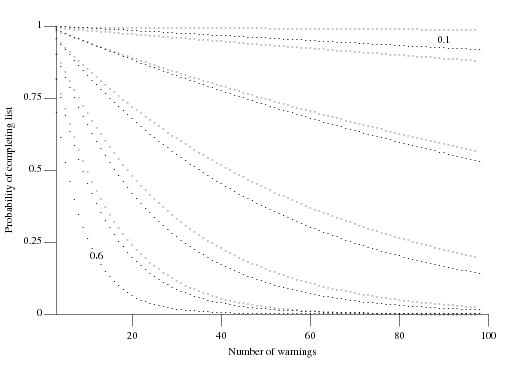
which plots the probability of not encountering a sequence of
Nconsecutive false positive warnings (dotsN=3, crossesN=4) after having processed a given number of warning messages for various underlying rates of false positive (ranging from 0.6 to 0.1 in increments of 0.1).
These models are both based on the false positive rate as judged by the developer, which need not reflect reality. For instance, when dealing with warnings involving complex constructs a developer may be unwilling to put the effort into understanding what is going on and either go along with the what the static analysis tool says, thus underestimating the actual false positive rate, or default to assuming the waring is a false positive, thus overestimating the actual false positive rate.
I have been meaning to write about this topic for a while and an email from Paul Anderson galvanized me into action. Paul’s email involved a slightly different issue “… if the human has seen lots of false positives, there is an increased probability that a true positive will be misjudged as a false positive.”
In some companies developers are required to process each message generated by a tool. Now if a developer looses confidence in a tool it would look suspicious if at some point they simply flagged all subsequent warnings as false positives. What algorithm might such developers use to ‘recalibrate’, e.g., skipping over the next M warnings? This sounds like a problem in foraging theory and a possible topic for a future post.
Network protocols also evolve into a tangle of dependencies
Four years ago I started work as an adviser to the Monitoring Trustee appointed by the European Commission in the EU/Microsoft competition court case. The work revolved around the protocol specification documents being written by Microsoft; at the time these documents were super secret but they are now publicly available for download.
The EU case involved the server protocols, known as WSPP, (the US/Microsoft case involved the client protocols) and with so many of them, over 100, attempts were made to divide them into distinct subsets for licensing to third parties who might only be interested in specific functionality.
On starting one of the first things I did was to create a graph like the one below (this one was created by extracting document cross reference information, using PowerGREP, from the public specifications and plotting it using Graphviz). Each line in the plot represents a dependency between the two protocols whose name’s appear in the ellipsoid nodes (actually a cross reference link in the normative sections of one protocol document to another protocol document).
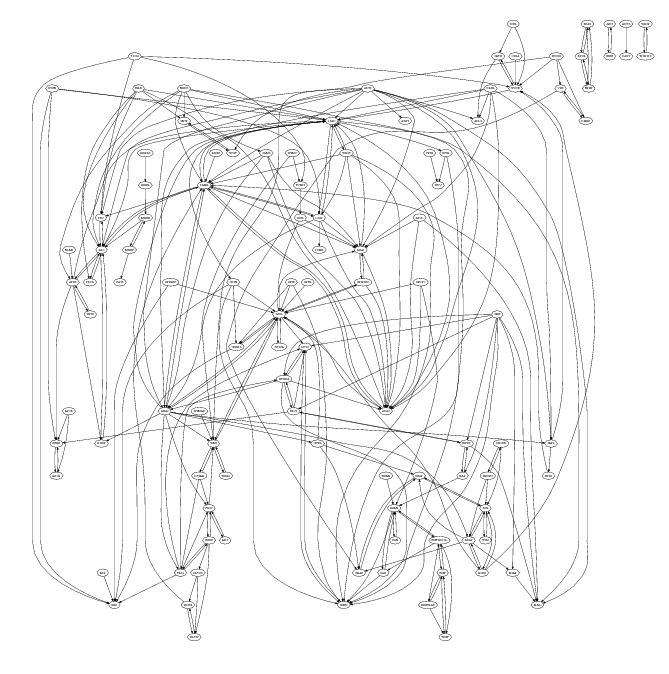
To simplify the diagram references to the ten most referenced protocol documents (i.e., MS-RPCE, MS-ADTS, MS-SMB, MS-KILE, MS-NLMP, MS-SPNG, MS-NRPC, MS-DRSR, MS-DCOM and MS-ADSC) have been excluded. The fact that these protocols are so pervasive is a good indicator of their core importance.
I was not surprised when I saw this graph. When new protocols were added to WSPP it would make sense for developers to make use of functionality provided by existing protocols, creating a dependency.
This extent of the dependencies between these protocol creates advantages and disadvantages for Microsoft. One advantage is that a potential competitor has to make a huge investment in implementing everything (so huge I don’t expect anybody will do it; Samba are nibbling away on a tiny corner); it does not look like its possible to focus on just the most profitable ones. One disadvantage is that these dependencies will make it very difficult for Microsoft to make substantive changes to their protocols.
Do other collections of networking protocols have similar amounts of dependencies between protocols? I don’t know of any analysis that attempts to answer this question. One problem with analyzing the so called ‘open’ protocols like the RFCs is that the quality of the documentation is not that good, with developers often relying on the source code of existing implementations to fill in any missing details.
Any technical benefits to C++ in a C project?
If you are running a large project written in C and it is decided that in future developers will be allowed to use C++, are there any C++ constructs whose use should be recommended against?
The short answer is that use of any C++ construct in existing C code should be recommended against.
The technical advantages of using C++ come about through use of its large scale code organizational features such as namespaces, classes and perhaps templates. Unless an existing C code base is restructured to use these constructs there is no real technical benefit for moving to C++; there may be non-technical reasons for allowing C++, as I wrote about recently.
My experience of projects where developers have been given permission to start using C++ within an existing C code base has not been positive. Adding namespaces/classes is a lot of work and rarely happens until a major rewrite; in the meantime C++ developers use new instead of malloc (which means the code now has to be compiled by a C++ compiler for a purely trivial reason). In days of old // style comments were sometimes touted as a worthwhile benefit of using C++ (I kid you not; now of course supported by most C compilers), as was the use of inline (even though back then few C++ compilers did much actual inlining), and what respectable programmer would use a C printf when C++’s iostreams provided << (oh, if only camera phones had been available back in the day, what a collection of videos of todays experts singing the praises of iostreams I would have ;-)
There are situations where use of C++ in an existing code base makes sense. For example, if the GCC project is offered a new optimization phase written in C++, then the code will presumably have been structured to make use of the high level C++ code structuring features. There is no reason to turn this code down or request that it be rewritten just because it happens to be in C++.
GCC moves to attract more developers
The GCC steering committee have just approved the use of C++ in GCC (I assume they are using GCC here to refer to gcc, not the Gnu Compiler Collection). On purely technical grounds it does not make much sense to allow developers to start adding C++ constructs to a large, established C code base, in fact I can think of some good reasons why this is a poor decision technically, but I don’t think this decision was based on technical issues.
Software is written by developers and developers have opinions (sometimes very strong ones) about which languages they are willing to use. Any project that relies on unpaid contributions (GCC does have a core of paid developers working on it) has to take developer language opinions into account. In fact even projects staffed purely by paid employees have to take language opinions into account; I was once heavily involved in the Pascal community and employers would tell me they had difficulty attracting staff because being seen as a Pascal developer would limit their future career prospects.
Over the years GCC has had a huge amount of input from various people’s PhD work. I suspect that today’s PhD graduate is much more likely to write in C++ than C and have little interest in a rewrite in C just to have it accepted into the gcc source tree.
What of up and coming developers interested in getting involved in a compiler project, are they willing to work in C? If they want to use C++ rather than C, then until Sunday the compiler project of choice for them would be LLVM.
The GCC steering committee have finally acknowledged that they need to allow the use of C++ in gcc if they are to attract a sufficient number of developers to work on it.
Frequency of floating literals in a given range
Last month I talked about one idea for estimating the ‘interestingness’ of a floating-point literal, counting the number of digits it contains. Another idea is to use the magnitude of the literal’s value; many values seem to cluster in the range -1 to +3 and perhaps a match against a value in this range ought to be filtered in some way.
Assume the two values 1.2 and 1200.0 are in the interesting number database. Both contain the same number of non-zero digits. More matches are likely to occur against the value 1.2, but this does not mean its false positive rate is higher compared to the value 1200 (that information can only come from knowledge of the application domain of the files whose contents are being matched).
Filtering based on the magnitude of a value might be used to reduce the total number of matches reported, e.g., only report the first match of a literal having a value within a certain range.
How often do floating-point literal values occur in source code? The following is based on 4.47 million non-zero floating-point literals (i.e., any literal having value 0.0 was not counted) in a wide variety of numeric source code:
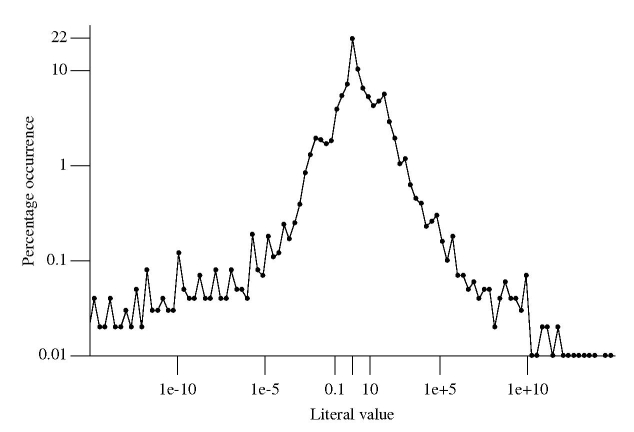
The literal values were put into bins whose width were based on powers of 2. For instance, values between 0.25 and 0.5 went into bin -1, between 0.5 and 0 into bin 0, between 0 and 1 when into bin 1 and so on for smaller and larger numbers.
At 21.6% literals between 0.5 and 0.0 were the most common range, followed at 10.4% for literals between 0.0 and 1.0. The plot is slightly skewed towards having more values greater than 1.
Two discontinuities occur in the value frequencies between 0.001-0.02 and 16-64 (with the smaller values occupying a slightly larger range). This unexpected behavior has been added to my list of things to investigate at some point.
Building directly from a .tgz file
Working on lots of different code bases means I am forever having to extract the contents of tar/zip files before compiling/analysing the files in the extracted directory tree, then deleting the directory tree when I am done. It is about time development tools such as make and compilers had the ability to build directly from an archive.
Vi (well actually Vim and other editors) supports the editing of files contained within an archive and thanks to libarchive the latest version of Numbers also has this functionality.
This is not about saving disc space, it is a way of working that creates a barrier between files created elsewhere and files created by me; it would make it harder for me to accidentally leave my work files in the directory I happened to be sitting, in the directory tree, when working on the source.
There are some design issues that need to be sorted out if build configuration via .configure files is to work correctly. I leave these design issues to the people who know about configuration management.
We will need to extend the existing directory-path/file syntax to support the specification of a file contained within an archive. How about using ::tgz:: as a file prefix to indicate that the subsequent directory/file specification is to be interpreted as referring to the contents of an archive file, e.g.,
cc /home/stuff/::tgz::app.tgz/src/foo/bar.c
I don’t think a separate prefix is needed for each kind of archive, any character sequence that is sufficiently unused at the moment will do.
Go readers, spread the word!
SEC wants prospectus source code to be published
The US Securities and Exchange Commission are proposing new rules involving the prospectuses for public offerings of asset-backed securities including publishing the source code used to calculate the contractual cash flow provisions.
Requiring that the source code used to perform the financial modeling for a prospectus be made available is an excellent idea. A prospectus document contains a huge number of technical details and more importantly for anybody trying to understand the thinking behind it, a lots of assumption. Writing a program requires that all necessary details be enumerated and appropriately connected together and more importantly creating code that can be meaningfully executed usually means making explicit any assumptions that were previously implicit.
There are parallels here with having access to the source code and data used to make climate predictions.
The authors of the proposals are naive to think that simply requiring source to be written in a language for which there is an open source implementation (i.e., Python) is all they need to specify for others to duplicate the program output generated by the proposer (I have submitted some suggestions to the SEC about the issues that need to be addressed). The suggestions that a formally defined language be used is equally naive.
The availability of this source code opens up some interesting commercial prospects. No, not selling analysis tools to financial institutions but selling them program fault information, e.g., under circumstance X the program incorrectly predicts A will happen when in fact B will actually happen. Of course companies know this will happen and will put a lot more effort into ensuring that their models/code is correct.
Will these disclosure rules change the characteristics of financial software? One characteristic that I’m sure will change is the percentage of swear words in the comments and identifiers.
Recent Comments